The Plural of One
In a village outside Foligno, chef Giulio Gigli has brought international technique home to a sixteenth-century mill, creating a restaurant shaped by water, preservation and the people around it.
Words and photograph by JJ Wong
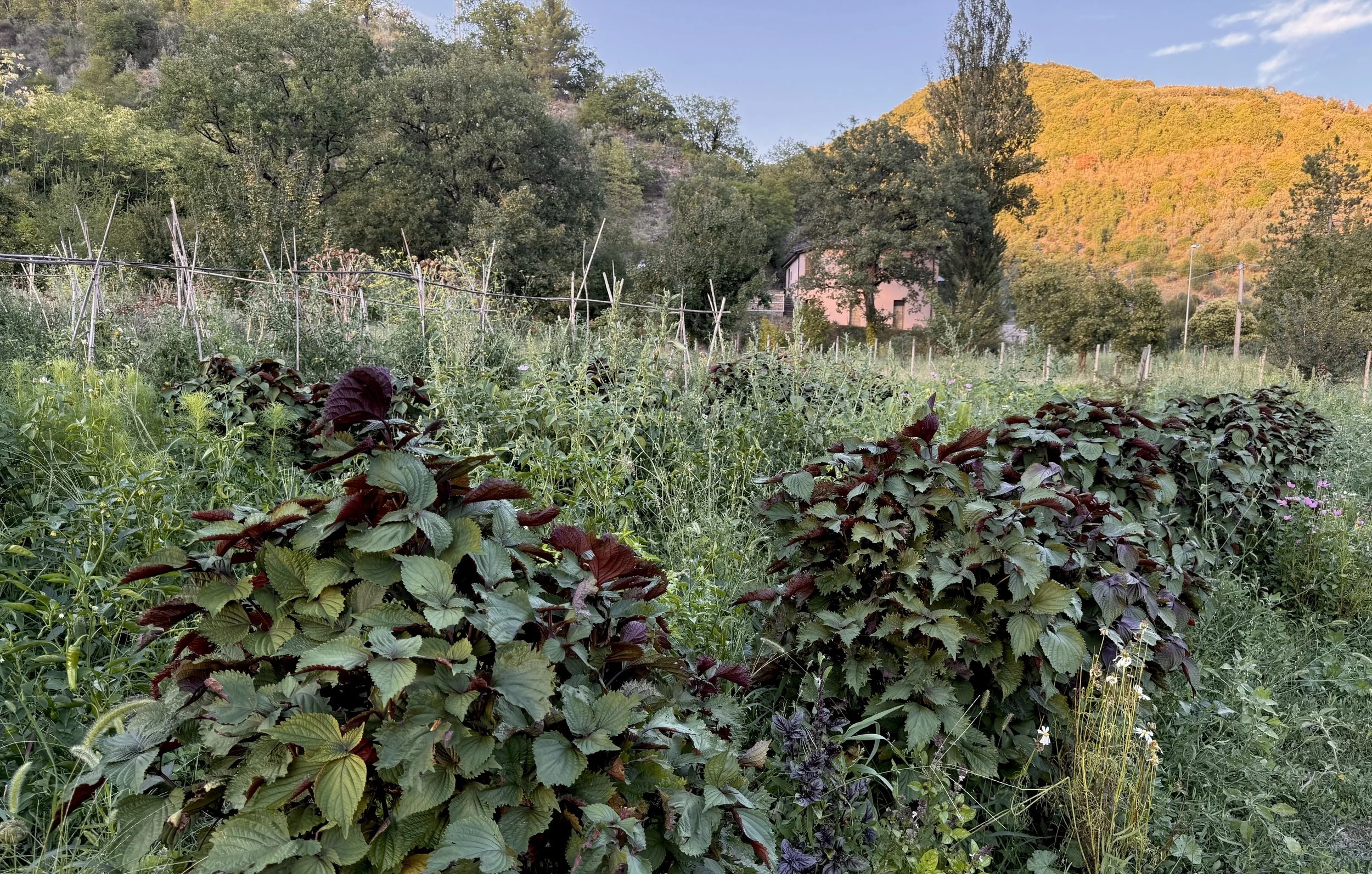
UNE began before dinner.
The road into Capodacqua passed through the Umbrian countryside before narrowing into a village where residents had gathered for an evening aperitivo. People stood outside talking, the scene belonging entirely to the rhythm of local life. Nothing announced that, a few steps away, one of Umbria’s four Michelin-starred restaurants was preparing to open.
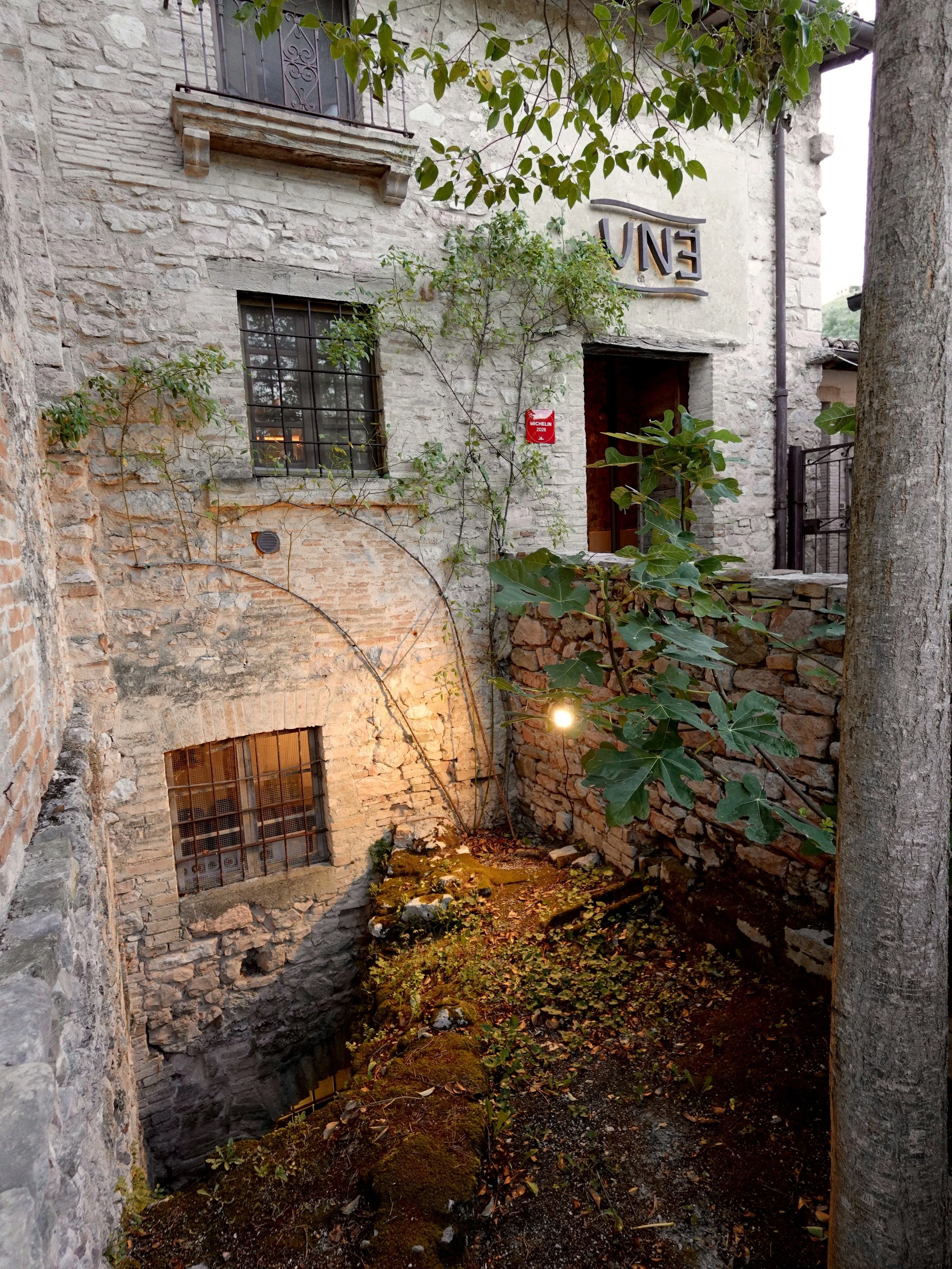
UNE occupies a restored sixteenth-century mill in Capodacqua, outside Foligno.
We arrived shortly before dinner service. Just inside the entrance was the Diario di Campo, a wall-sized illustrated record of what grows around the restaurant. Created by visual artist Giulia Filippi with Alice Mazzarella of Viaindustriae, it is not a finished artwork but an evolving one. Several times a year, new plantings and seasonal changes are added to the wall using pigments derived from materials also found in the kitchen: dandelion pollen, mallow leaves, paprika, grapes and pomegranate.
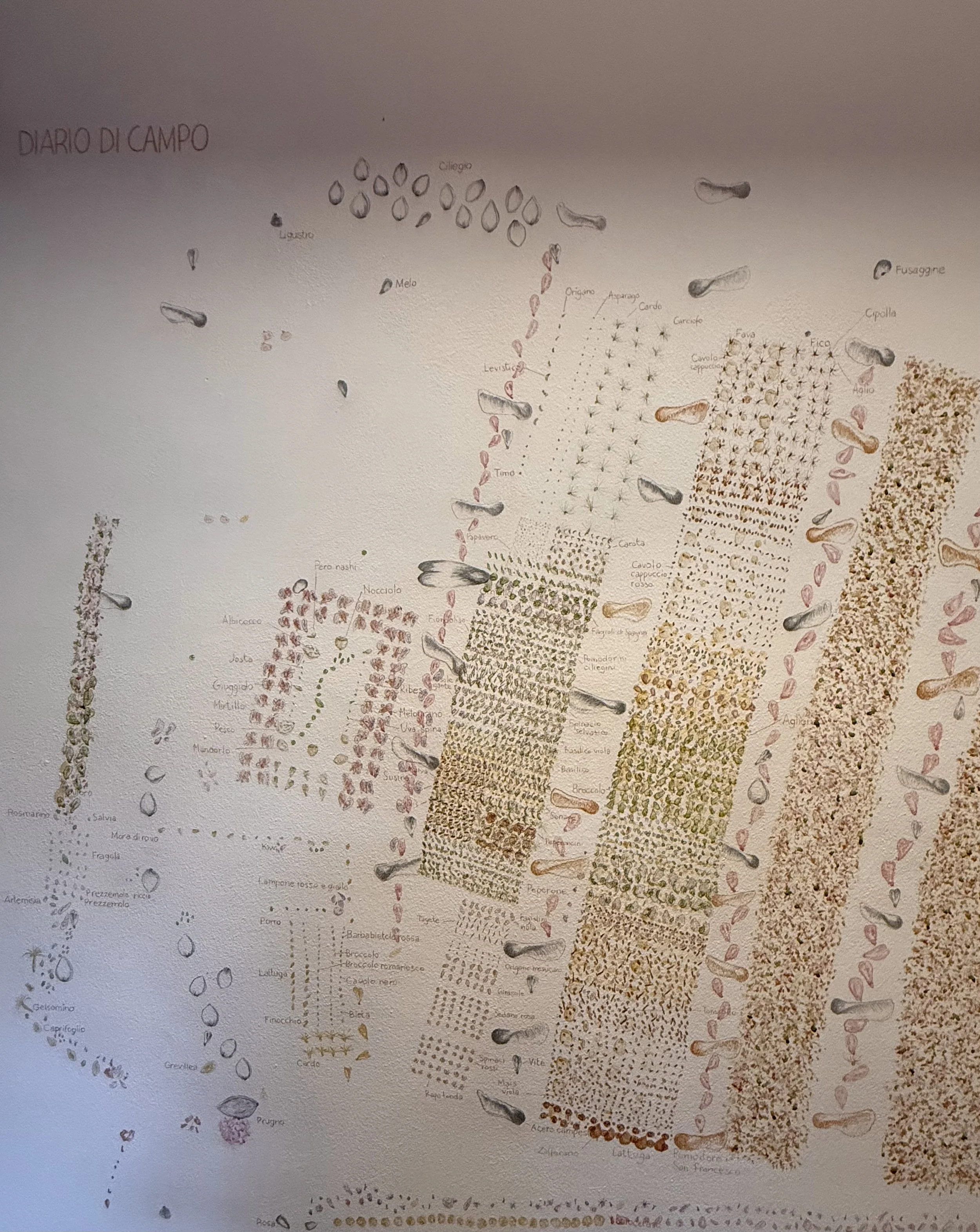
The Diario di Campo is an evolving record of the plants, fruit trees and pathways around UNE.
Before I had fully taken it in, chef Giulio Gigli appeared at the reception to welcome us. There was no formal preamble. He led us outside and into the garden.
It was the first indication that the order of the evening mattered. At UNE, the philosophy is not explained only through a menu placed on the table. It is encountered first as a landscape, then as produce, then as a room full of preserved seasons, and only afterwards as food.
Before the first course
UNE’s grounds extend across some 6,000 square metres. They include seasonal vegetables, perennial crops, older local varieties, fruit trees, herbs, wheat and vines trained using the traditional vite maritata system, in which vines grow with the support of maple trees. The wheat supplies flour for the restaurant’s bread. The garden provides partial self-sufficiency, a distinction worth making in a hospitality world often too eager to turn a kitchen garden into a totalising claim.
Giulio moved through it with the enthusiasm of someone showing us an active experiment rather than a polished attraction. He stopped to explain what was growing and invited us to taste as we walked.
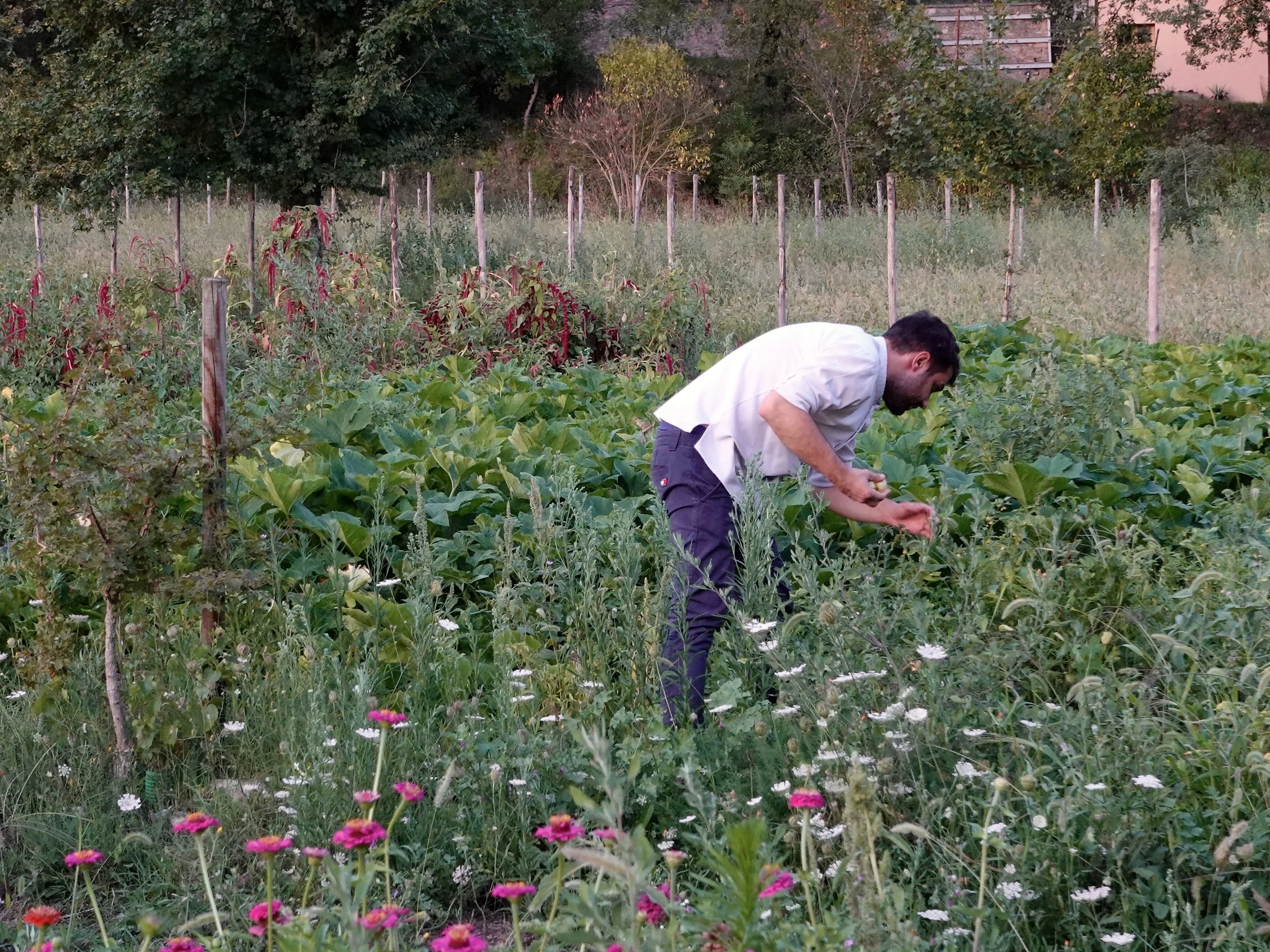
Giulio Gigli in UNE’s allotment, where familiar Umbrian crops grow alongside plants gathered from a wider culinary vocabulary.
Among the plants was Japanese shiso. I tasted a leaf and its familiar fragrance took me at once to a meal in Taipei, where a chef had wrapped sweet sashimi prawns in shiso leaves. The memory arrived before I had time to search for it. Here, the same plant was growing against an Umbrian hillside.
The moment captured something essential about Giulio’s cooking. International influence at UNE does not arrive as a collection of borrowed gestures. It appears through the instincts of a chef who has lived and cooked elsewhere, yet is now working within the possibilities of one particular landscape.
He next handed me a purple tomatillo, still partly enclosed by its papery husk. Its skin moved between green and violet; the flesh was juicy, gently acidic and not especially sweet. It was an ingredient I had never tasted in that form. The exchange was small and informal, but it made the garden tour feel personal. I was not being shown a concept. I was being asked to taste it.
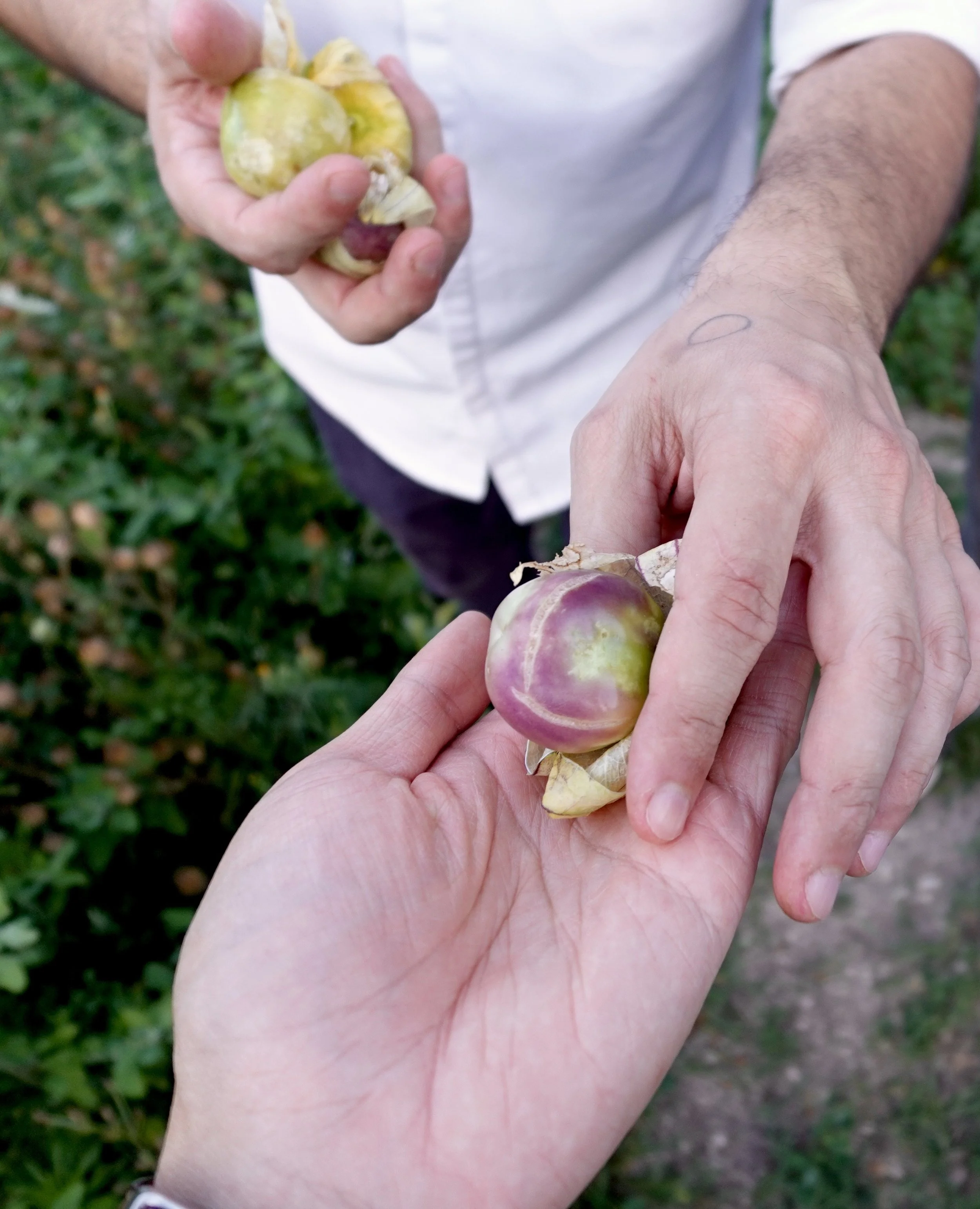
A purple tomatillo, passed directly from the allotment.
The garden also makes clear that UNE’s idea of Umbrian cooking is not one of preservation through stasis. Native plants and old agricultural methods coexist with unfamiliar species. Tradition is treated as a living resource: something that can absorb new knowledge without losing its identity.
The pantry below
From the garden, we moved beneath the dining room into the former olive mill. The old machinery remains: presses, stone, vessels and the evidence of a building once organised around the transformation and storage of agricultural produce.
It is now UNE’s pantry.
Hundreds of jars filled the shelves—vegetables in oil, pickles, ferments and fruits preserved in alcohol. UNE produces approximately 1,500 to 2,000 of them each year, using ingredients drawn largely from its own land and the surrounding woods.
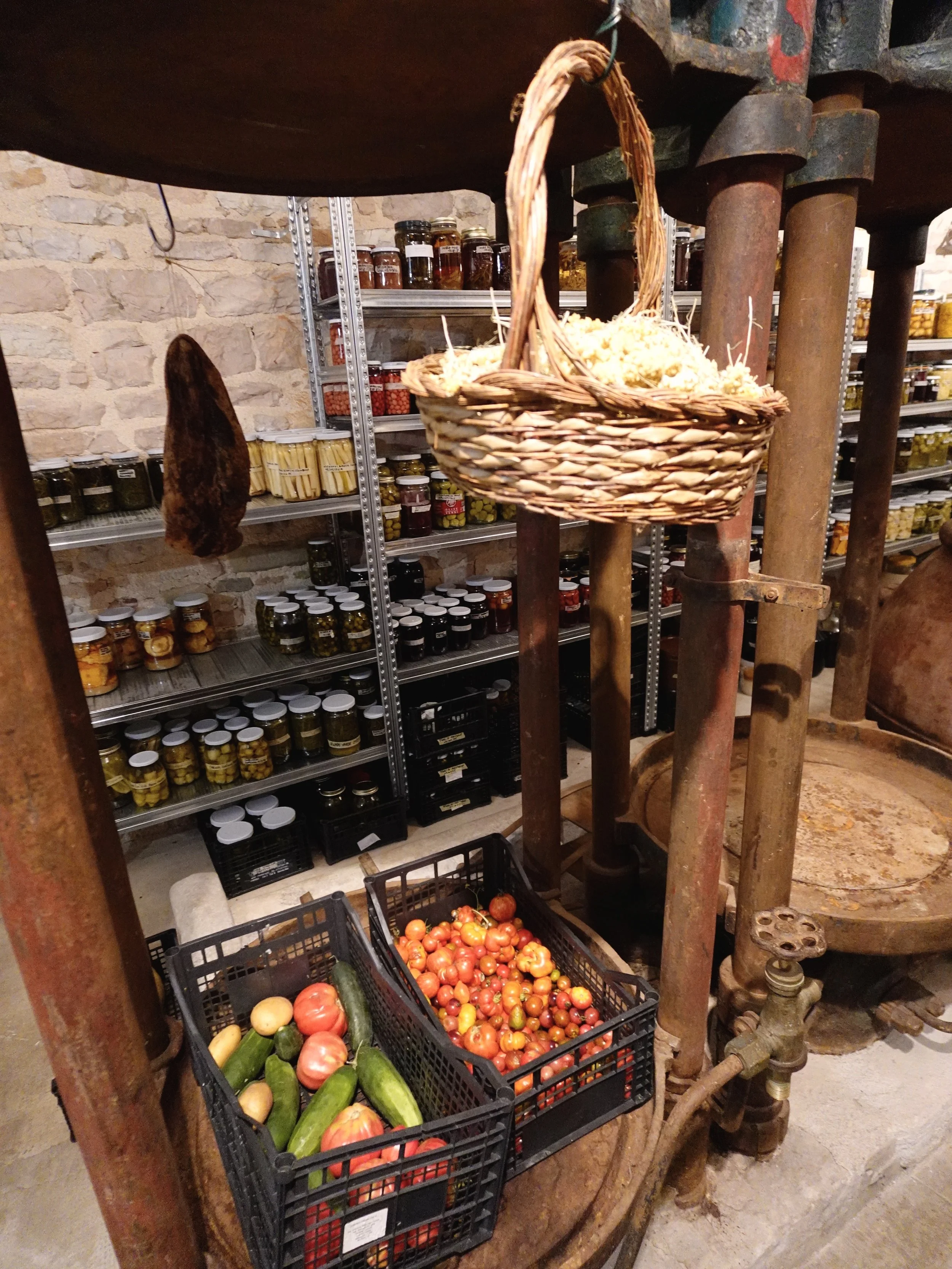
In the former olive mill, newly gathered produce sits beside jars holding earlier harvests.
What struck me was how unstaged the room felt. Plastic crates sat beside old equipment. Fresh tomatoes and courgettes waited near shelves holding earlier harvests. Labels were handwritten; jars differed in size and colour. Nothing had been arranged to simulate rustic abundance for a photograph. It was a working pantry, and its beauty came from use.
For me, seeing ingredients before they are cooked changes the way I understand a meal. In the garden, I had seen what was growing now. In the pantry, I could see what had grown before. Preservation allowed those two moments to coexist.
This is where UNE’s environmental language becomes tangible. Preserving a harvest is a way of reducing waste, but for Giulio it is also a creative instrument. It captures an ingredient when it is at its best, introduces acidity and fermentation, responds to uncertain weather and allows one season to reappear inside another. A preserved vegetable served in August may carry the conditions of spring; fruit in alcohol may wait for a menu that does not yet exist.
The practice also connects his international career with knowledge inherited at home. As a child, Giulio learnt from his maternal grandfather how to preserve vegetables in oil and vinegar and how to make jams. Techniques encountered in other kitchens later expanded that vocabulary. The pantry is where domestic memory and professional research meet.
A mill shaped by water
UNE occupies a restored sixteenth-century mill in a village whose name, Capodacqua, announces its relationship with water. The Roveggiano stream once supported the mills, olive presses and other water-dependent activities around which the village developed. Above it stand the Rocca dei Trinci and a medieval aqueduct that still carries water towards Foligno.
The restaurant’s name reaches further back. The menu traces une—the ancient Umbrian word for water—to the language preserved on the Iguvine Tablets found in Gubbio. On the Relazioni menu, the word acquires another meaning: unire, to unite.
The building holds both ideas. Water explains the place; relationships explain the restaurant.
Upstairs, the dining room felt warm and grounded. Timber beams, terracotta, brick and old stone were allowed to remain themselves. A date marked on a roof tile offered one of those details that reveals the building’s age only to someone who happens to look up. Botanical illustrations appeared lightly across the walls, echoing the plants outside without turning them into a decorative theme.
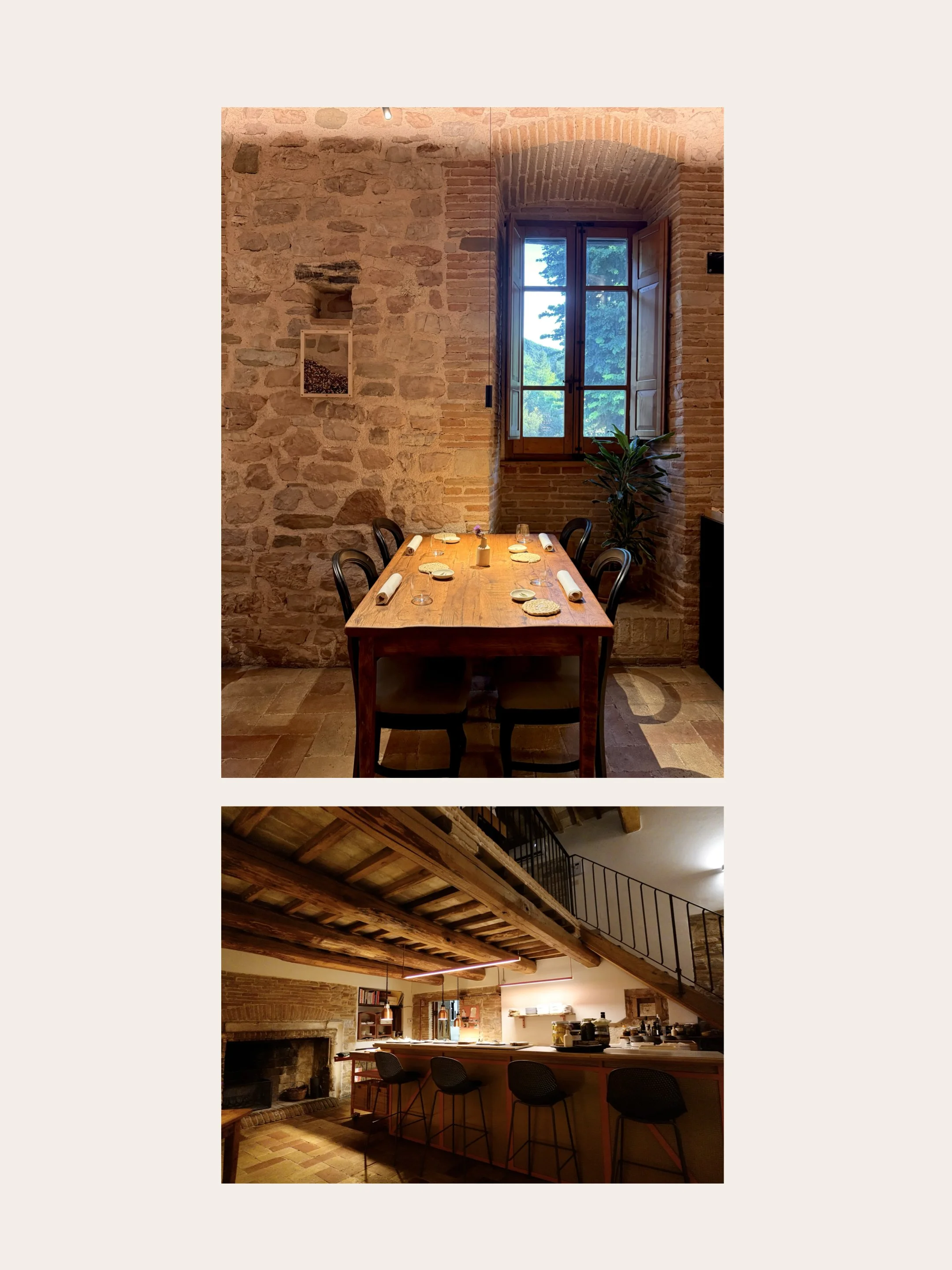
The dining room retains the mill’s timber, terracotta, brick and stone.
Most dishes receive their final touches at the counter before reaching the table.
There were no loud design statements and no attempt to make a rural Umbrian building conform to an international fine-dining aesthetic. Even the menu felt like an extension of the place: muted green, printed on tactile, speckled paper, unfolding into botanical drawings that recalled the Diario di Campo near the entrance.
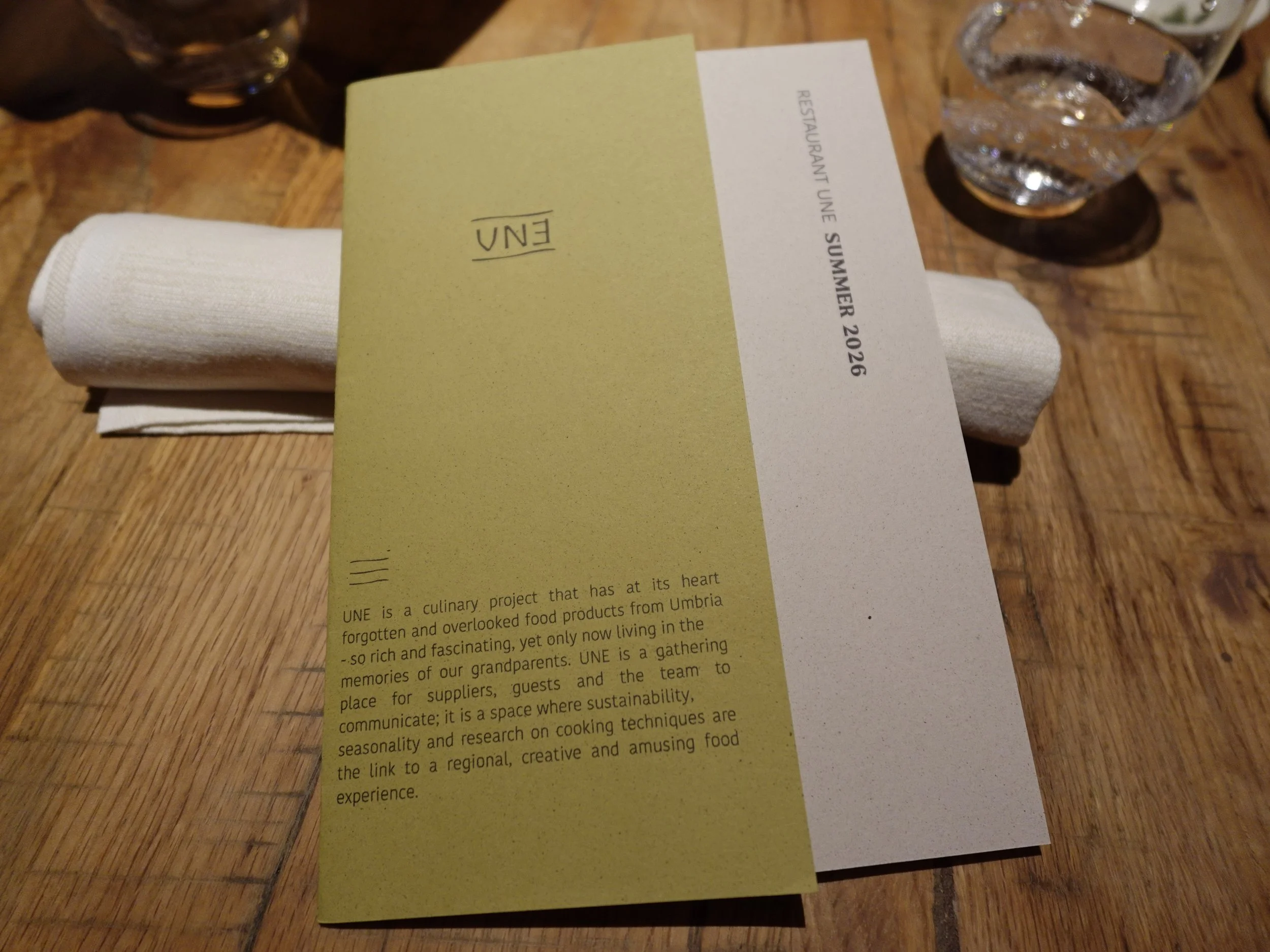
The menu carries the botanical language of the Diario di Campo to the table.
The result was contemporary without being detached from its setting. UNE did not look as though it had been inserted into the mill. It felt as though the mill had continued its former purpose—transforming what the land produces—through a different medium.
Relazioni
UNE offers two tasting menus. We chose Relazioni, an eight-course sequence intended to express the restaurant’s cooking in its broadest form. It moved from opening snacks and an Italian antipasto through ingannapreti with anchovy, cod, aglione and Taggiasca olives; rainbow trout with sour potato, parsley and purslane; pigeon from Capodacqua with brewer’s yeast, popcorn and sweetcorn; then pre-dessert, a Sacher-inspired composition of pumpkin seed, mole Chiboust cream, apricot and pepper, followed by the final sweets.
The menu listed the restaurant’s local suppliers. This was not a page of generic provenance claims but an acknowledgement of individual relationships: the neighbour who raises the pigeons, the person who brings trout from Sellano, the growers, millers, cheesemakers, brewers and craftspeople whose work makes each course possible.
Preserved vegetables from the garden appeared early in the meal. Having seen the jars below us, I no longer experienced them merely as sharp or fermented accents. They were evidence of time passing through the kitchen. The route from garden to pantry to plate was not a slogan; we had just walked it.
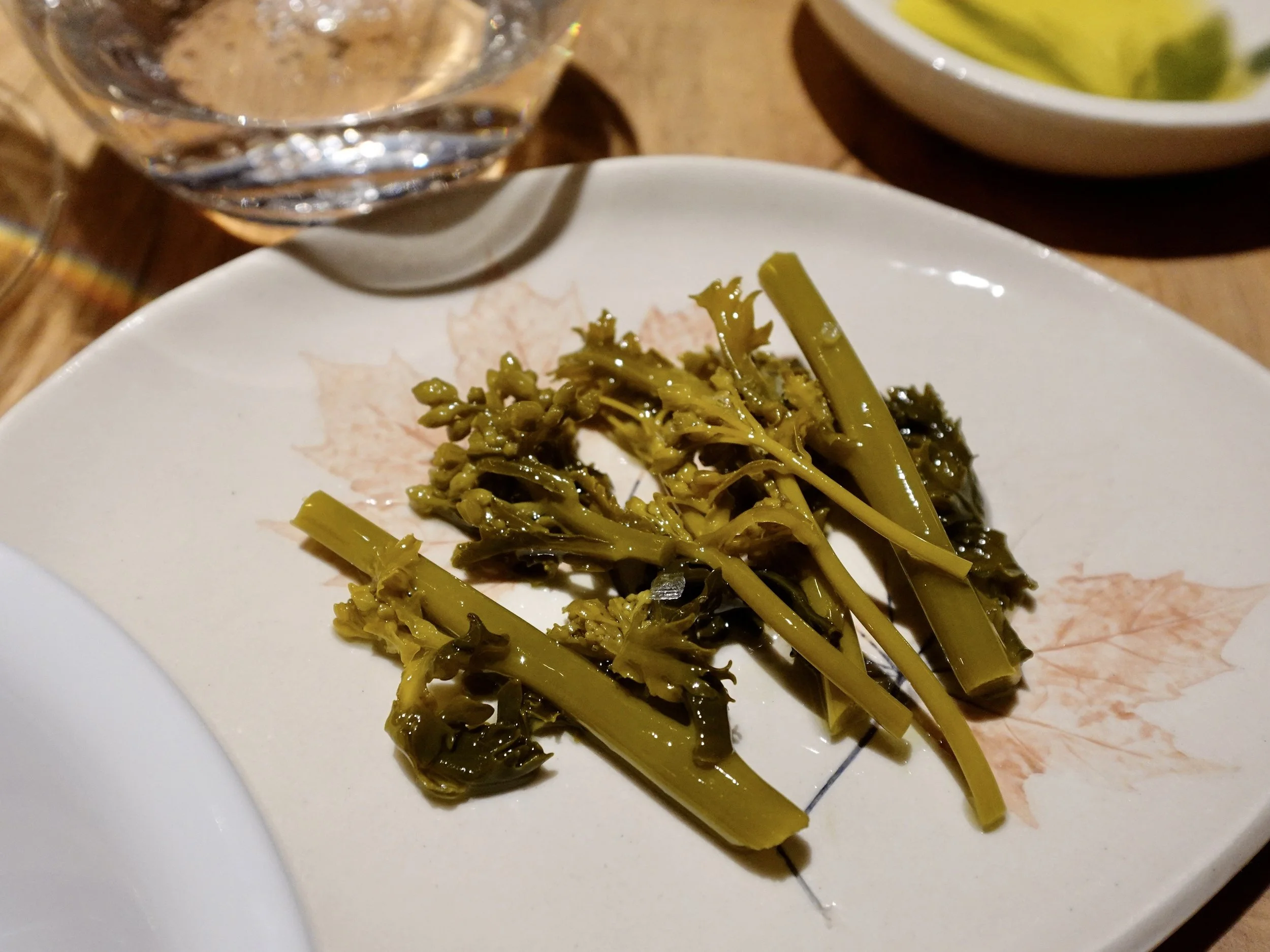
Vegetables from UNE’s allotment, preserved in the pantry and returned to the table.
The ingannapreti was the first dish that stopped me completely. Its name means “deceive the priests”. As the story was told at the table, a priest once demanded payment in filled pasta, and local women slipped in pieces folded without filling to fool him. Food legends rarely submit to one definitive version, but the tale suited a pasta whose appearance contained its own element of surprise.
Each piece opened like a small flower, precise in its geometry but generous rather than severe. The aroma reached me as soon as the bowl arrived. Anchovy, cod, elephant garlic and Taggiasca olives gave the dish depth and salinity, yet the impression was not of competing strong ingredients. It was composed, fragrant and remarkably balanced—an object of visual beauty that justified itself again in flavour.
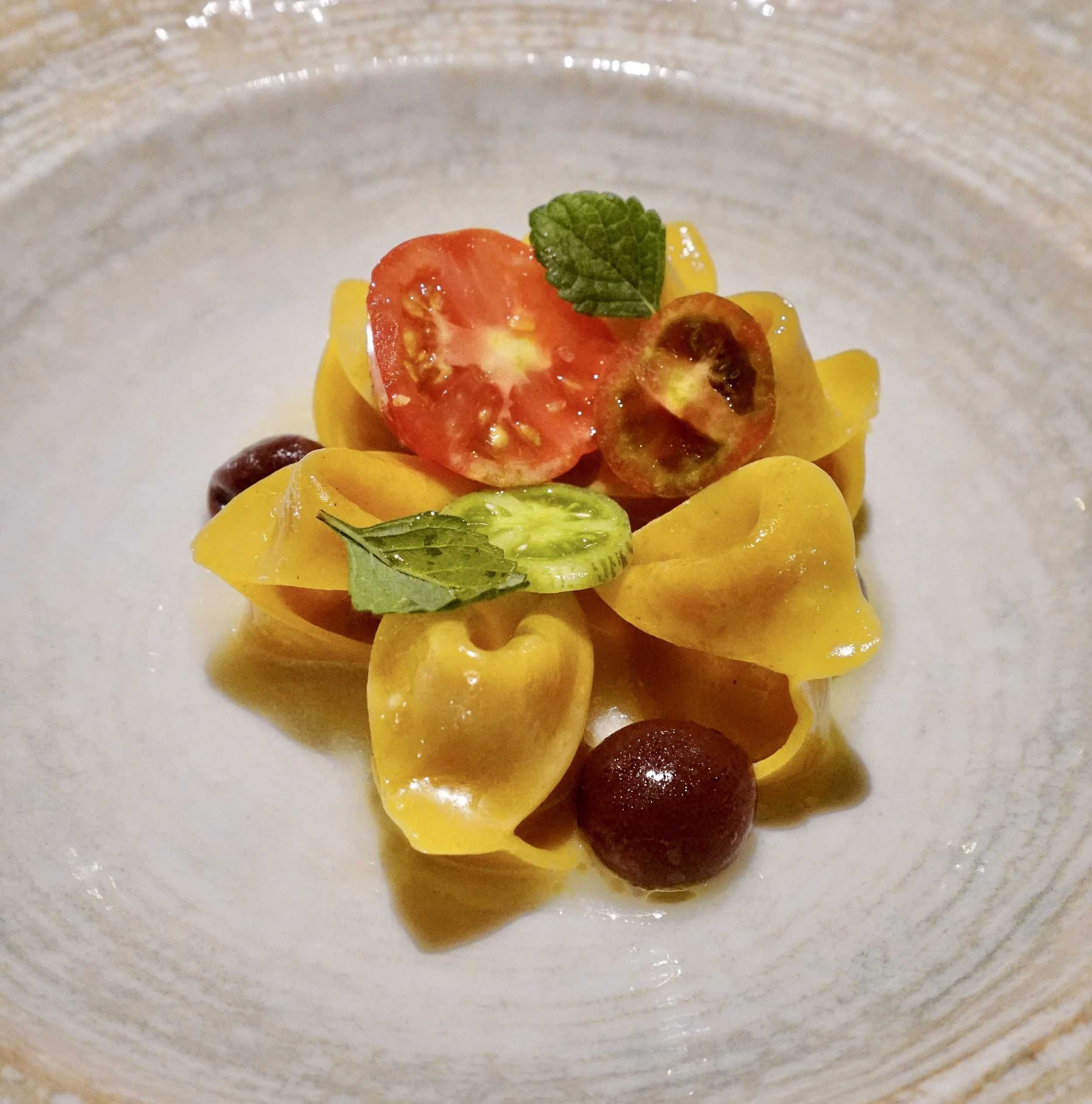
Ingannapreti with anchovy, cod, aglione and Taggiasca olives.
The rainbow trout that followed was drawn from the region rather than the sea, accompanied by sour potato, parsley and purslane. Then came the pigeon from Capodacqua: succulent, deeply flavoured and paired with a reduction of brewer’s yeast, sweetcorn and finely shaved popcorn. The combination could easily have become theatrical. Instead, the yeast brought savoury concentration, the corn sweetness, and the popcorn a familiar aroma in an unfamiliar context.
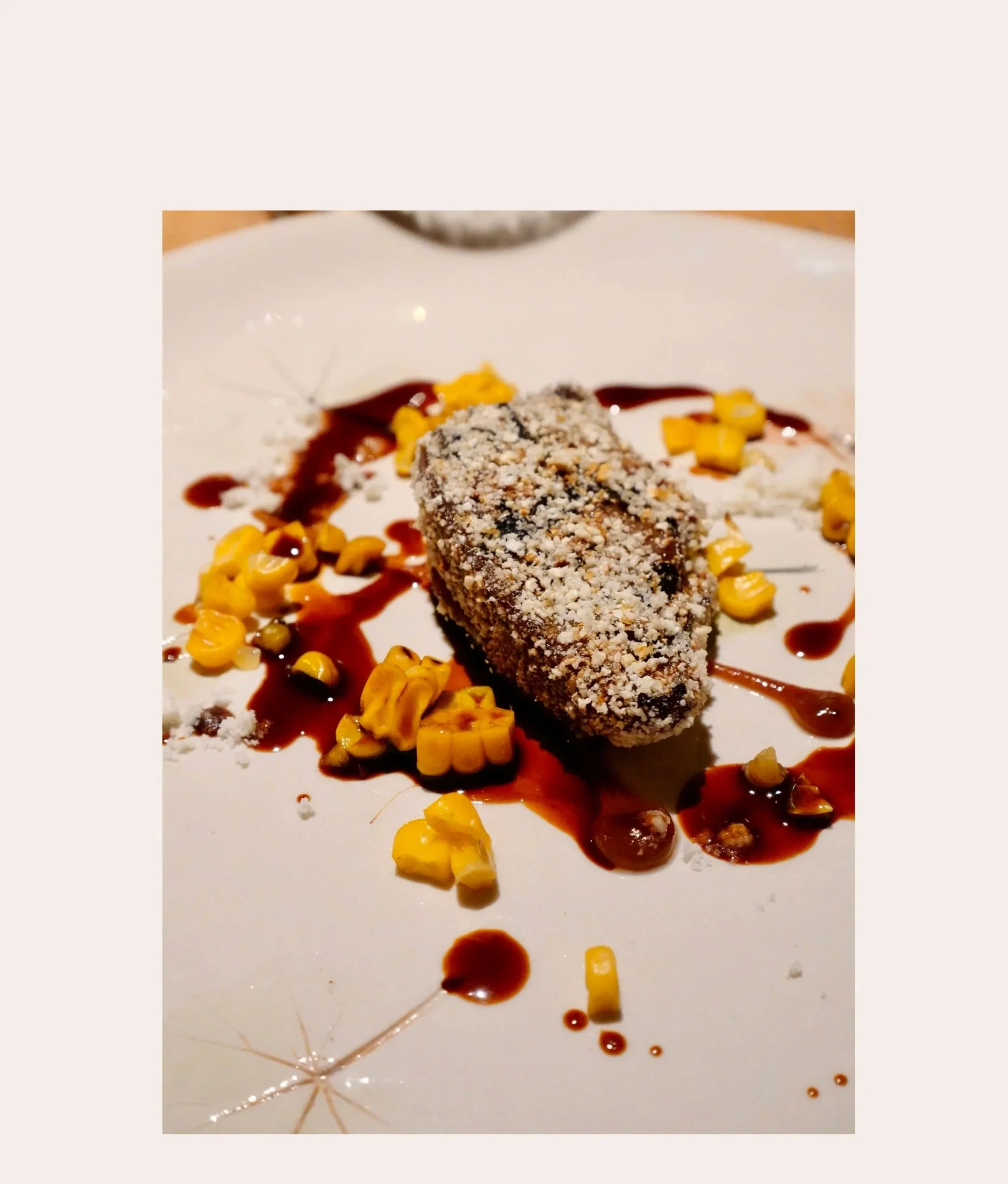
Pigeon from Capodacqua with brewer’s yeast, popcorn and sweetcorn.
Across the menu, Giulio’s contrasts were substantial but controlled. Acidity did not flatten the ingredients; fermentation did not become the subject of every plate. The techniques served structure and memory.
Some of the preserved flavours also felt unexpectedly familiar to me as a Malaysian. The cuisines are unrelated, but the instinct to sharpen, extend or transform an ingredient through pickling crosses cultures. At UNE, those flashes of acidity occasionally brought me closer to home while I was eating food rooted emphatically in Umbria.
Before dessert, we were presented with several varieties of pepper and invited to smell them. Their aromas prepared us for Giulio’s interpretation of a Sacher, built around apricot, pumpkin seed, mole Chiboust cream and a sorbet carrying the fragrance of pepper.
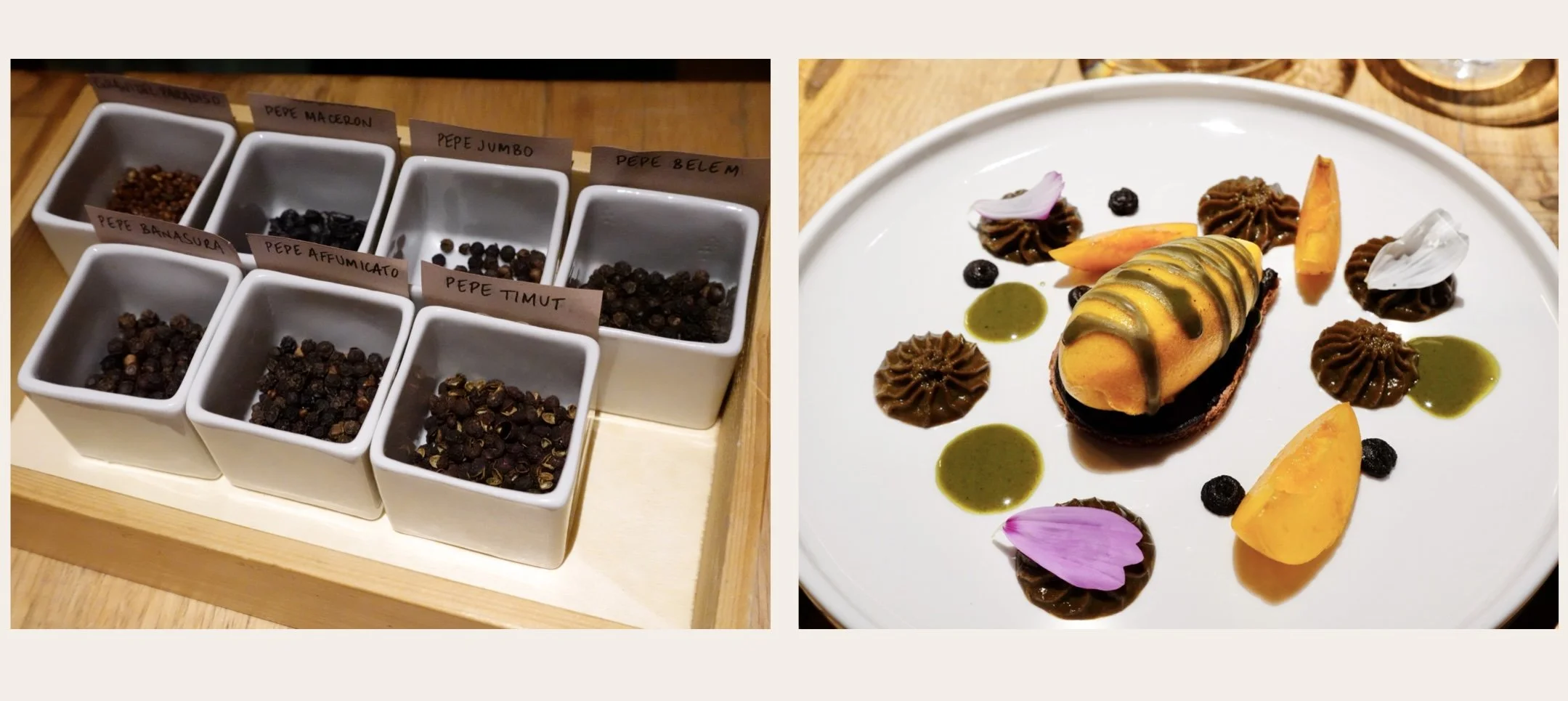
Several varieties of pepper were presented first through aroma.
Giulio’s Sacher-inspired dessert with pumpkin seed, mole Chiboust cream, apricot and pepper sorbet.
The plate looked like a painter’s palette. Apricot orange, deep brown, green, black and lilac sat across the white surface like separate pigments. Yet the pleasure was not merely visual. The nuttiness of the pumpkin seed softened the brightness of the fruit; the cream gave weight; the peppers contributed perfume and depth rather than blunt heat.
The final sweet returned us to the pantry one last time. A small almond-and-cacao-nib croccantino had been immersed in oil scented with Timut pepper—a technique developed at UNE to protect the confection from moisture and preserve its crispness. It tasted of caramel and nuts, rich but not heavy. Even at the final bite, preservation was not a supporting principle. It was part of the pleasure.
The evening was among the most understated and deeply moving dining experiences I have had. It was also one of the best meals I have eaten in Italy—not because every course announced its ambition, but because the entire experience possessed coherence. The drive, the village, the Diario di Campo, the garden, the pantry, the room and the food all belonged to the same thought.
The chef who returned
Giulio began cooking professionally at sixteen and left Italy at eighteen. His career took him through some of Europe’s and America’s most technically accomplished kitchens, including Il Pagliaccio in Rome, Le 1947 à Cheval Blanc in Courchevel and Benu in San Francisco. He then spent four years at Disfrutar in Barcelona, eventually leading its creative work.
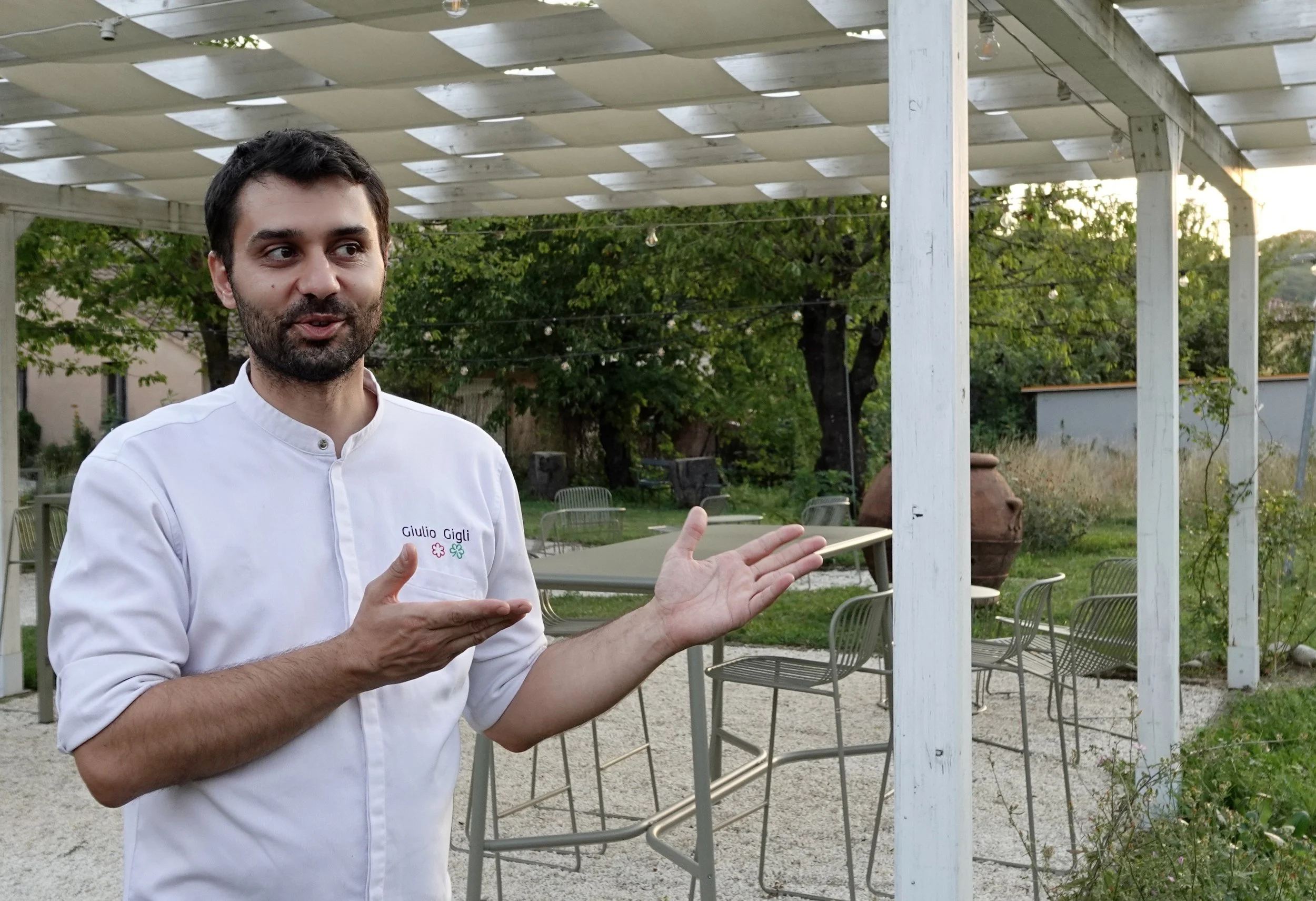
Chef Giulio Gigli returned to his native Foligno after a career in some of Europe and America’s most technically accomplished kitchens.
When I asked which cuisine had influenced him most, he resisted choosing one. His cooking, he said, contained a little of everything he had encountered in the restaurants where he worked.
That answer explains UNE better than a list of countries. The internationalism of the food is methodological rather than decorative. It can be found in how Giulio builds texture, handles acidity, uses fermentation and gives familiar Umbrian ingredients a different architecture. Beneath that technique are roveja, black chickpeas, fagiolina del Trasimeno, aglione, river fish, pigeon and vegetables grown or sourced nearby.
During the pandemic, he returned to Foligno and began thinking about what he could create at home. He found the old mill in Capodacqua and, with the help of family and friends, opened UNE in 2021.
This was not a retreat from international ambition. It was a decision to relocate that ambition—to apply what he had learnt abroad to a region with fewer stages for contemporary cooking, and to build one himself.
That makes the idea of Relazioni more than the name of a tasting menu. UNE describes itself as the sum of everyone who makes it possible: the kitchen and dining-room teams, growers, neighbours, artisans, artists and guests. In Giulio’s formulation, it becomes the plural of one. One person brings another; one skill meets another; individual contributions form a restaurant that no individual could make alone.
Giulio himself was central to the evening, but never performed the part of the distant, untouchable chef. He welcomed us, walked through the garden, placed a tomatillo in my hand, opened jars in the pantry and explained the thinking behind the food. His manner was warm, humble and deeply engaged. The restaurant’s ambition was evident everywhere; ego was not.
What UNE means for Umbria
Umbria’s food culture has never lacked depth, but its international gastronomic profile remains modest beside that of neighbouring regions. Geographically, Umbria is more than one-third the size of Tuscany; in the 2026 Michelin Guide, it has four starred restaurants to Tuscany’s 45.
The comparison is not an argument for Umbria to imitate Tuscany, nor a claim that stars are the only measure of a region’s food. It shows how much room remains for restaurants capable of interpreting Umbrian ingredients with contemporary confidence.
UNE received its first Michelin star in the 2024 Guide. In the 2026 edition, it became one of five new Italian recipients of the Green Star, awarded for environmental practice. In May 2026, Michelin announced that the distinction would be discontinued as it introduced Mindful Voices, a wider editorial platform spanning restaurants, hotels and wine. UNE therefore belongs to the last group of restaurants to receive it.
That timing gives the award a particular finality, but the plaque is less persuasive than the restaurant itself. UNE’s principles were visible before dinner began: in a garden that claims partial rather than complete self-sufficiency, in ancient grains grown for bread, in composting and biodiversity, in shelves of preserved harvests, in a menu restricted to two tasting sequences to reduce waste, and in the names of local suppliers printed on the page.
What stayed with me most was the return of talent to Umbria. The region does not need contemporary restaurants that could exist unchanged in London, Paris, Copenhagen or Bangkok. It needs people who have seen the world and can bring that experience home without using it to overwrite what is already here.
At UNE, shiso can grow against an Umbrian hillside. A technique developed abroad can preserve a local harvest. A centuries-old mill can house a modern kitchen without becoming a stage set. Pickled vegetables can recall Malaysia while remaining unmistakably part of Capodacqua.
By the time we left, the entrance was illuminated and the village had settled into the night. UNE’s name had gathered all its meanings. Water had shaped the building. Relationships had built the restaurant. The meal was the point at which they became one.
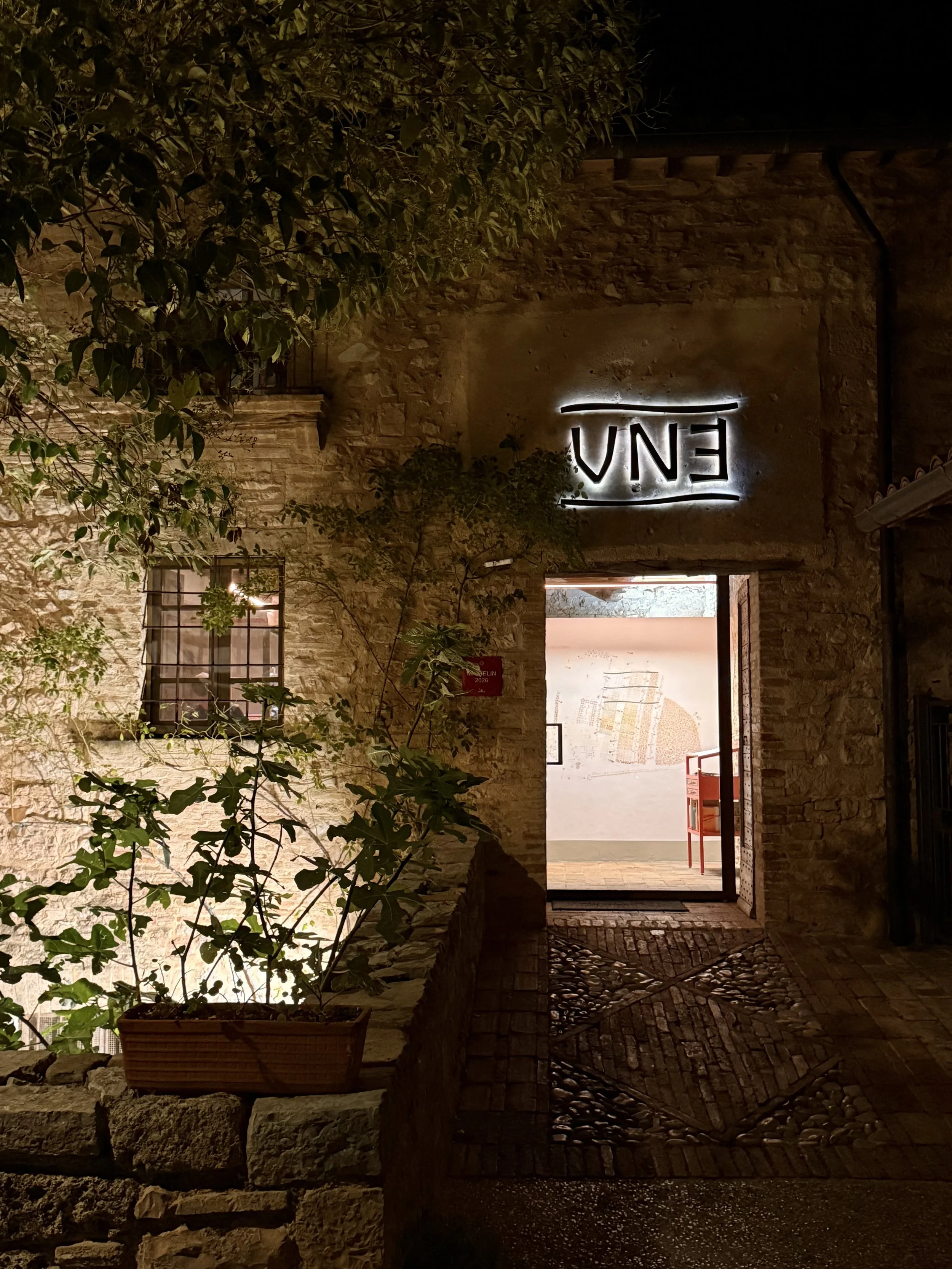
UNE after dinner, as Capodacqua settled into the night.
Before you leave, you are invited to sign The Guestbook.
Further Reading
If this story has deepened your interest in the region, you may also enjoy:
Before Umbria Becomes a Brand - on the new hotels, villas and restaurants shaping Umbria’s next chapter
Understanding Umbria - a companion for understanding the region before planning a first visit
The Craft of Gelato in Spoleto - another story about Umbrian ingredients, technical curiosity and the person behind the craft.
Three Curries with Angkrit - cooking with MasterChef Thailand winner Angkrit in Bangkok, where three Thai curries accompany conversations about food, family and shared Chinese roots.
Unless otherwise credited, all photography and written content are original works by Foodie Goes Travel.
