The Places We Are Taught to Want
Two journeys to Luang Prabang before the railway— and what they now make me ask about Umbria
Words and photograph by JJ Wong
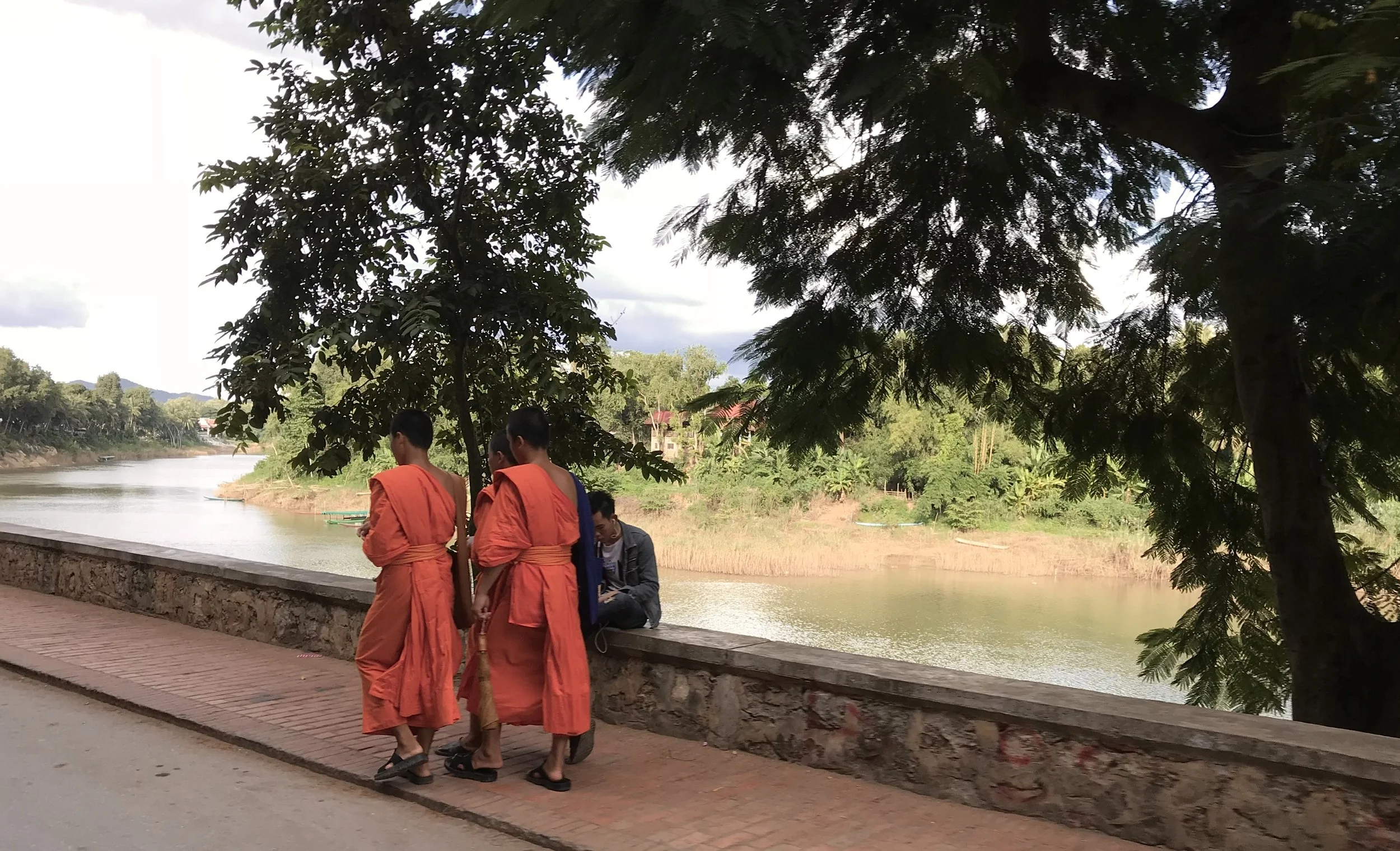
Luang Prabang, late September 2017.
In late May 2019, the detail that made me worry about Luang Prabang was not a crowded street, a tour bus or a large new hotel. It was an advertisement for paintball.
My reaction was immediate and slightly disproportionate: Oh dear. Mass tourism is coming.
One advertisement could hardly explain what was happening to an entire town. Luang Prabang did not feel overwhelmed. I saw more visitors than I remembered from my first journey two years earlier, particularly Western travellers on the streets and around the night market, but I could still walk or cycle without much purpose, stop at a café, visit a temple, go to the spa or spend part of the afternoon reading.
The advertisement bothered me for another reason. Paintball seemed to have no relationship with the place around it. It was an activity that could be inserted into almost any destination once someone decided that visitors needed more things to do.
That small sign made me wonder whether Luang Prabang might one day become less a town with its own daily life and more a setting into which an expanding catalogue of tourist experiences could be placed.
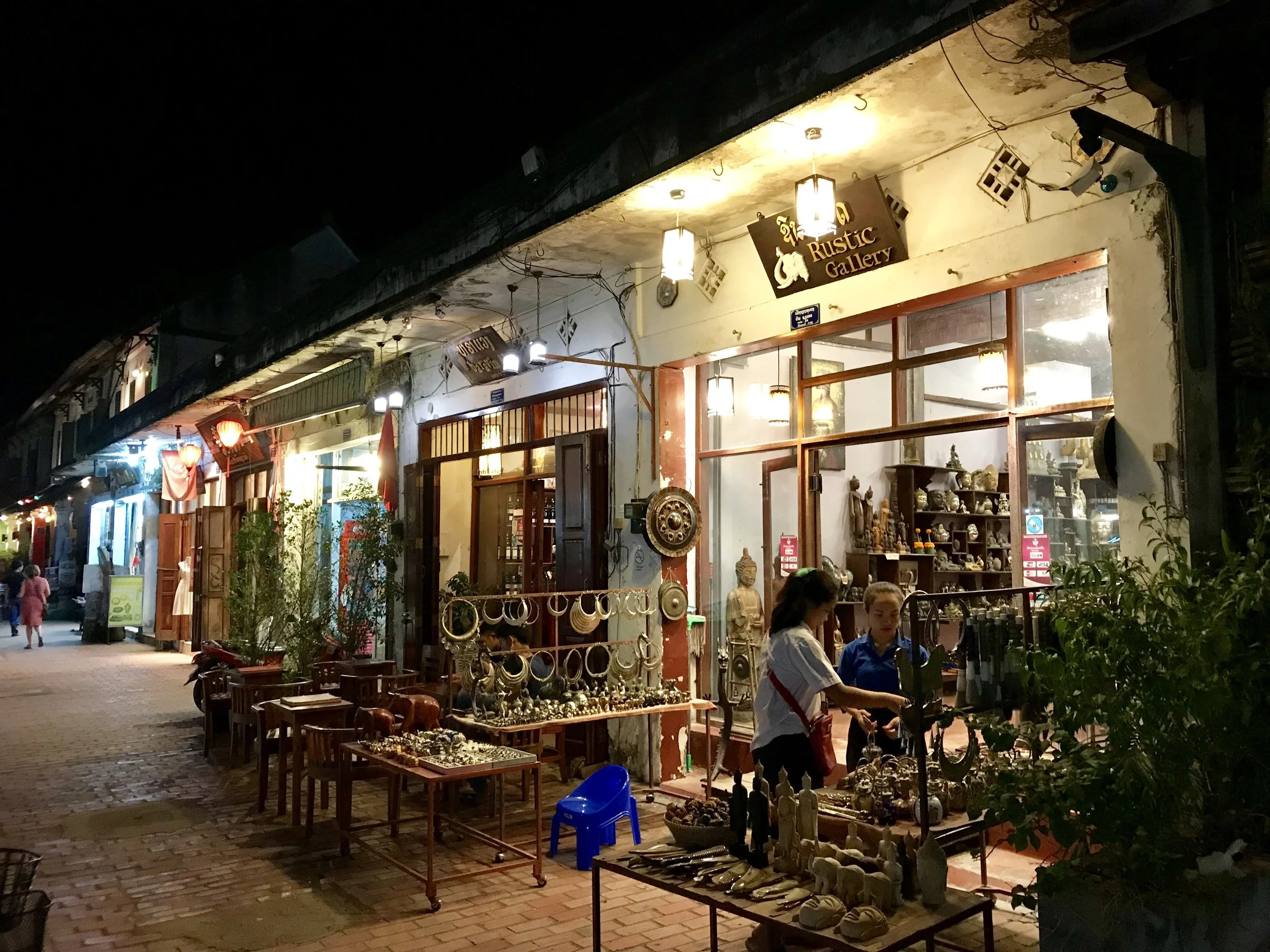
Luang Prabang after dark. Tourism was visible, but the streets never felt overwhelmed.
A warning from somewhere else
The thought did not come from Luang Prabang alone. It came partly from Bali.
Across six visits to Ubud between 2015 and 2024, I generally chose hotels away from the busiest streets. Yet the centre was difficult to avoid. Restaurants, spas and shops repeatedly drew me back into it. I would squeeze past groups of visitors, find myself seated beside loud tables, wait to enter a warung operating from someone’s courtyard, or sit in traffic while trying to reach somewhere beyond town.
What troubled me was not simply that Ubud had become popular. I was a visitor too, contributing to the same pressure. It was the sense that moving through the town increasingly required negotiating an industry built around people like me.
By 2019, Bali had made me alert to a particular threshold. A place can receive many visitors and continue to function principally as itself. Then, at some less visible point, its shops, roads, restaurants and daily rhythms begin to reorganise around what outsiders expect from it.
Luang Prabang had not crossed that threshold when I first arrived in late September 2017.
I was living in Hong Kong and travelling regularly within the region. I had started searching online for a non-city destination that was less established on the mainstream tourist circuit but still reasonably accessible. After some research, Luang Prabang seemed to offer that possibility. I could reach it from Hong Kong with a connection in Bangkok.
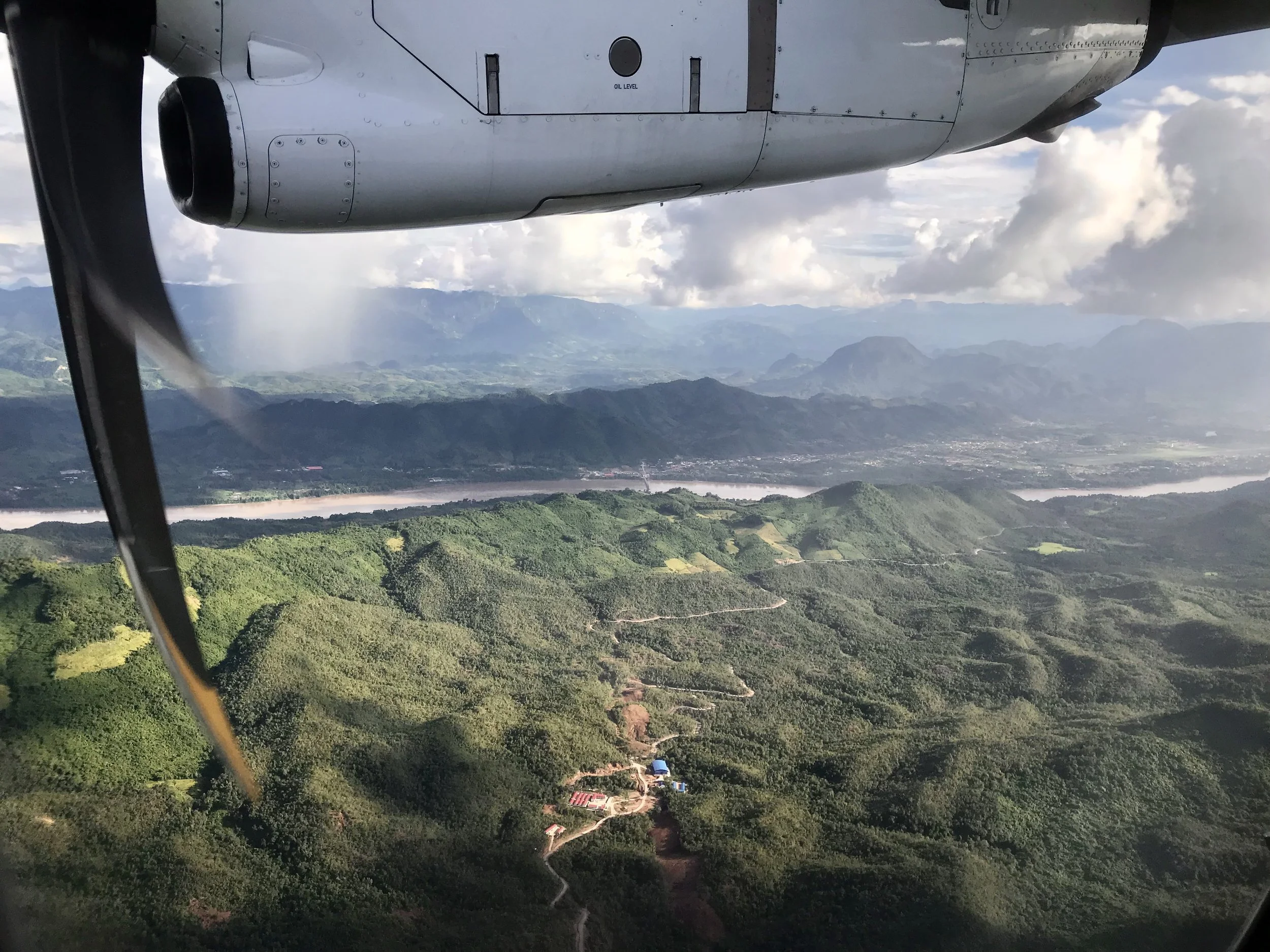
Arriving in Luang Prabang by air in 2017. Reaching the town still required a separate flight through a regional gateway.
I did not discover an unknown place. Luang Prabang had been a UNESCO World Heritage site since 1995, and its temples, waterfalls, French-Lao architecture and riverside landscape were already well established in travel imagery. International hotels had arrived long before I did. Even my search for somewhere “less touristy” depended on articles, photographs and booking platforms that had made the town visible to me.
I was already inside the system I would later begin to question.
The space between
I stayed at The Belle Rive Boutique Hotel on the Mekong. Its façade was white with blue shutters, and my room was on an upper floor. One of my clearest memories is unexpectedly small: a ceramic basin painted with a peacock and flowers. I thought it was exquisite.
Across the road, the hotel’s terrace sat beside the river. Breakfast there became one of the experiences I remembered most vividly—not because anything spectacular happened, but because the Mekong altered the feeling of the morning. The water was not an attraction reached during an excursion. It remained present while I ate, walked and watched the day begin.
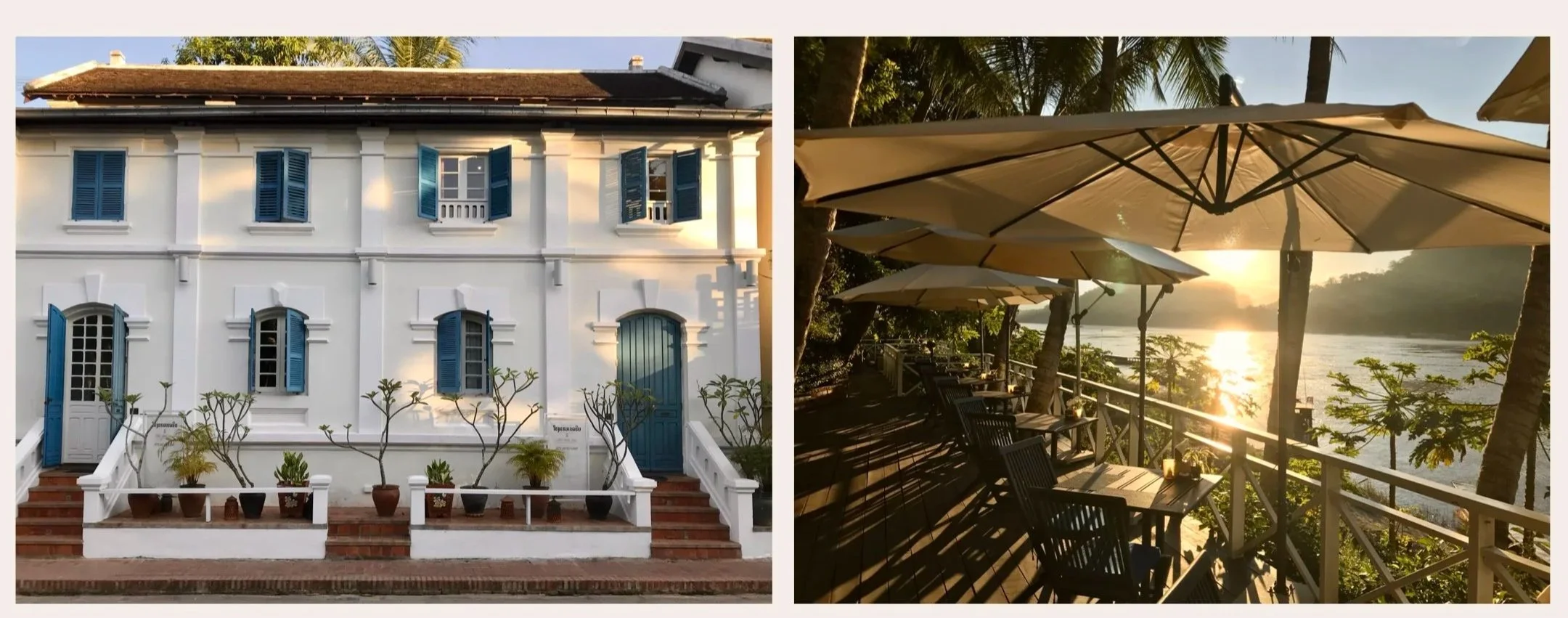
The Belle Rive and its riverside terrace, late September 2017. The hotel did not separate the stay from the Mekong; it made the river part of the day.
I cycled around town, visited temples, sat in cafés and read without arranging very much in advance. There was a sunset cruise with champagne, the river and surrounding mountains becoming more dramatic as the light changed. I saw the places for which Luang Prabang was already known, including Kuang Si Falls, but what stayed with me was the amount of space between them.
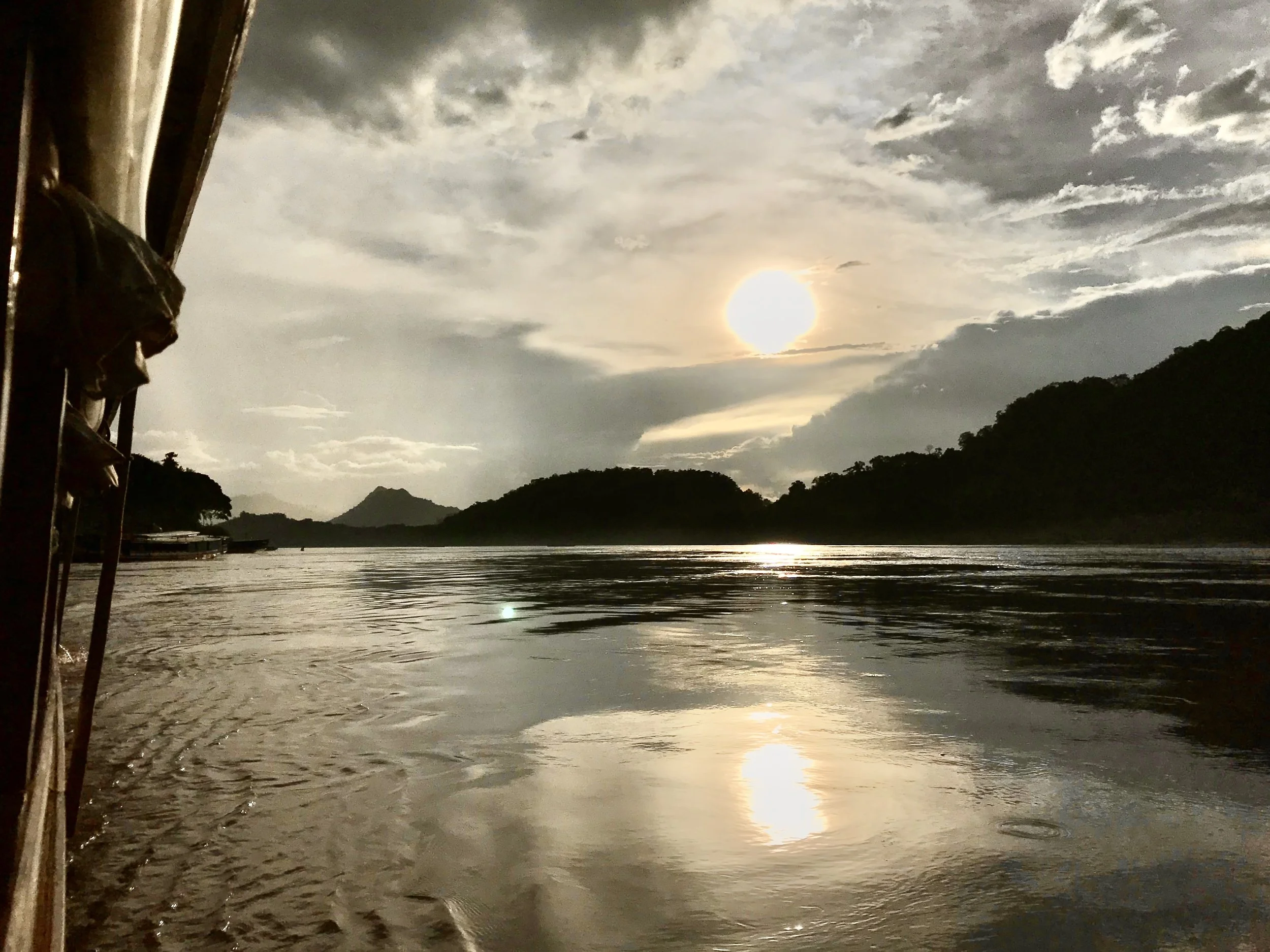
Sunset on the Mekong, 2017.
That was why I returned in 2019. I was not going back to complete an itinerary. I wanted to recover the feeling of having very little need for one.
This time I travelled from Singapore, again through Bangkok, and stayed at the Mekong Riverview Hotel, only a few doors from The Belle Rive. I deliberately chose the same part of town. I wanted to remain close to the water.
The hotel stood near the point where the Mekong and Nam Khan meet. To reach its spa, I crossed the Nam Khan on a seasonal bamboo footbridge, then continued on the opposite bank. By conventional hotel standards, this was less convenient than taking a lift to a treatment room. It was also far more memorable.
The journey to the spa could not be separated from the spa itself. The bridge moved slightly underfoot; the river, vegetation and opposite bank became part of the experience. It was hospitality whose meaning came from its setting.
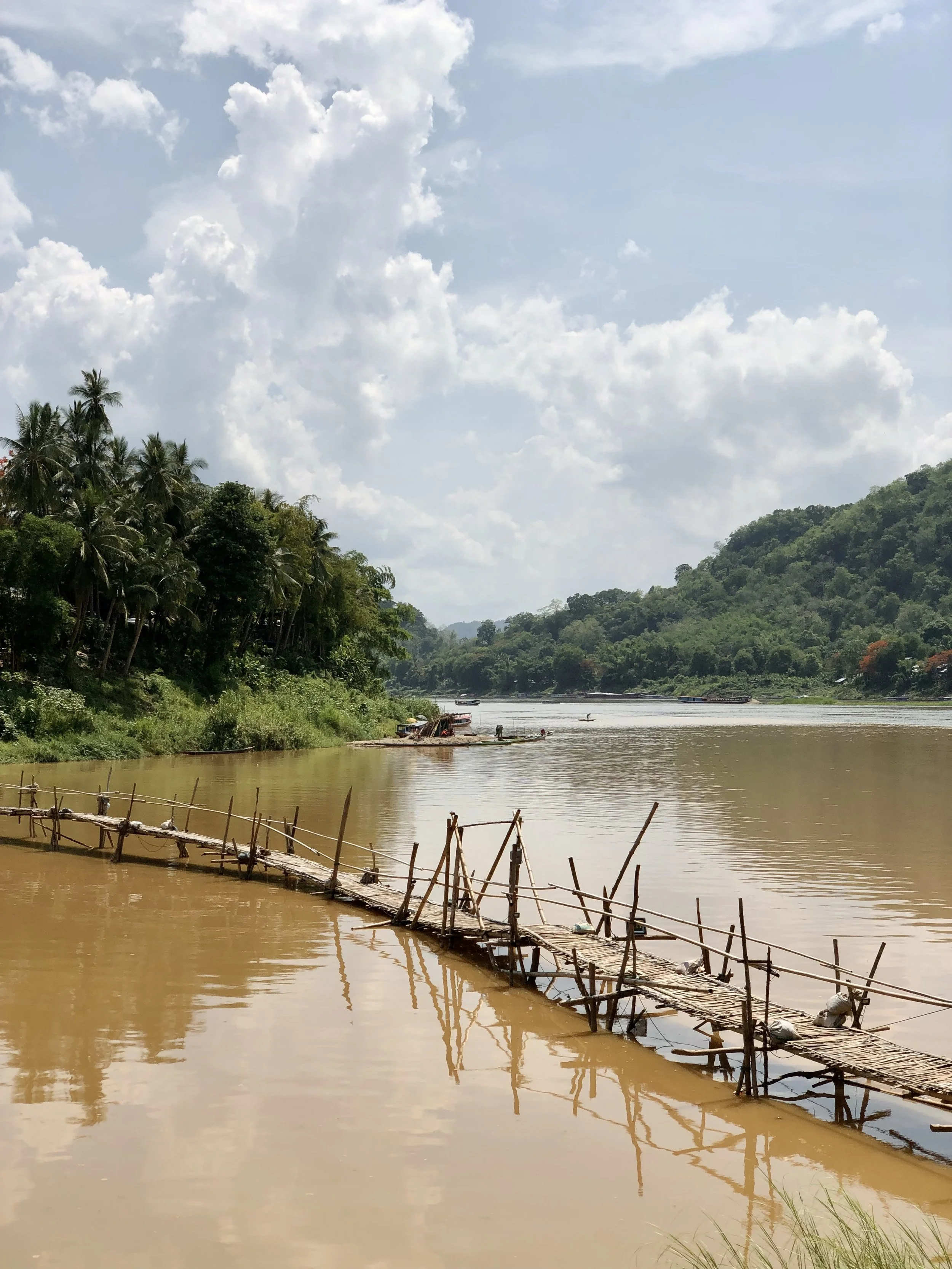
The seasonal bamboo bridge across the Nam Khan, late May 2019.
Looking back, the paintball advertisement and the bamboo bridge express two very different ways of offering an experience. One could be placed almost anywhere. The other made sense only there.
This does not mean every hotel or activity must be traditional, nor that a place should remain frozen for the benefit of travellers who preferred it on an earlier visit. It asks a more useful question: does hospitality help us enter into a relationship with a place, or does it give us a substitute for one?
What the numbers can—and cannot— tell us
My memory of Luang Prabang is shaped by timing. Both journeys took place during the wetter part of the year: the first towards the end of the monsoon in late September 2017, the second near its beginning in late May 2019. I did not experience the main visitor season. The green landscape, full rivers and uncrowded streets in my photographs are real, but they are not a complete picture of the town across the year.
The figures also correct the softness of memory. Luang Prabang province recorded 655,412 visitor arrivals in 2017 and 880,035 in 2019, an increase of about 34 per cent. What felt to me like a marginal rise in tourism was part of a substantial upward movement.
Then came a much greater change.
The Laos–China railway opened in December 2021. It reduced the journey between Vientiane and Luang Prabang, previously a long trip by road, to about two and a half hours by train. Luang Prabang did not need to become a global aviation hub. It became easier to add to a journey through Laos or from southern China.
That distinction matters. A destination boom does not always begin with dozens of new international flights. Sometimes one piece of infrastructure removes enough difficulty to change the scale of who can arrive, how often and as part of what itinerary.
By 2024, Luang Prabang province reported more than 2.3 million visitors, including over 1.55 million foreign visitors. The provincial total is not a count of people walking through the protected historic centre, and it should not be used as one. Still, it was more than two and a half times the total recorded in 2019.
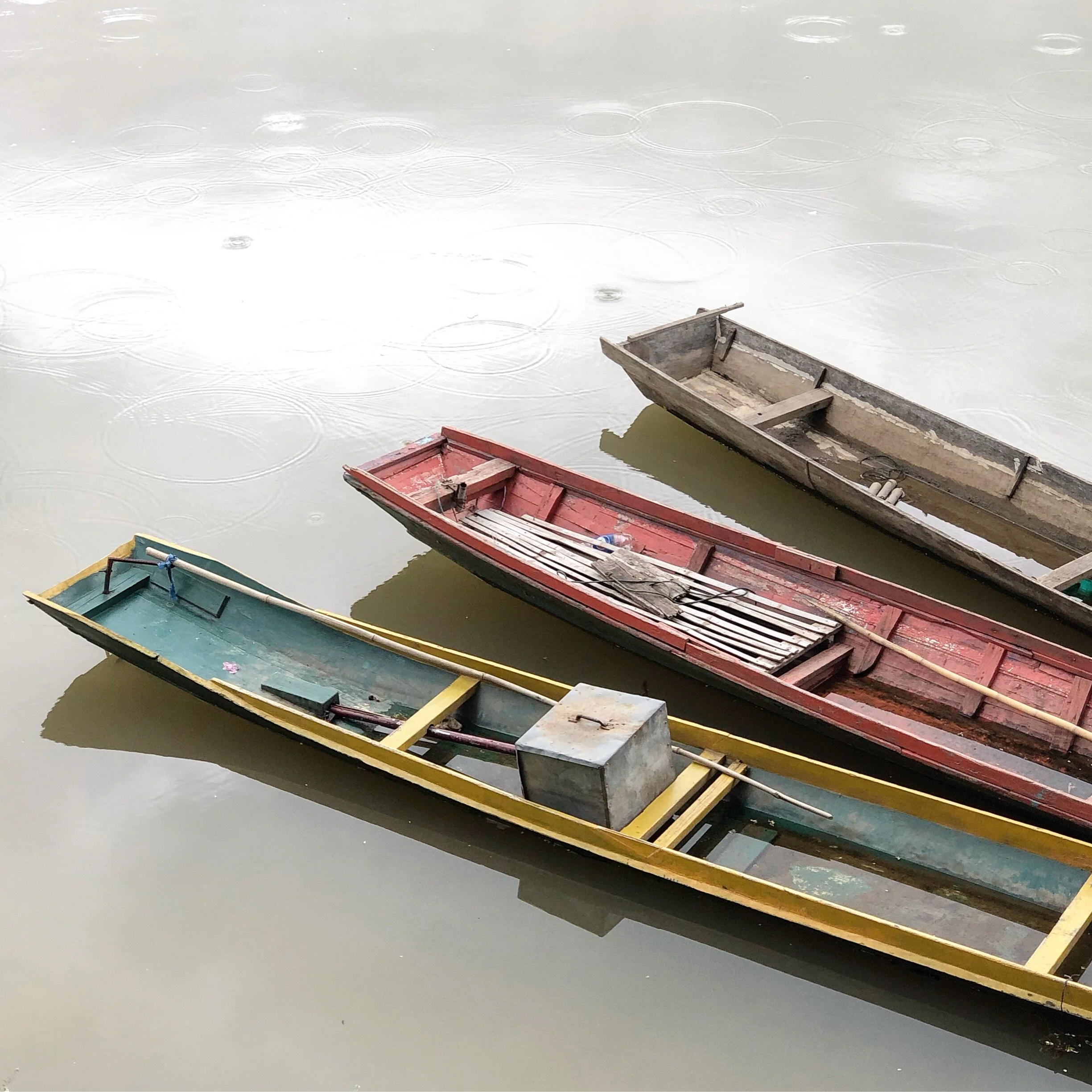
Boats on the river in late May 2019. The photographs preserve a moment; they cannot tell us what the town feels like now.
I have not returned since 2019. I cannot claim, from statistics or other people’s reports, to know the atmosphere of its streets today. A town can absorb a surprising number of visitors without feeling permanently congested; it can also be changed by tourism before crowding becomes the most obvious symptom.
Numbers tell us that access and volume changed. They do not tell us whether a resident still shops in the same market, whether a family can afford to remain in the historic centre, or whether a visitor encounters ordinary life rather than a performance of it.
Those are harder things to measure, and more important ones to ask.
How hospitality teaches us to see
By my second visit, Luang Prabang was already being interpreted for international travellers by operators including Aman, Accor, Avani and Rosewood, often through properties small in scale and attentive to architecture, landscape and the town’s heritage. Alongside them were hotels such as The Belle Rive and Mekong Riverview, as well as cafés, craft shops and guesthouses that made the town comfortable and understandable to outsiders.
This is one of hospitality’s most powerful and least discussed roles. A hotel does more than provide a bed. Through its photographs, design, food, suggested activities and language, it explains a destination before the guest arrives. Its distribution network makes the place searchable and bookable. Its interpretation tells the traveller what should be noticed—and, by omission, what need not be.
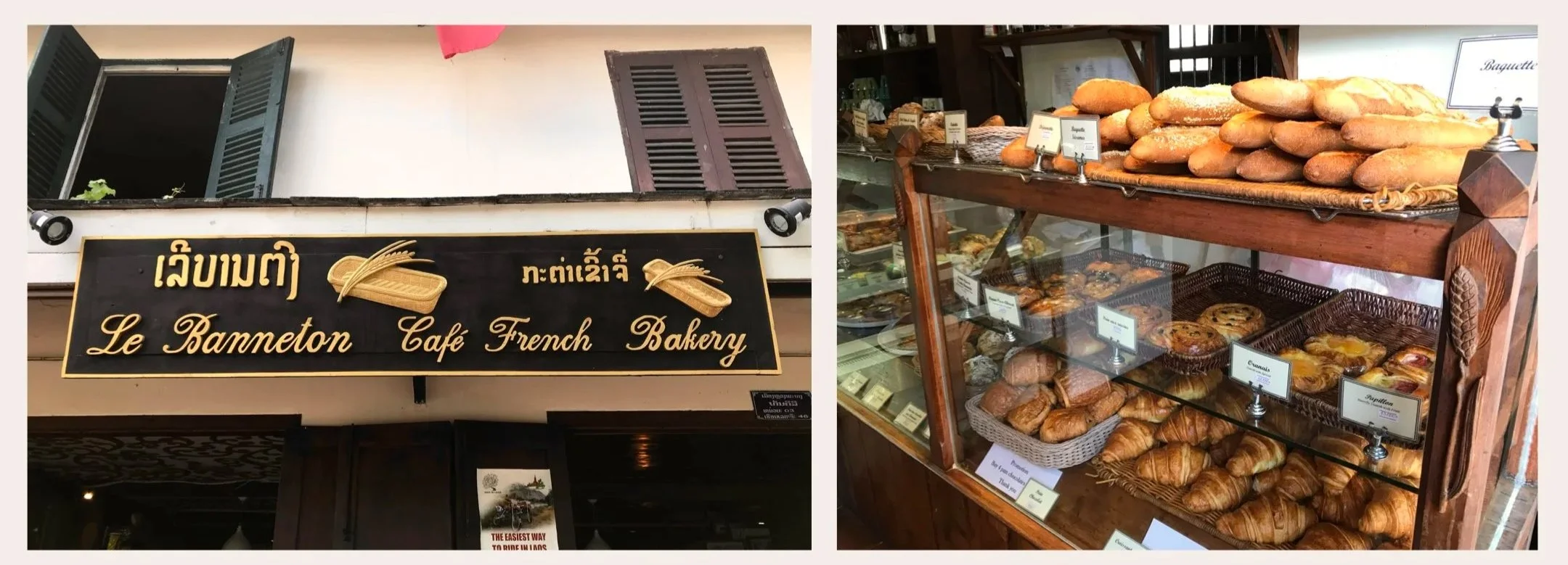
A French bakery in Luang Prabang, 2017. The town’s appeal was already expressed through a language of heritage, food and international hospitality.
That translation can be intelligent. It can direct attention towards local craft, food, history and ecology. It can restore an old building, employ people with deep knowledge of the place and give visitors enough confidence to look beyond the familiar sights.
It can also compress a living culture into a limited set of recognisable signals: a material, a motif, a ritual, a view. Once those signals circulate widely enough, visitors begin arriving with a ready-made idea of what the destination should provide. Businesses respond. Eventually, the image does not simply represent the place; it starts to instruct it.
The dividing line is not between international brands and independent hotels, or between luxury and simplicity. A global operator can approach a place with seriousness, while a small business can reduce it to a cliché. The better distinction is between hospitality that draws meaning from its surroundings and hospitality that treats the surroundings as a backdrop.
Luang Prabang now faces decisions far larger than any one hotel. UNESCO’s 2025 decision refers to a tourism management plan under technical review, as well as proposals involving riverside and hillside development, a new Mekong bridge and an airport upgrade. None of this proves that the town has been lost. It shows that the relationship between access, development and heritage is no longer theoretical.
The question is not whether Luang Prabang should welcome visitors. Tourism provides livelihoods and can fund conservation. The question is what kind of visitor economy the town is being asked to sustain—and whose idea of Luang Prabang will shape it.
Looking back from Umbria
Luang Prabang returned to my mind this summer while I was looking out of the window at home in Umbria.
Nature is abundant here. Mountains are no longer scenery I have travelled to see; they form the background to ordinary days. At the same time, Umbrian towns have become noticeably busier during summer. Recently, I struggled to find a parking space outside a large supermarket because there were so many visitors. It was not an important monument or a famous restaurant. It was an ordinary car park—and for that reason it revealed something more useful about pressure on daily life.
Umbria and Luang Prabang are not versions of the same place. Their geography, economies, political structures and patterns of tourism are entirely different. Nor has Umbria experienced a single change in access equivalent to the Laos–China railway.
But access here is changing too. Passenger traffic at Perugia airport rose from 219,183 in 2019 to 534,210 in 2024. New routes matter, although many international visitors still arrive through Rome, Florence or Bologna and continue by road or rail. The larger change is cumulative: transport becomes easier, international hospitality interest grows, and more imagery circulates showing the region as a coherent destination to desire and book.
In Before Umbria Becomes a Brand, I considered what may happen as the region’s hospitality landscape becomes more internationally visible. Looking back at Luang Prabang has made the mechanism clearer. A place can begin changing before it appears crowded. Infrastructure makes it easier to reach. Hospitality makes it easier to understand. Images teach a wider audience what to want.
Writers participate in this process too. Every photograph, article and recommendation selects one version of a place over another. I found Luang Prabang because other people had already translated it for me. Now, in writing about Umbria, I am helping to make another region more legible to people who may come.
That does not mean we should stop writing about places, travelling to them or investing in their hospitality. It means the work carries a responsibility beyond finding the next beautiful image.
The most valuable hotels do not merely borrow the appearance of their surroundings. They help guests understand what already exists there. The most useful travel writing does not treat local life as atmosphere. It pays attention to the systems, labour and compromises that allow a place to remain inhabited while it is also being visited.
I still do not know what I would feel if I returned to Luang Prabang now. I may find a town that has accommodated growth with more resilience than the numbers suggest. I may recognise the riverside street immediately. I may also find that the paintball advertisement was not a warning at all—only a small sign onto which I projected what Bali had taught me to fear.
But the thought it provoked has stayed with me because it was never only about paintball. It was about the moment a destination begins to believe that its own landscape, culture and daily life are not enough—that every increase in access must be answered with another experience designed for outsiders.
A living place does not need to remain unchanged. It should be allowed to change for the people who inhabit it, not only for those passing through. The measure should not be whether a visitor always has something new to do. It should be whether the people who live there can still recognise the place being offered in their name.
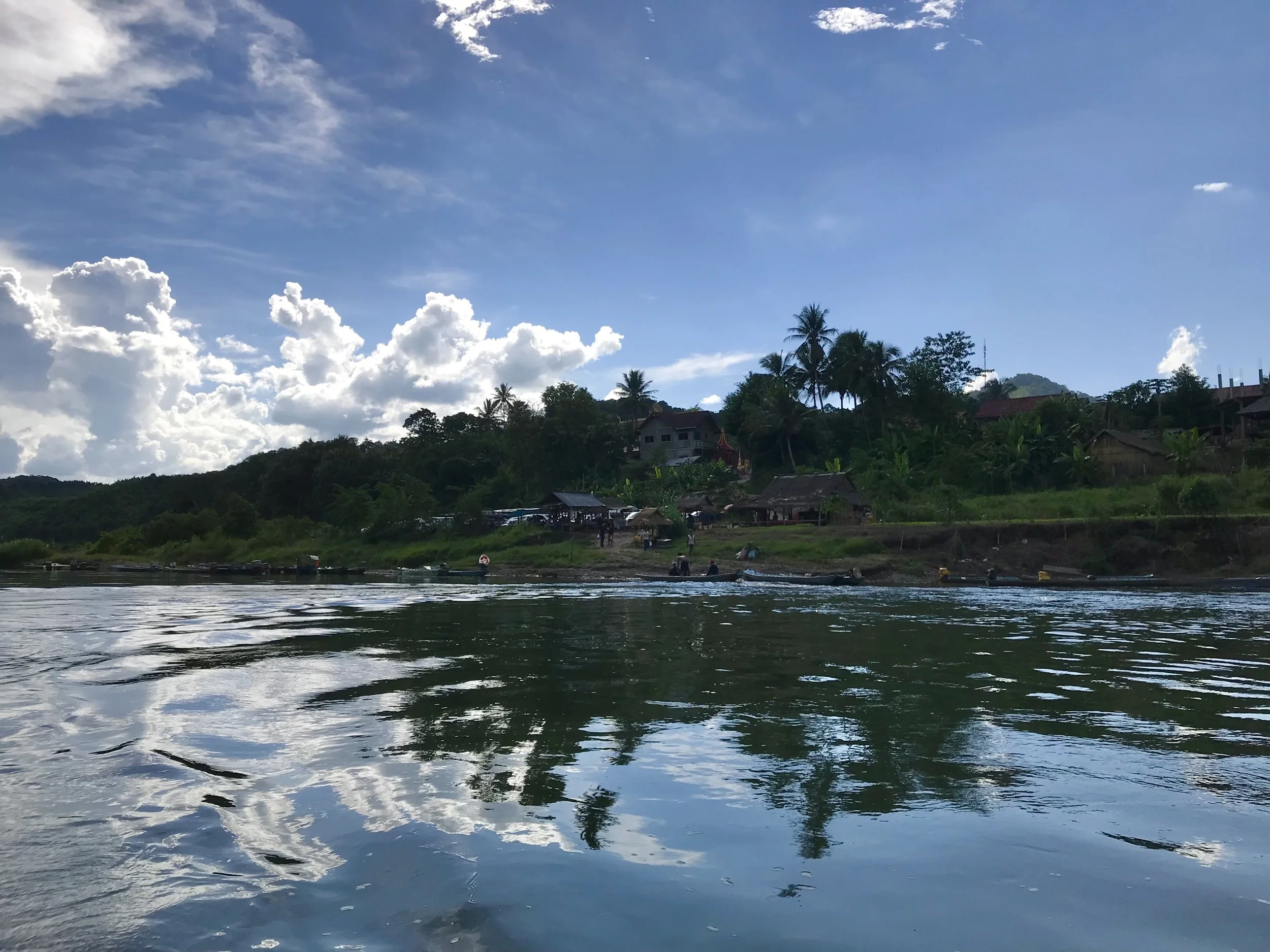
The Mekong, late September 2017.
Before you leave, you are invited to sign The Guestbook.
Further Reading: Places, Hospitality and What We Learn to See
Unless otherwise credited, all photography and written content are original works by Foodie Goes Travel.
