What a Bottle Leaves Out
At Terramante, beside the Tiber near Todi, a first white harvest reveals the friendship, uncertainty and imagination held inside a bottle of natural wine.
Words and photograph by JJ Wong
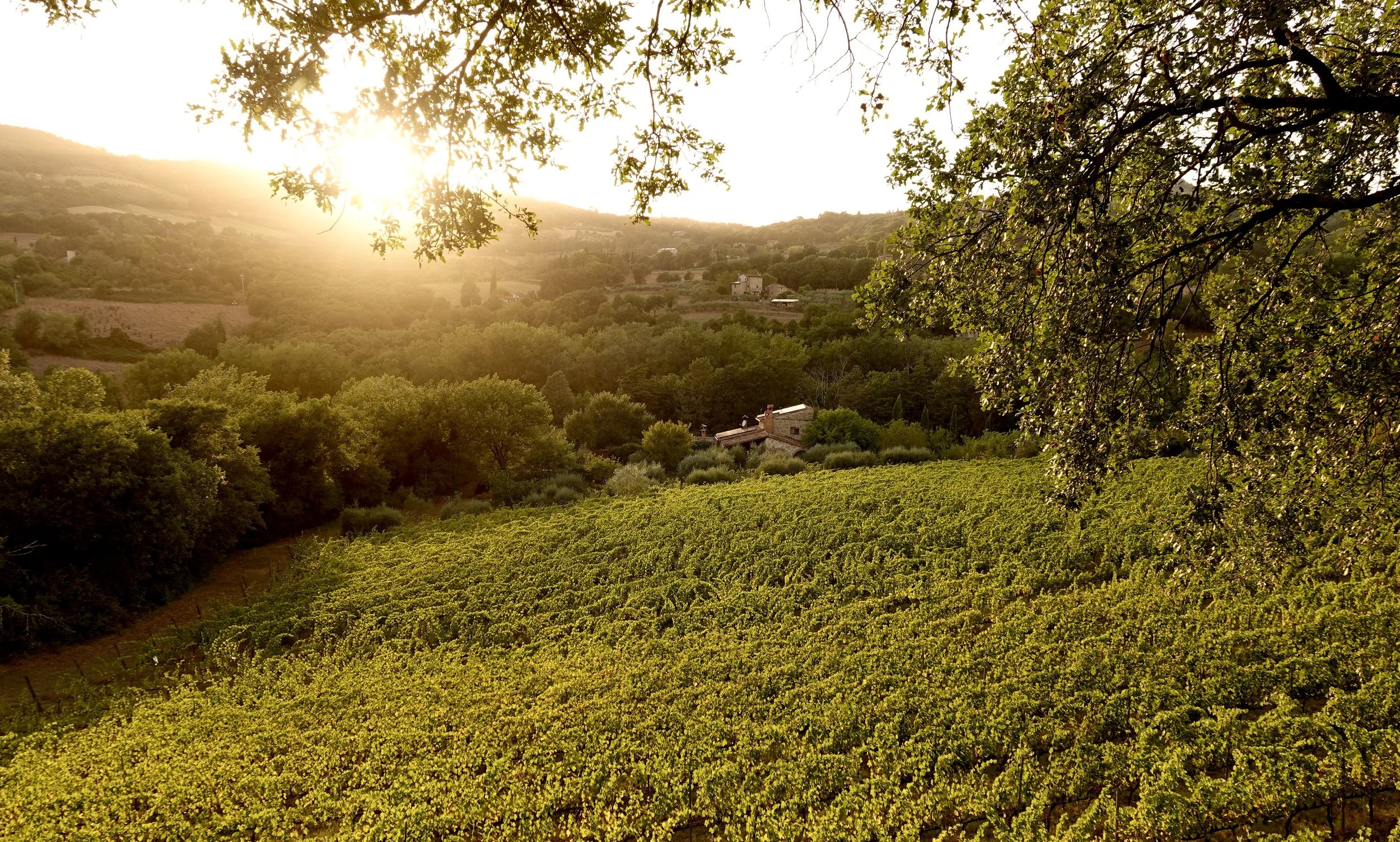
Terramante's vineyards descend towards the wooded Tiber valley near Todi.
At 4.30 in the morning, wine looked nothing like wine.
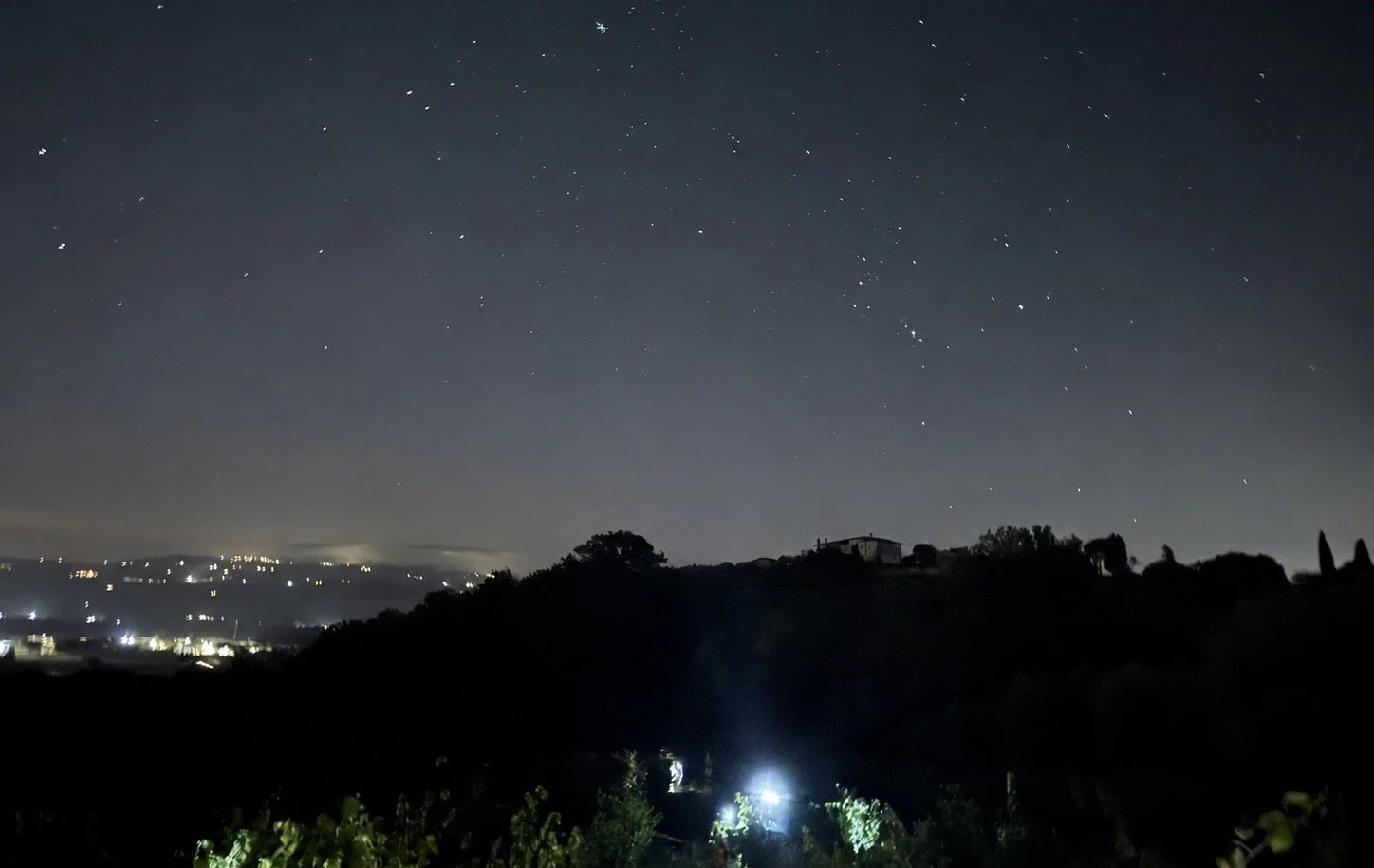
The harvest began at 4:30am, under stars and work lights.
It looked like the hard white glare of a tractor's headlamps, towers of empty plastic crates and ten figures disappearing into rows of vines. The sky above Terramante was still crowded with stars. Somewhere below us, invisible in the darkness, the Tiber moved past the vineyard.
We were not a hired harvest crew. We were friends of Claudia Rizza and Everett Thomas, the artists and winemakers behind this small estate near Todi, who had come together for the morning. Each person took a row. We cut the pale clusters by hand, lowered them into red buckets and emptied the buckets into crates. When someone finished a row, they moved to the next one that needed help.
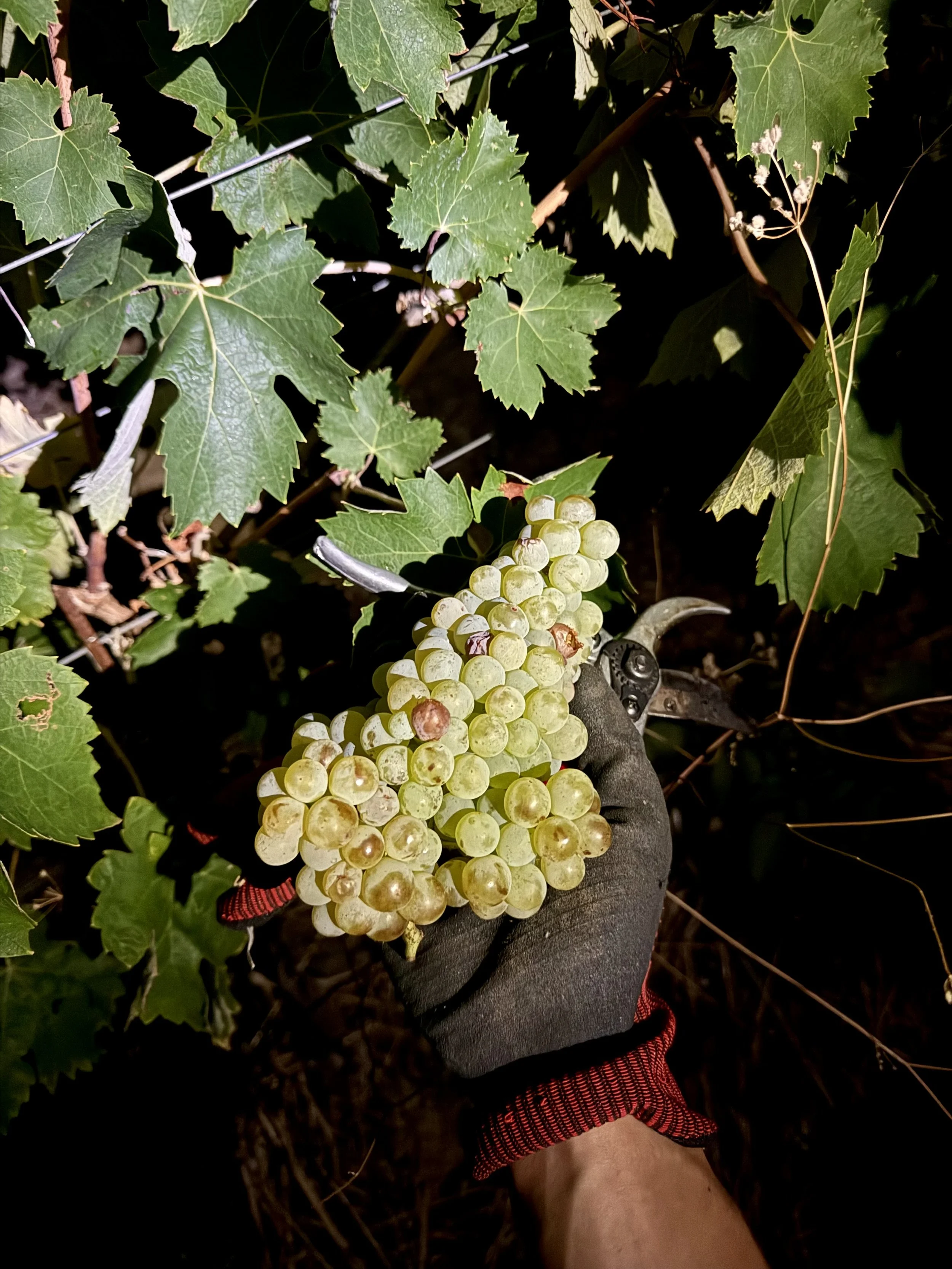
Turbiana grapes were cut by hand before sunrise.
It was a good opportunity for friends to get together and catch up.
At around 6:30, first light began to separate the vines from the surrounding hills. By seven, the ten of us had harvested 700 kilos of white grapes. Written down, the figure looks efficient. In the vineyard, it felt physical: bent backs, sticky hands, secateurs working in the dark and crates that became steadily heavier.
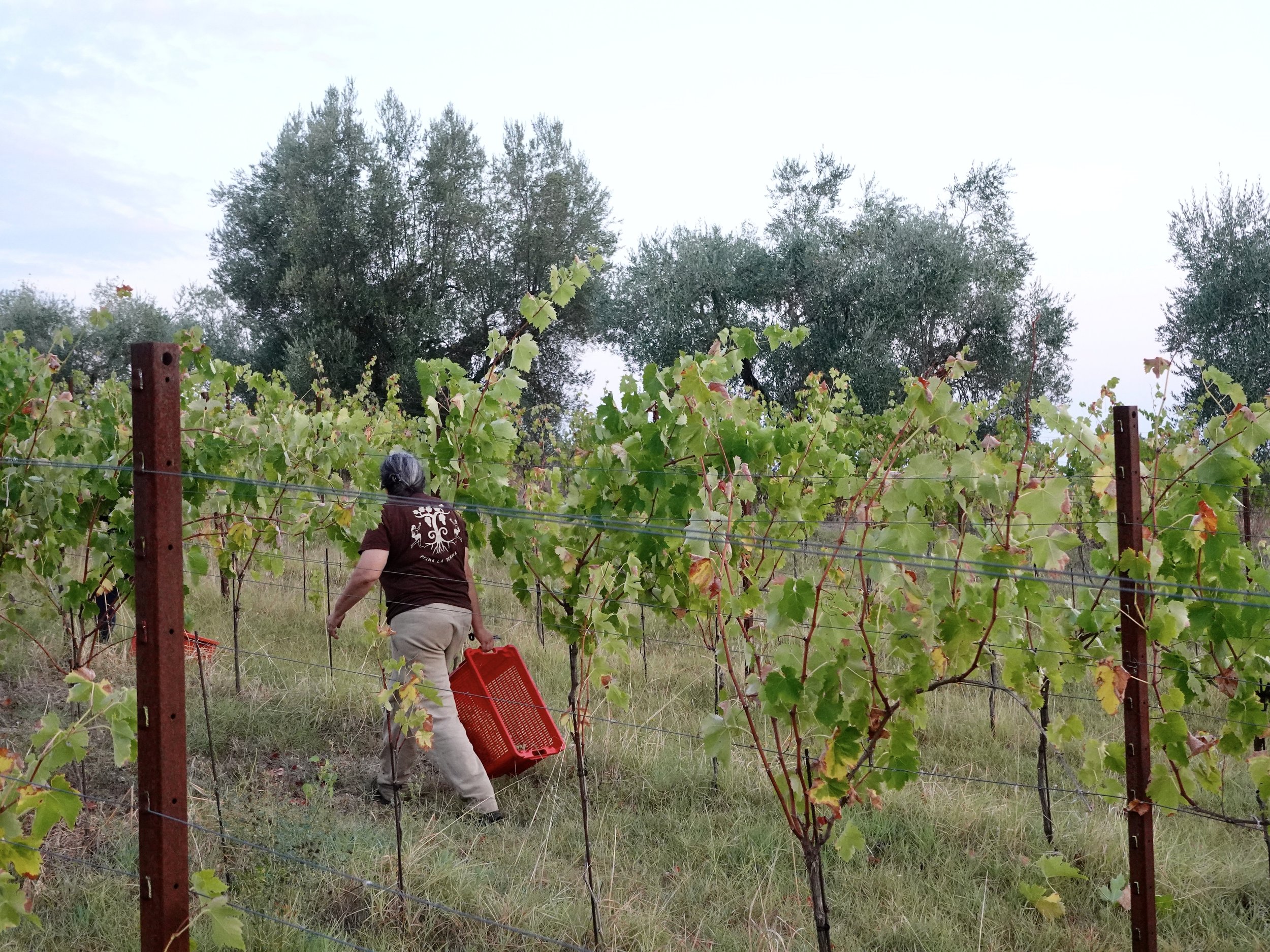
Claudia moving between rows as first light reached the vineyard.
The friendship involved was not incidental to the harvest. On an industrial scale, labour can disappear into a production figure. Here, it remained visible. These were familiar hands, offered to Claudia for a few hours before most people had begun their day. If the grapes eventually become around 400 bottles, each one will contain a small, unrecorded share of that affection.
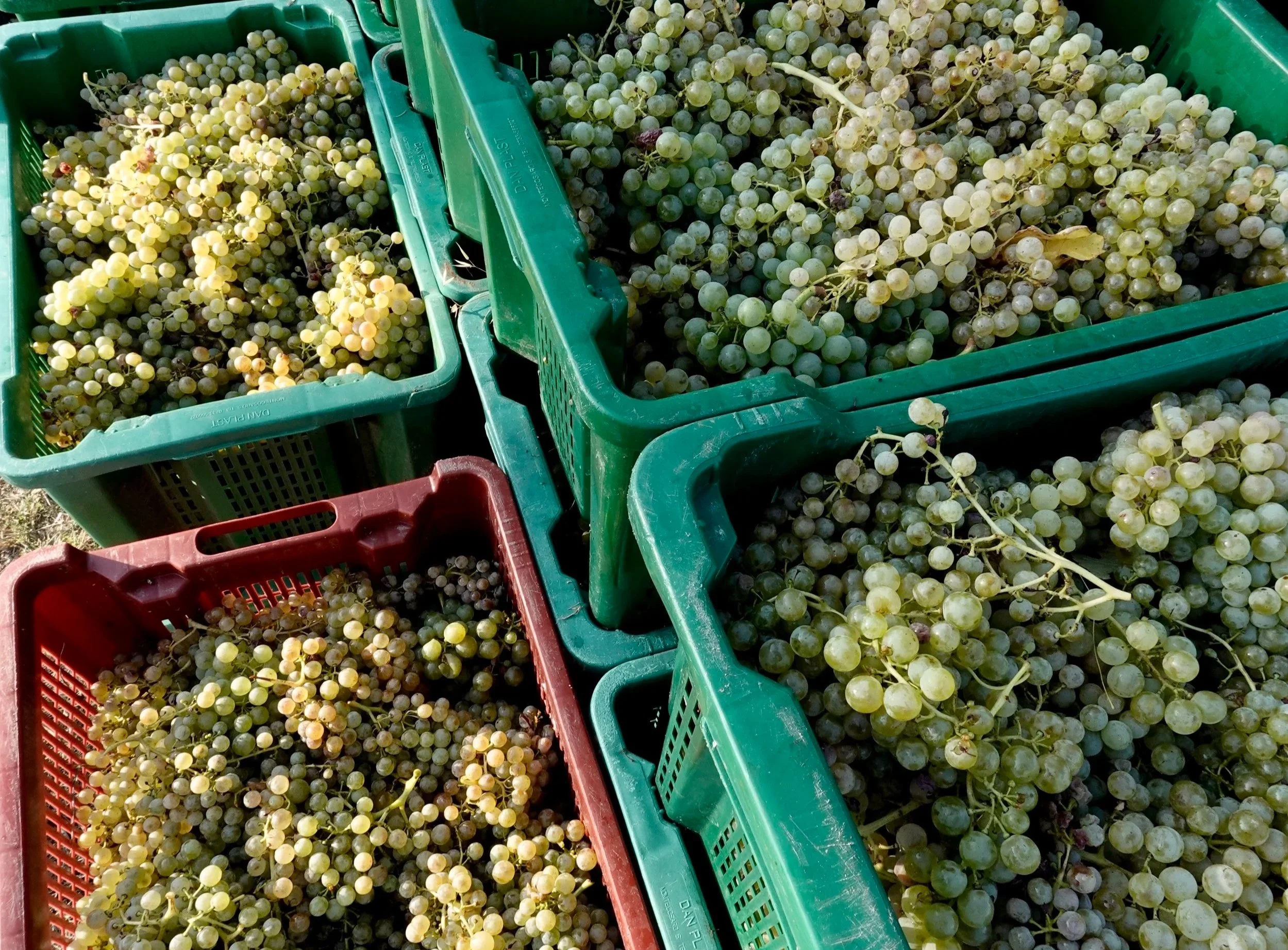
By 7am, ten friends had gathered 700 kilos of grapes.
Before the wine had a name
This harvest marked a first for Terramante. Until now, the estate had produced red wines and a rosé. The grapes we cut were Turbiana, the variety traditionally known as Trebbiano di Lugana, and they are intended for Claudia's first proper single-variety white wine.
The vines themselves carry a family journey. Claudia and Ev took cuttings from her uncle's small vineyard in Lugana and asked a nursery to propagate them. They planted the resulting vines around four years ago on higher ground in Monte Castello di Vibio, approximately 250 to 300 metres above sea level. The site is removed from the immediate humidity of the Tiber, with drier, more clay-like soil than Terramante's lower vineyards.
There had been an experiment with the fruit in 2025, but it did not become the wine Claudia wanted. The 2026 harvest is therefore both a beginning and a second attempt: roughly 400 bottles expected next spring, if all goes well. There is no confirmed name and no label design yet.
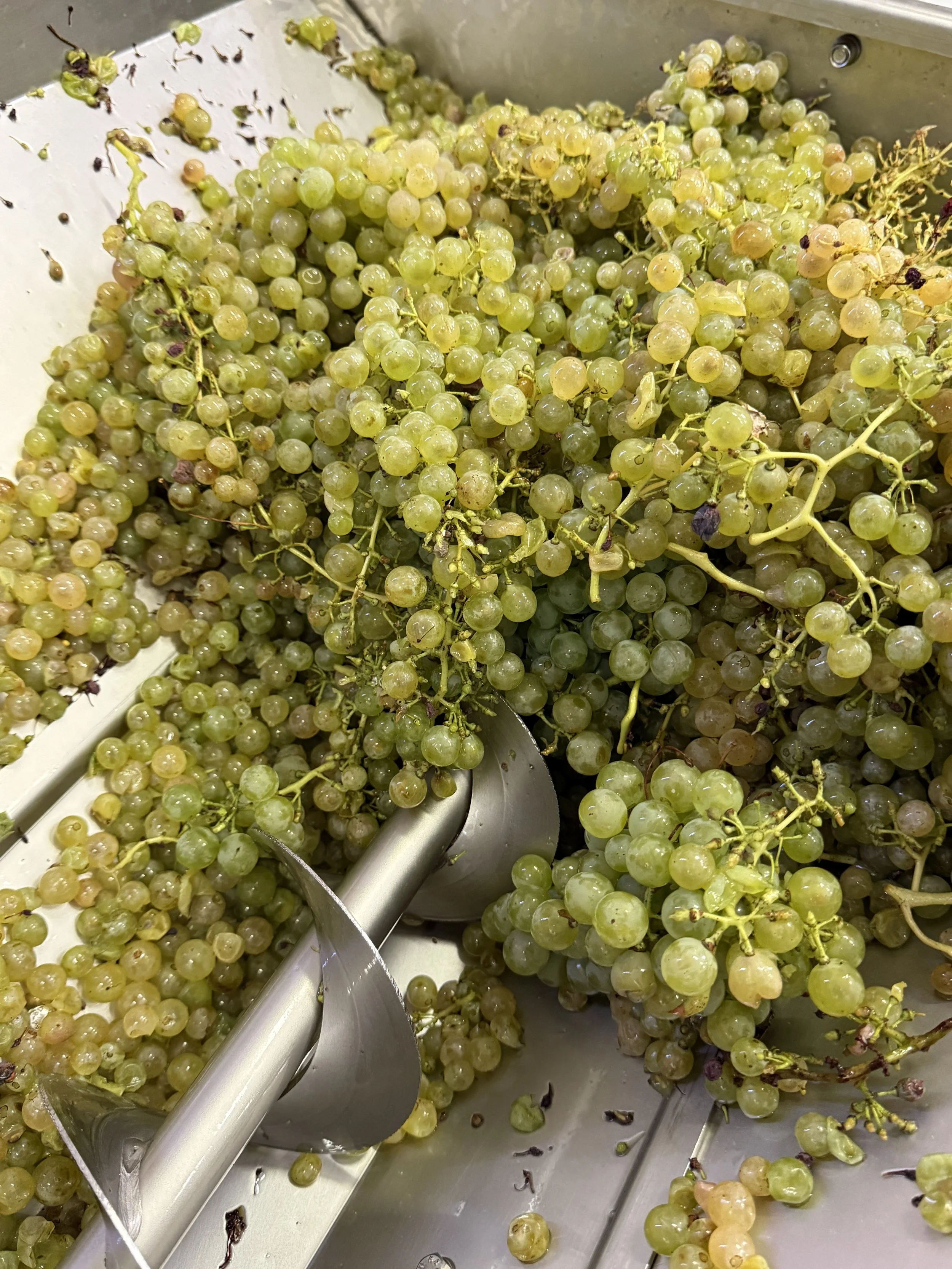
The grapes were taken to a nearby working cantina and pressed immediately.
At the nearby working cantina, we prepared the equipment and began pressing. Whole bunches disappeared into stainless steel. Juice ran out pale, clouded and capped with foam. We tasted the freshly pressed must. It was delicious: sweet, bright and alive, still carrying the simple pleasure of the grape before fermentation made it more complicated.
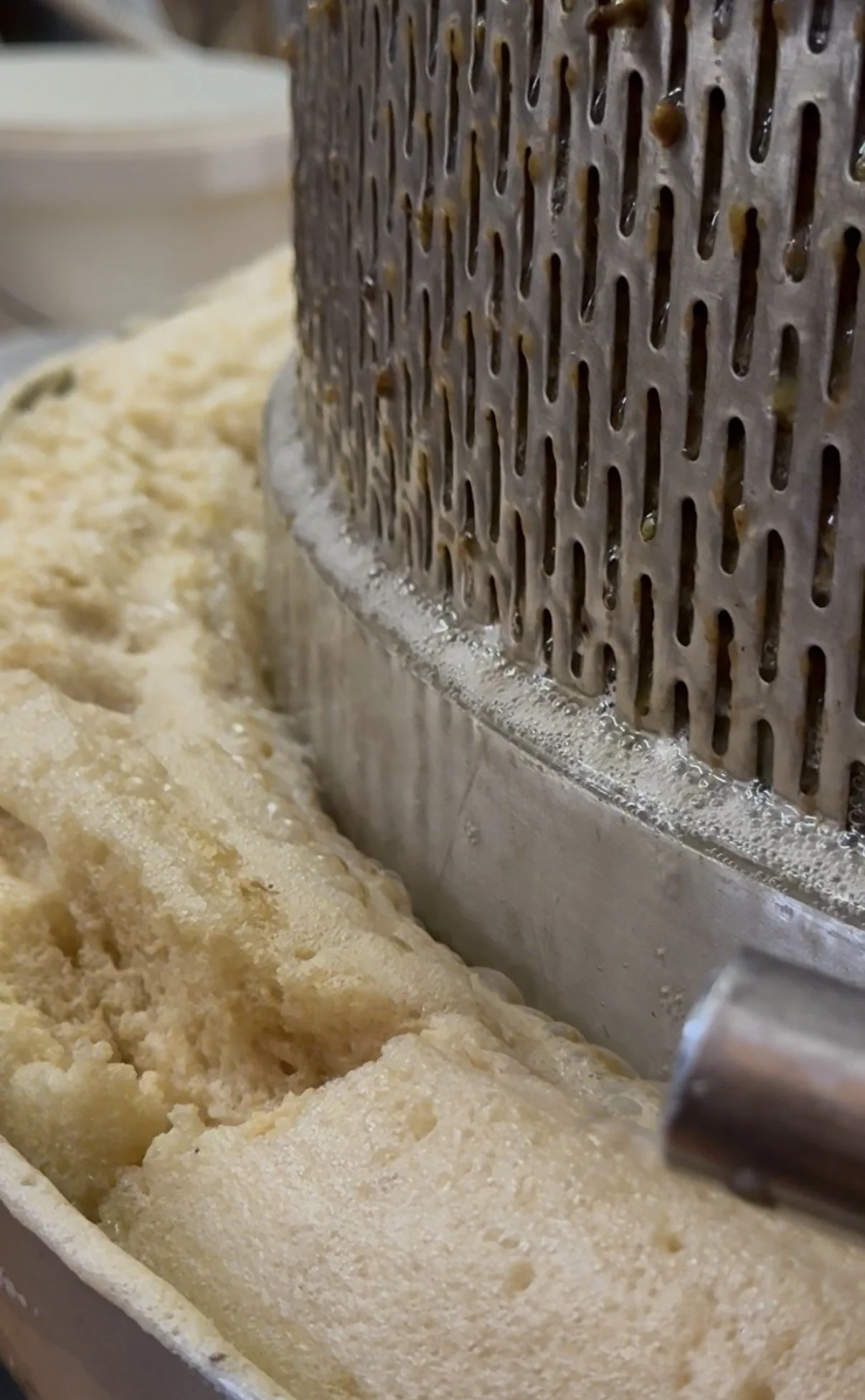
Freshly pressed must, sweet and bright before fermentation.
We also tasted the 2024 and 2025 Syrah and the 2025 Iubelo. Yet the most memorable taste remained the unformed one. The new white was not wine, not bottled and not yet named. It was possibility in a cup.
By ten, pressing was finished. What followed was another two hours of cleaning: washing the equipment, clearing wet skins and residual pulp, and discarding the stems. The compressed grape cake looked dense and almost architectural as it emerged from the press. At noon, we were done and satisfyingly exhausted.
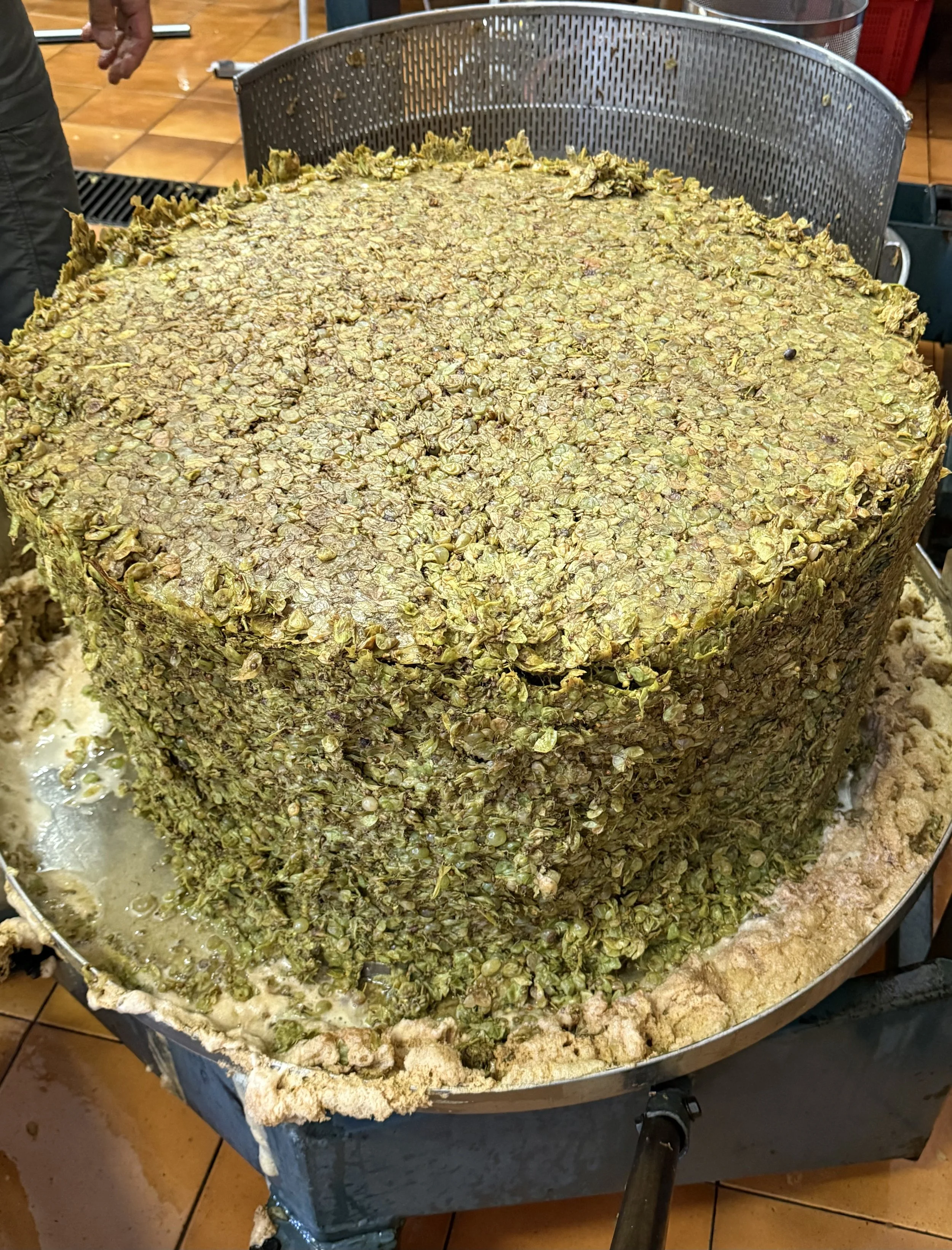
Pressing left a dense cake of skins and pulp, followed by two hours of cleaning.
This is one of the things a finished bottle conceals. Wine writing has a rich vocabulary for colour, aroma, structure and finish. It has fewer words for hoses, floor drains, sticky tiles and the long cleaning that begins after the photogenic part is over.
A winery found by accident
Terramante did not begin with a business plan or formal training in oenology. Claudia and Ev were living in Sicily when they first considered buying a house in Todi. The property they found beside the Tiber was close to ruin. They had not even understood, initially, how much land came with it.
They returned during the summers to restore the house. As they worked, people from the nearby village began visiting and telling them what the estate had once been. A family had made wine there decades earlier, before the vines and land were abandoned. Claudia and Ev began experimenting with the plants that remained.
They learned winemaking because the place gave them a reason to learn it.
That origin matters. The winery was not imposed upon the landscape as a ready-made concept; it grew from information recovered through neighbours, land they brought back into cultivation and repeated attempts. Every vine at Terramante was planted by Claudia and Ev. However, there was Foglia Tonda, one of the estate's most limited wines, began with discovery. When Claudia and Ev acquired the property, parts of the vineyard were covered in brambles. Beneath them they found vines of this old, low-yielding variety and later managed to propagate it.
Terramante's other wines continue to map the differences within the land. Iubelo and Laudatus come from lower ground in the valley, where humidity and rocky soil make their own demands. Syrah from the lower vineyard can carry smoke, pepper and a note recalling incense, with structure that avoids excessive extraction. Porcamiseria, a juicy, fruit-led Sangiovese, comes from higher, drier and more clay-rich ground.
These distinctions sound technical until one has walked between the sites. Then soil and altitude stop being tasting-room abstractions. They become the difference between damp vegetation beside a river and dry earth higher on the slope.
The artist in the vineyard
Before wine, Claudia's language was art. She trained in Florence and works as a ceramic artist. Her labels are not a separate branding exercise applied after production; they extend the way she observes the vineyard and its surroundings.
The repeated horizontal lines across Terramante's labels represent the waters of the Tiber. On Porcamiseria, something breaks through those lines: a creature with an open mouth, rising from the water.
Its source is a detail of Jonah and the whale from the Verduner Altarpiece at Klosterneuburg Abbey in Austria. Completed in 1181 by Nicholas of Verdun, the medieval work comprises champlevé enamel panels depicting biblical scenes. Claudia removed the boat and its alarmed human figures, isolating the whale and the waves. The result is both ancient and unmistakably hers.
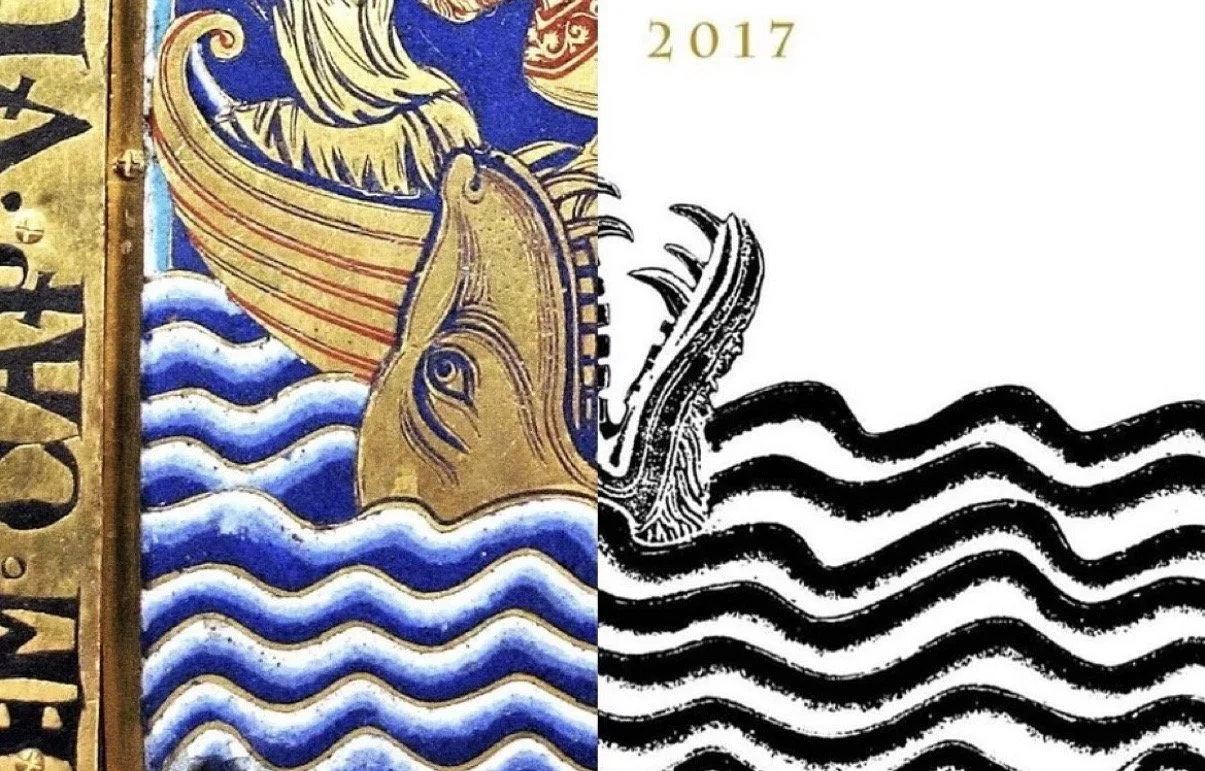
Claudia's Porcamiseria label reworks the whale from Nicholas of Verdun's 1181 enamel, replacing the original scene with Terramante's Tiber-inspired waves. (Photo credit: Terramante’s Instagram)
Porca miseria is one of those Italian expressions whose meaning changes with the force behind it. It can carry frustration - "damn it" or "for God's sake" - but also astonishment. Ev used it often in response to the bureaucracy, weather and unforeseen turns of winemaking. The phrase became the wine's name, written as one word: Porcamiseria.
The label contains the estate's philosophy without needing to announce one. Trouble can rise from apparently calm water at any moment. The answer is not control, which agriculture never fully permits, but attention, work and the capacity to continue. It also leaves room for the other meaning: Porca miseria, what a wine.
Natural, but not effortless
Natural wine is frequently described through absence: fewer additives, less technology, less intervention. A morning at Terramante made me understand that "less intervention" does not mean less work. Very often it means more observation, more manual labour and fewer ways to correct a mistake later.
There is no single statutory definition of natural wine across Italy or the European Union. Organic wine is regulated; natural wine remains a category shaped largely by producers' associations and their individual codes. Terramante is a member of VinNatur, whose rules apply to the entire winery and are checked by independent certification bodies rather than relying only on self-declaration.
Those rules require manual harvesting and spontaneous fermentation using the indigenous yeasts already present on the grapes and in the winery. They prohibit chemical herbicides, synthetic systemic pesticides, selected commercial yeasts and many common fining agents. Sulphur dioxide is the only permitted additive, with total limits of 50 milligrams per litre for white and rosé wines and 30 for reds.
The restrictions are specific, but they do not make every natural wine automatically delicious, healthier or morally superior. Alcohol remains alcohol. Conventional producers can farm responsibly and make exceptional wines; natural wines can also be unstable or flawed. "Better" is too blunt a word.
What the best natural wines can offer is a more legible connection between a season, a piece of land and the decisions of the person making the wine. That connection is what I began to value at Terramante. The appeal was not an abstract promise of purity. It was the ability to see the chain of choices - and the human effort - with unusual clarity.
The wider interest is real, even if the market is difficult to measure because the category has no universally accepted boundary. In May 2026, drinks-market analyst IWSR described natural wine as the leading opportunity within its index of alternative wines, with younger drinkers driving demand and particularly strong performances in China, Australia and the United Kingdom. The same research identified familiar barriers: limited availability, price and uncertainty about value.
For a producer of Terramante's scale, growth cannot simply mean making far more wine. Small estates face the cost of manual work, erratic weather, labour shortages, bureaucracy and cash tied up long before a bottle is sold. A recent Nomisma study for the Italian Federation of Independent Winegrowers found that more than 80 per cent of its members offer wine tourism; those activities account for an average of 23 per cent of their revenue, while 46 per cent of visitors come from abroad.
The figures concern independent wineries more broadly, not natural wine alone, but they point towards an opportunity. For small producers, the future may depend less on volume than on direct relationships: visitors walking the vineyard, tasting with the person who made the wine and understanding why a limited bottle costs what it does. Terramante's new terrace can be read in that way. It creates economic possibility without asking the vineyard to become something larger than it is.
The river in every bottle
At Terramante, the Tiber is not scenery. It affects humidity, soil, access and even where wine can legally be made. Regulations linked to the property's proximity to the river prevented Claudia and Ev from building a winery beside the vineyards. Their search for an alternative led them to an old cellar beneath the Church of San Michele Arcangelo in Montemolino, where monks and, later, local priests had made wine for more than seven centuries.
The discovery gave Terramante a cellar with a history far older than the business itself. Not every stage of production happens there, however. The Turbiana we harvested was pressed at another working cantina nearby. The distinction is important: the historic cellar belongs to Terramante's story, but it was not the setting for that morning's pressing.
Before the Tiber becomes the monumental, embanked river of Rome, it passes through rural Umbria as a more intimate force. The regional Tiber River Park covers 7,295 hectares across seven municipalities, including Todi and Monte Castello di Vibio, taking in wooded banks, the Forello Gorge and the lakes of Corbara and Alviano. Here, the river shapes farms and villages before it enters national mythology.
For Terramante it is also a line drawn repeatedly by Claudia's hand: wave after wave across the labels, changing colour and context from one bottle to another. Geography becomes graphic identity.
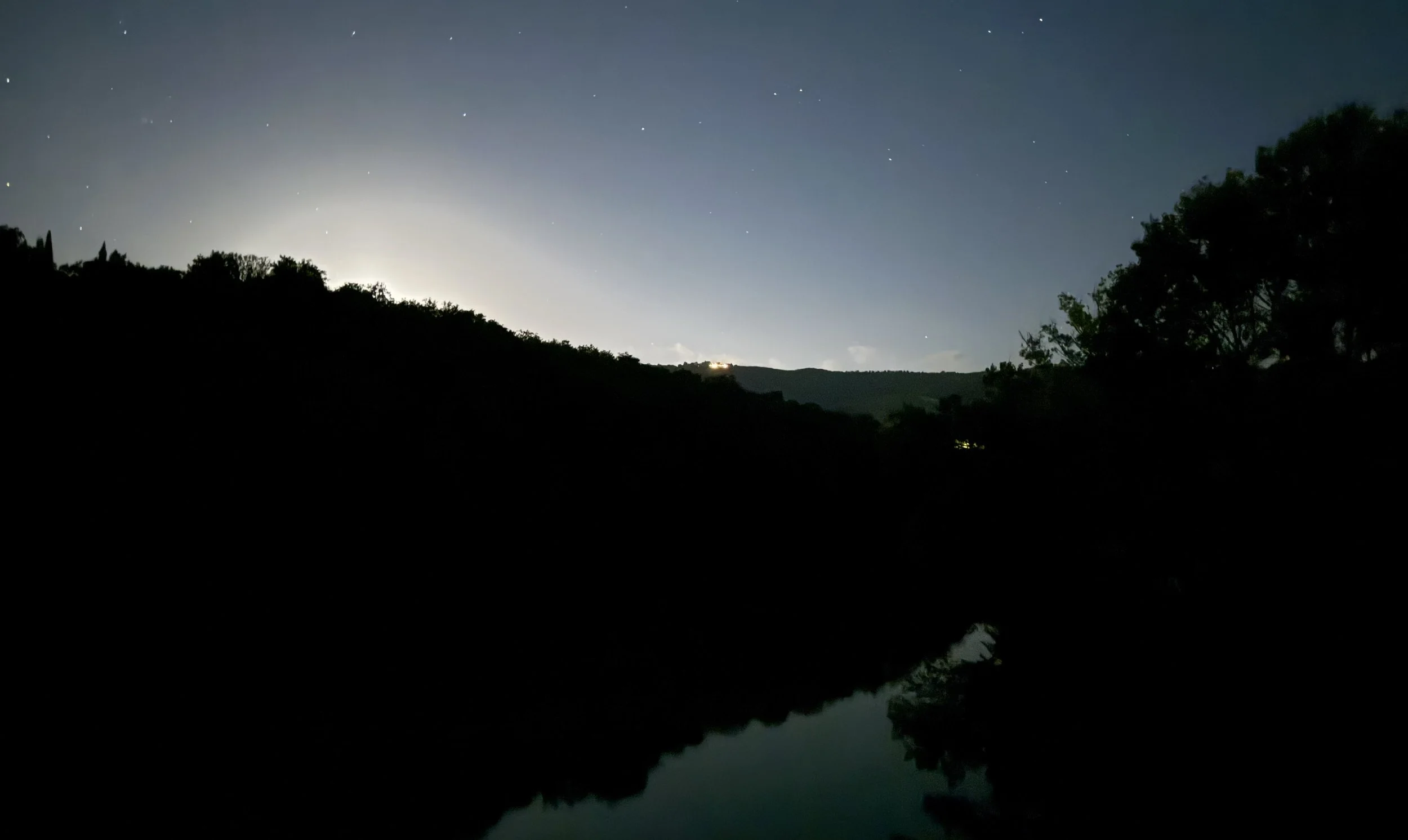
At night, the Tiber becomes a dark line beside the vineyard.
What remains after the work
When we met again at the wooden terrace above the vineyard, the scene was far removed from the cantina floor. The platform is built among mature trees, looking across the vines towards the wooded valley. Claudia's dogs settled near us. A cat followed me along one of the rows as if assigned to make sure I did not get lost.
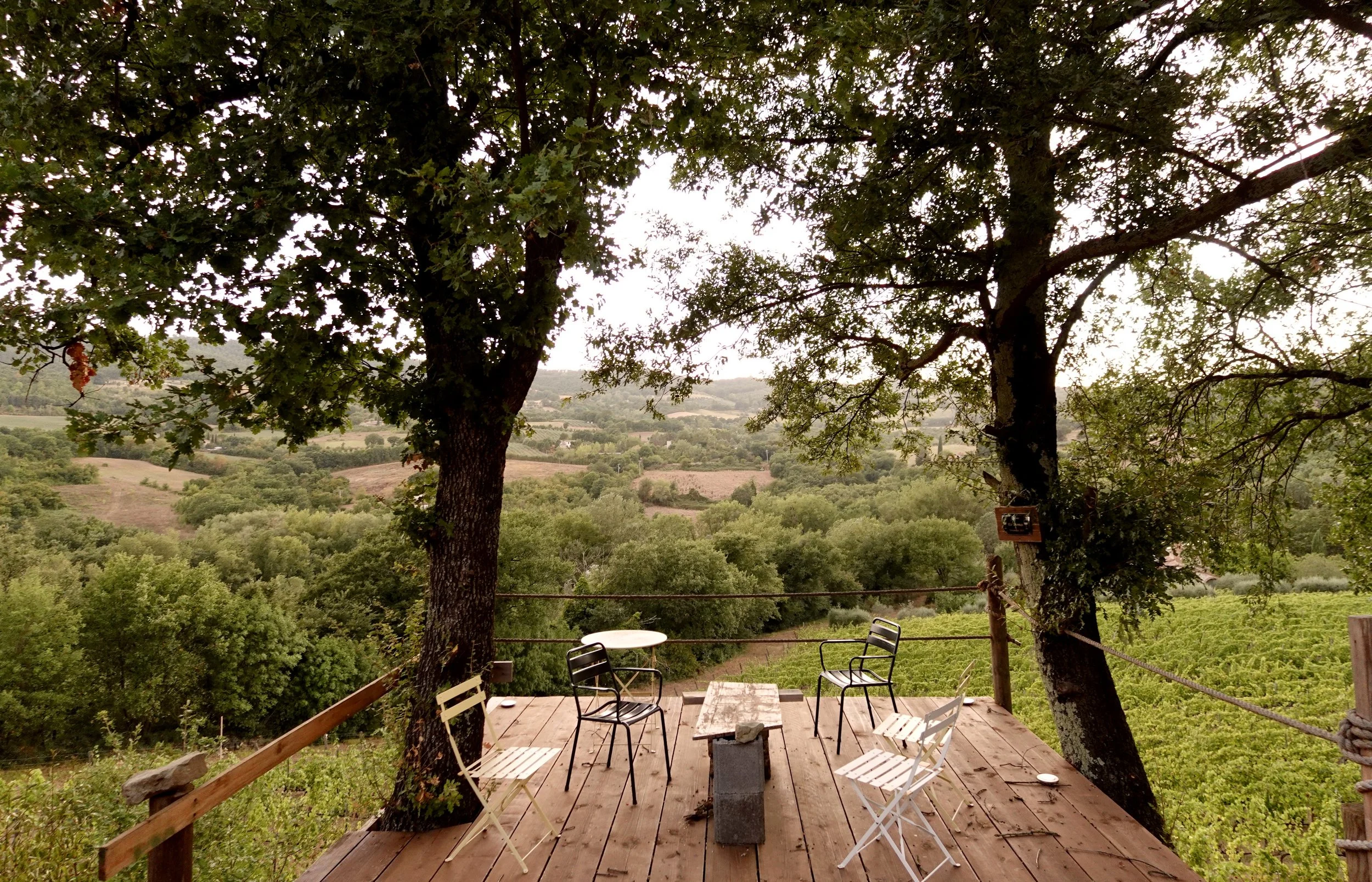
The wooden platform is built between mature trees above the vines.
We did not drink a Terramante wine that evening. Instead, we shared a white from another winery made with the same Turbiana variety we had harvested. It was not a preview of Claudia's wine - site, vintage and the decisions made in the cellar will make hers different - but it offered a reference point. We were drinking one possible future while Terramante's own version sat elsewhere at the very beginning of fermentation.
I grew up in Kuala Lumpur and later lived in Hong Kong and Singapore, cities where contact with nature often has to be planned around the demands of urban life. Sitting on that wooden platform, with animals moving between the chairs and the last light falling over the vines, I registered how fortunate I am to live in a region where an evening like this can be part of ordinary life.
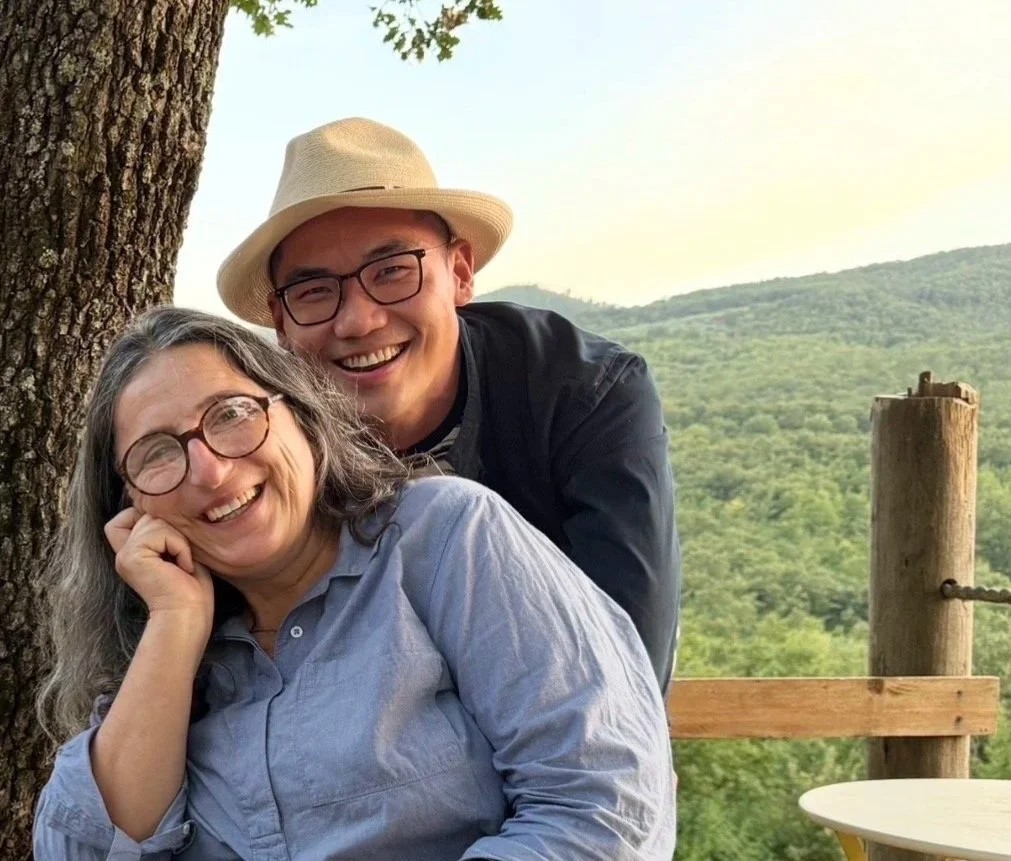
Claudia and I on Terramante's vineyard terrace.
The feeling did not need to become a grand conclusion. It was enough to look back at the previous morning: ten friends arriving in darkness, 700 kilos of grapes, a sunrise, the sweetness of fresh juice and two hours spent cleaning what the photographs usually leave out.
I appreciate wine more now, but not because I have learned a longer list of tasting terms. I appreciate it because a bottle has become less complete in my imagination. It no longer begins when it is opened. It begins with a ruined house, villagers remembering that wine had once been made on the land, vines planted by Claudia and Ev, cuttings carried from an uncle's land, an artist redrawing a medieval whale, friends lending their hands before dawn and a winemaker accepting that nature will always retain the final vote.
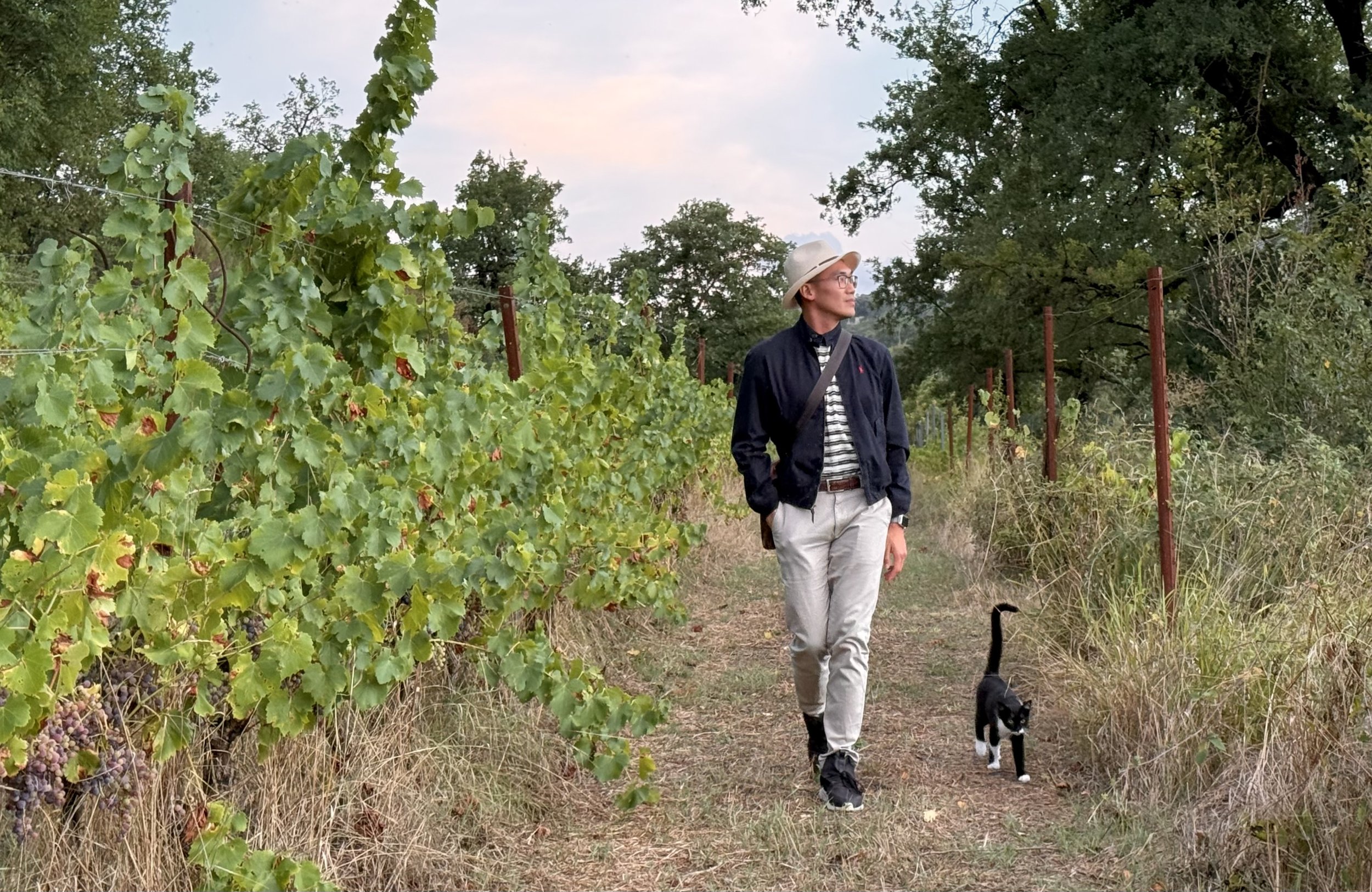
One of Claudia's cats accompanied me through the vineyard.
Next spring, if everything goes well, there may be around 400 bottles of Terramante's first proper white wine. For now, it has no name and no label.
That seems fitting. Before a wine becomes a product, it is work shared among people. Before it becomes a bottle, it is a story most of us never get to see.
A QUESTION BEFORE YOU GO
Have you ever understood something differently after seeing how it was made?
Continue exploring Umbria
If this story has deepened your interest in the people, land and craft of the region, you may also enjoy:
The Plural of One — another Umbrian story about land, preservation and the relationships behind a singular creative vision.
Before Umbria Becomes a Brand — on the region’s growing international visibility and what should remain recognisable as it changes.
Understanding Umbria — a companion for understanding the countryside and everyday life that shape the experience of travelling here.
Unless otherwise credited, all photography and written content are original works by Foodie Goes Travel.
