The Source We Were Taught to Remember
Following my father’s footsteps to our Hakka family in Dabu, Meizhou (大埔,梅州)
My paternal grandparents left Dabu for Malaya long before I was born. In my thirties, I travelled with my parents to the villages they had left, where relatives I had never met held my hand and called me one of their own.
In Anle Village, a cousin I had never met told me that she remembered my name.
Decades earlier, letters from my grandmother in Malaysia had carried news of the family she was raising there, including the name of a grandson who had never seen this part of China. Before my cousin and I had accumulated a single shared memory, she already knew where I belonged.
My grandmother died in 1993 and my grandfather in the early 2000s. By the time I reached their hometowns, neither could tell me what they had felt when they left, which details they had missed, or what version of these places they had carried with them to Malaya. I would have to approach their lives through other people’s recollections, through what remained of two houses, and through a landscape I had previously known only from family stories.
I had thought of the journey as a search for my Hakka roots. Once I arrived, it felt less like discovering something lost than entering a conversation that had continued without me.
Arrival
From Shenzhen North, the high-speed train reached Meizhou West in a little over two hours. A car then carried us farther into the mountains towards Dabu. At the roadside, the two characters 大埔 appeared in gold on a great stone marker as a scooter passed in front of it. The name had long existed in our family vocabulary; now it occupied physical space.
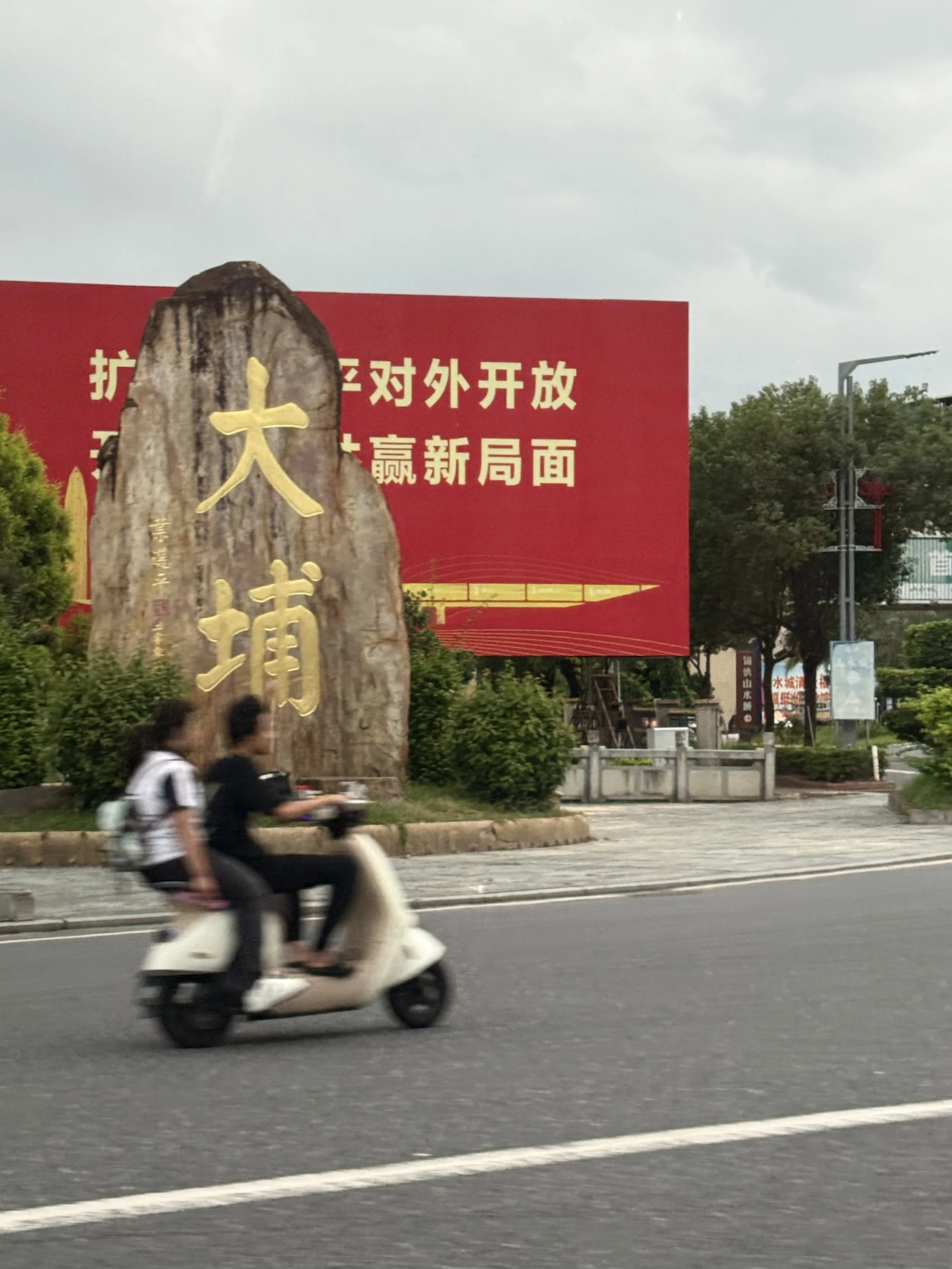
Arrival in Dabu, where a name from family history became a place in front of us.
The ease of the journey made the distance my grandparents had crossed more visible rather than less. I had flown from Italy to Hong Kong, continued by high-speed rail and then by car. For them, China and Malaya had been separated by weeks at sea, expensive journeys and letters that had to do the work now performed instantly by a phone.
My paternal grandfather was born in Anle Village (安乐村), within Chayang (茶阳镇) in Dabu County (大埔县), and remained there until he left for Malaya in the 1940s. My paternal grandmother grew up in Chayang town. After marrying him, she followed in the 1950s. They left before Malaya became independent, and built another life there.
Among the few surviving records of that new life is a hawker’s licence issued to my grandfather by Kuala Lumpur Municipality in 1953. Its printed headings and handwritten entries preserve something family stories often leave out: the practical work of beginning again. He was licensed to sell fish and vegetables.
In the photograph attached to the licence, he is a young man already far from Anle—not yet the grandfather whose story I inherited, but a migrant earning a living in a city that would become home to the generations after him. The ruined house in Anle would later show me what he had left behind. This document showed me the labour of what came next.
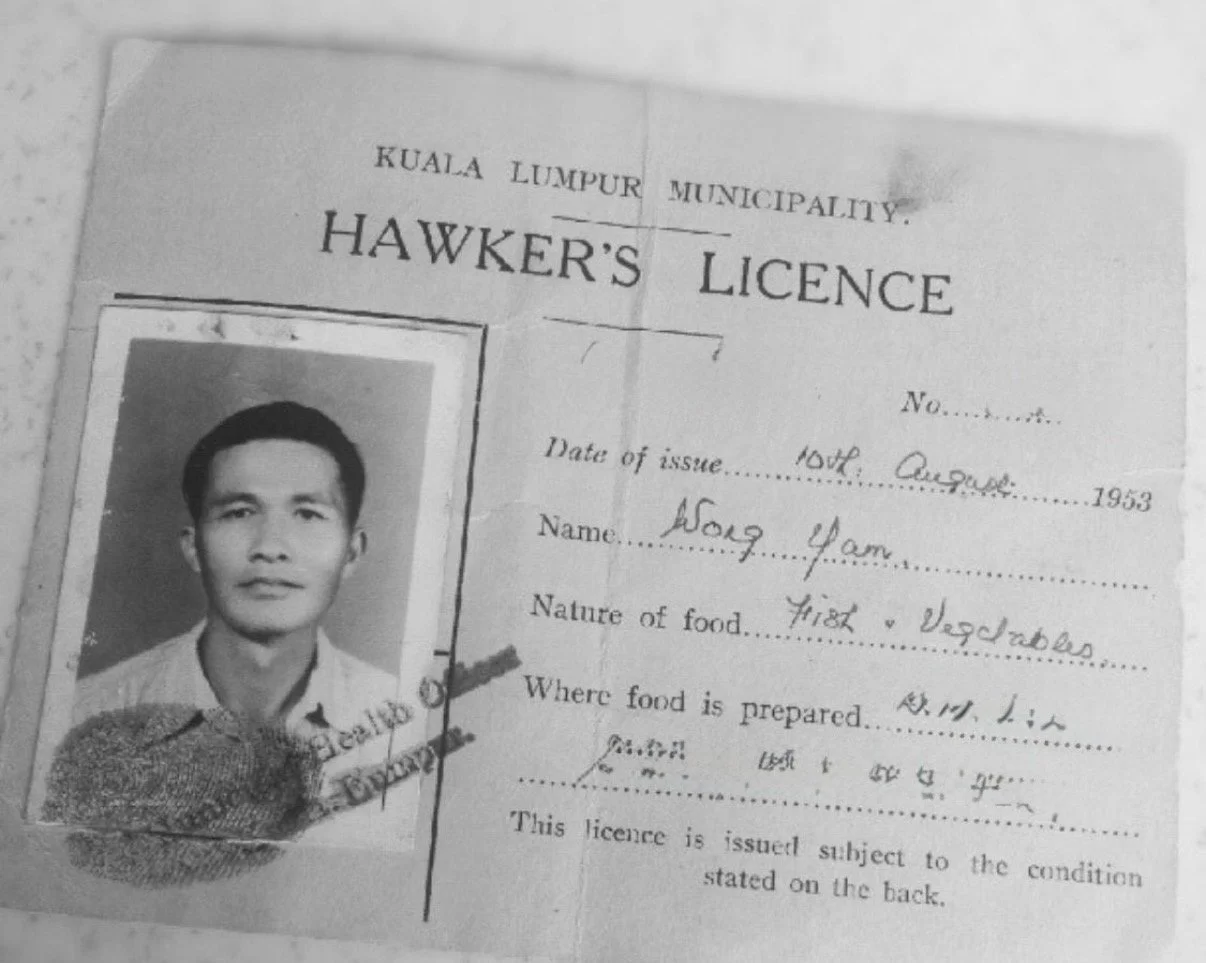
My grandfather’s hawker’s licence, issued in Kuala Lumpur in 1953. The house in Anle recorded what he had left behind; this document offered a glimpse of how he began again.
In their early years in Malaya, they had no abundance to send home. My father told me that even when they were living with very little, they sent pork lard, used clothes and small sums of money back to relatives in China. Their departure did not end the relationship. It changed the forms through which the family could care for one another.
The road beneath the bamboo
The road towards Anle narrowed beneath a canopy of bamboo. After the heavy rain, several stems—some around five metres tall—fell across the road in front of our car. I got out and lifted them aside.
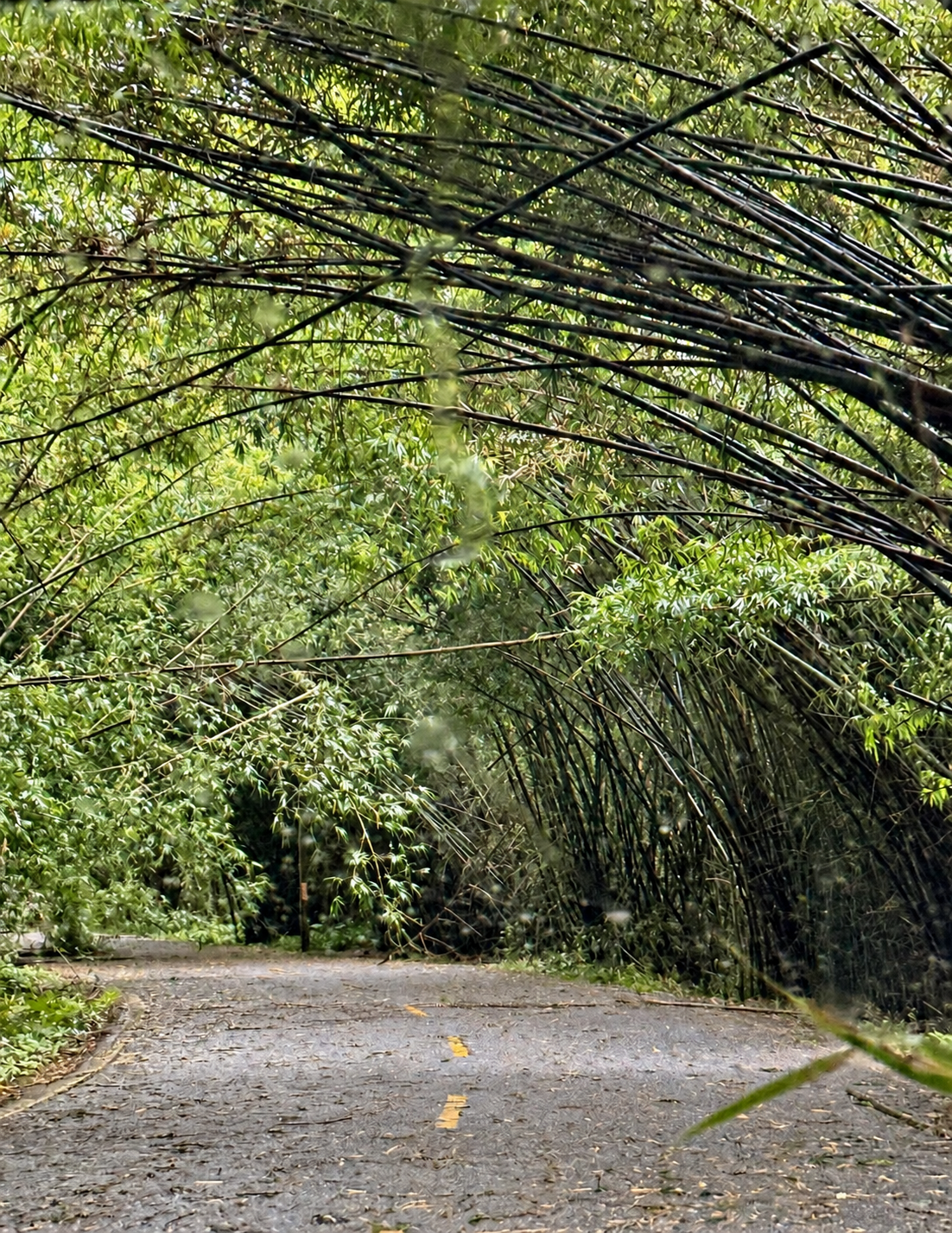
The bamboo road before Anle Village, where fallen stems briefly blocked our way.
It was a small action, but I noticed how little the situation unsettled me. I grew up in Kuala Lumpur and spent much of my adult life in cities. I had not learnt to respond to fallen trees, unstable roads or sudden changes in weather until I moved to the Umbrian countryside. I had travelled to China expecting ancestry to explain why this landscape mattered. I did not expect another countryside, thousands of kilometres away, to have prepared me to enter it.
Under umbrellas, we continued through Anle towards the place where my grandfather had lived. The rain darkened the walls and roof tiles. Balconies projected above the narrow path; cultivated fields began almost where the buildings ended. We were not walking towards a restored ancestral residence. We were walking towards what was left.
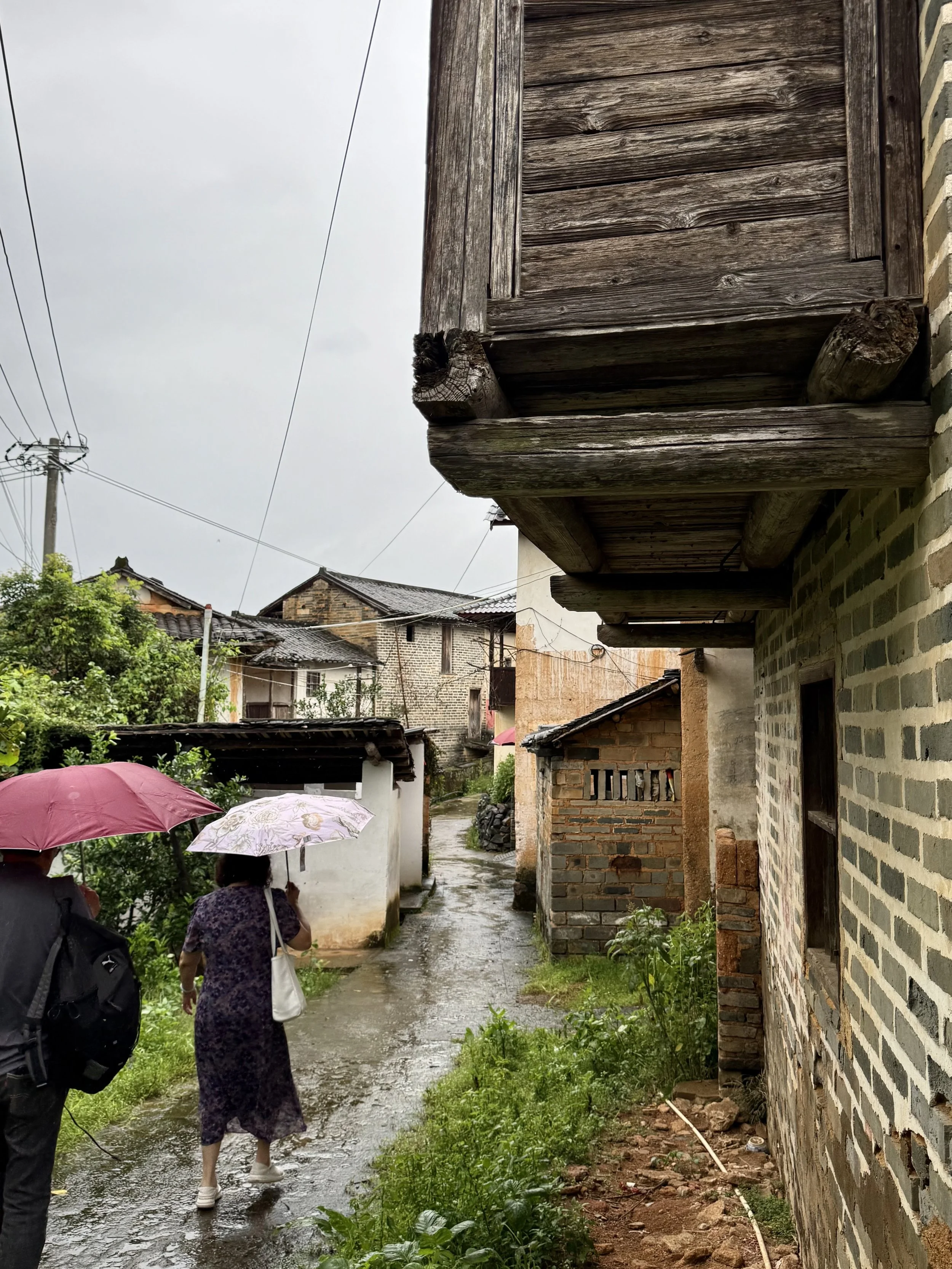
Walking through Anle Village towards the house my grandfather left before moving to Malaya.
What the house could still tell me
Much of my grandfather’s old house had been destroyed. I could not enter a preserved room and imagine where he had slept, or place my hand on a table he had used. The absence was not dramatic. It sat among vegetation and neighbouring homes, absorbed into the ordinary life of the village.
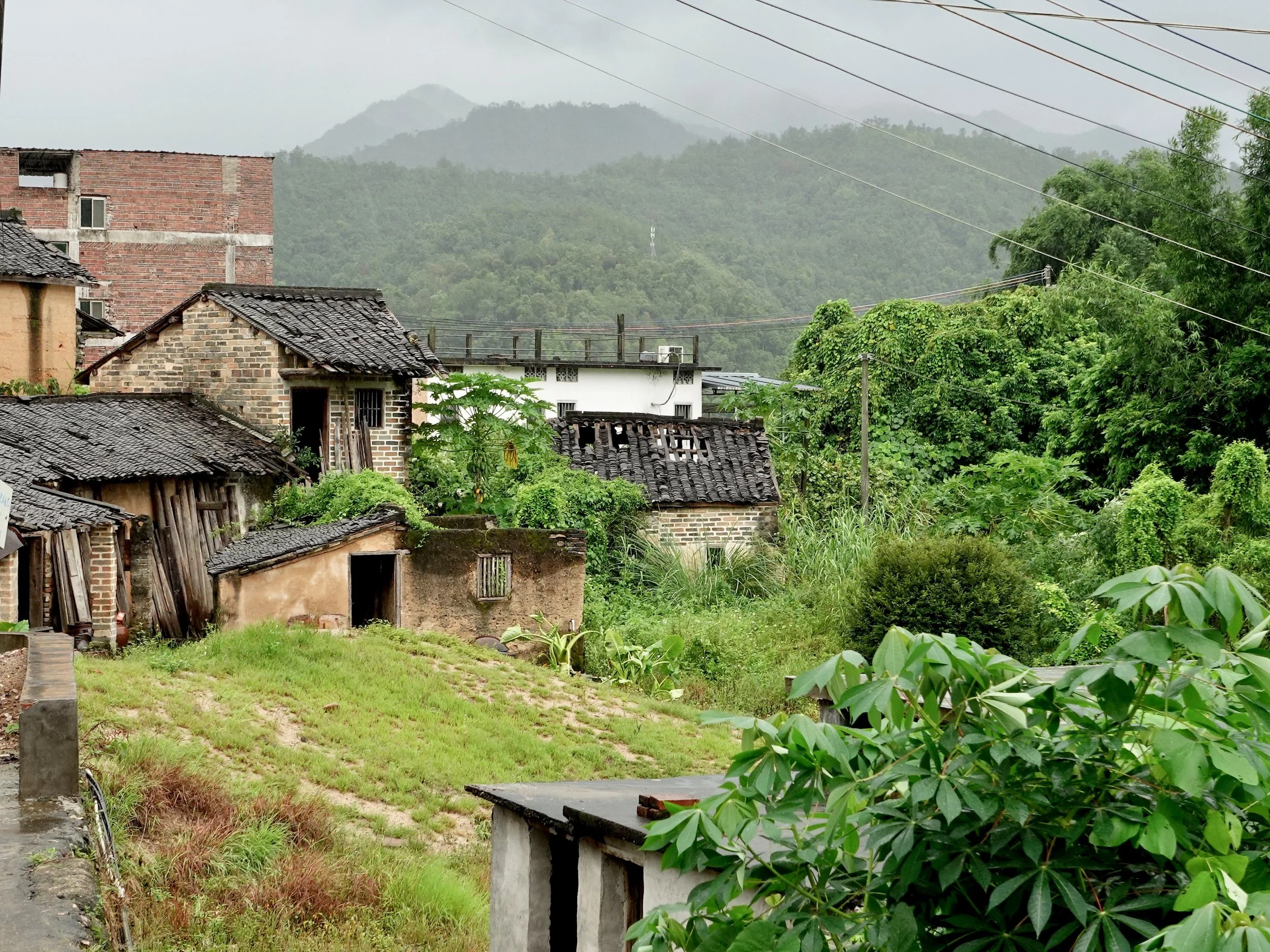
The site of my grandfather’s former home in Anle Village. Much of the house has been destroyed.
Some of the roof tiles were still intact. Their repetition made them appear almost complete when photographed closely, although the house beneath them was not. I found myself looking at those tiles for proof: not that I remembered the building, but that the building had once sheltered a life from which mine eventually followed.
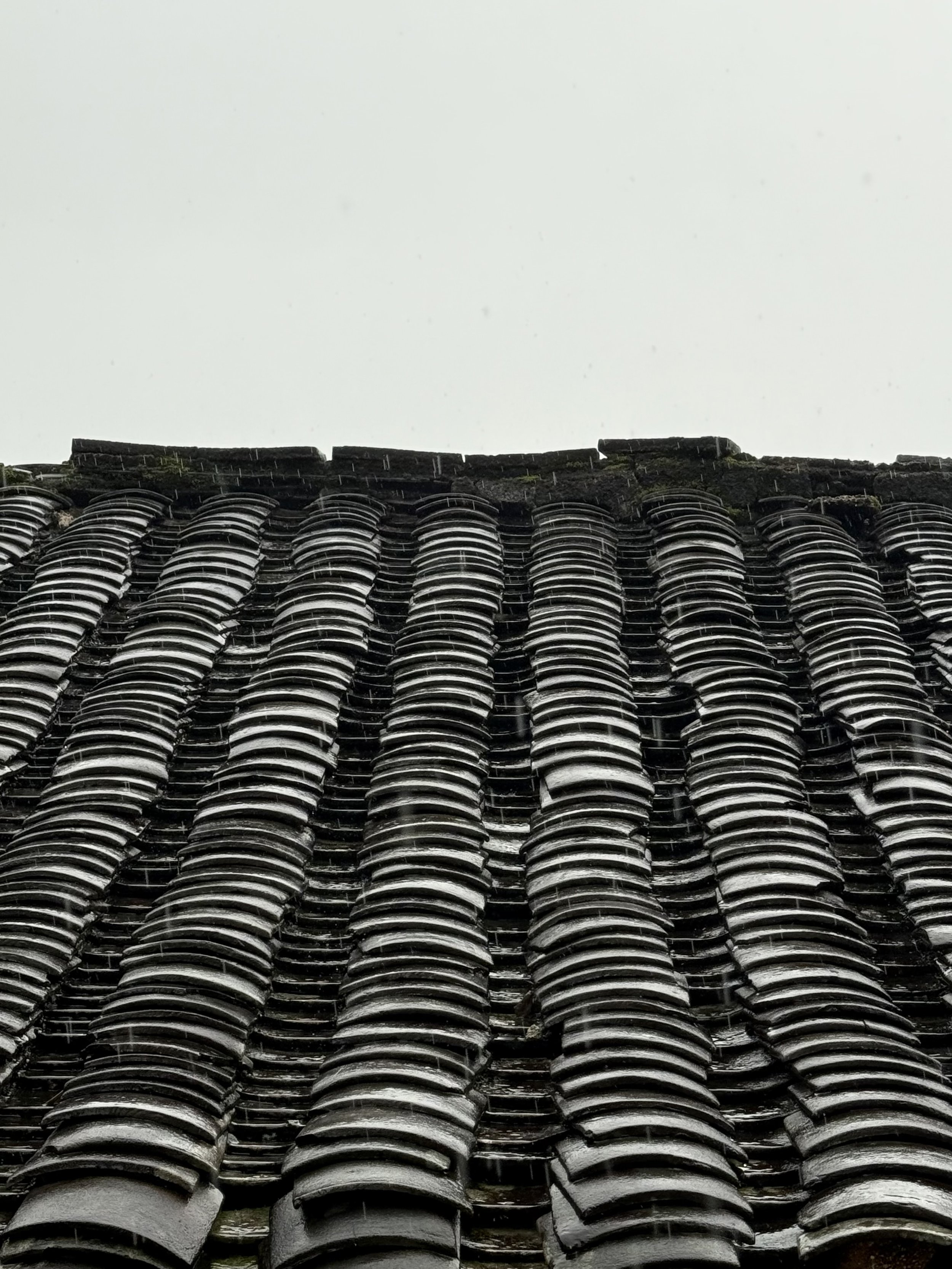
The roof tiles survived even where much of the house below them did not.
In front of the house, the rice field opened towards the mountains. I stood there and closed my eyes. The wind moved across the field and over my body. I tried to imagine the scale of my grandfather’s childhood: the distance between the house and the crops, the work contained within a day, and the surrounding hills long before the journey I had just made could be completed with such ease.
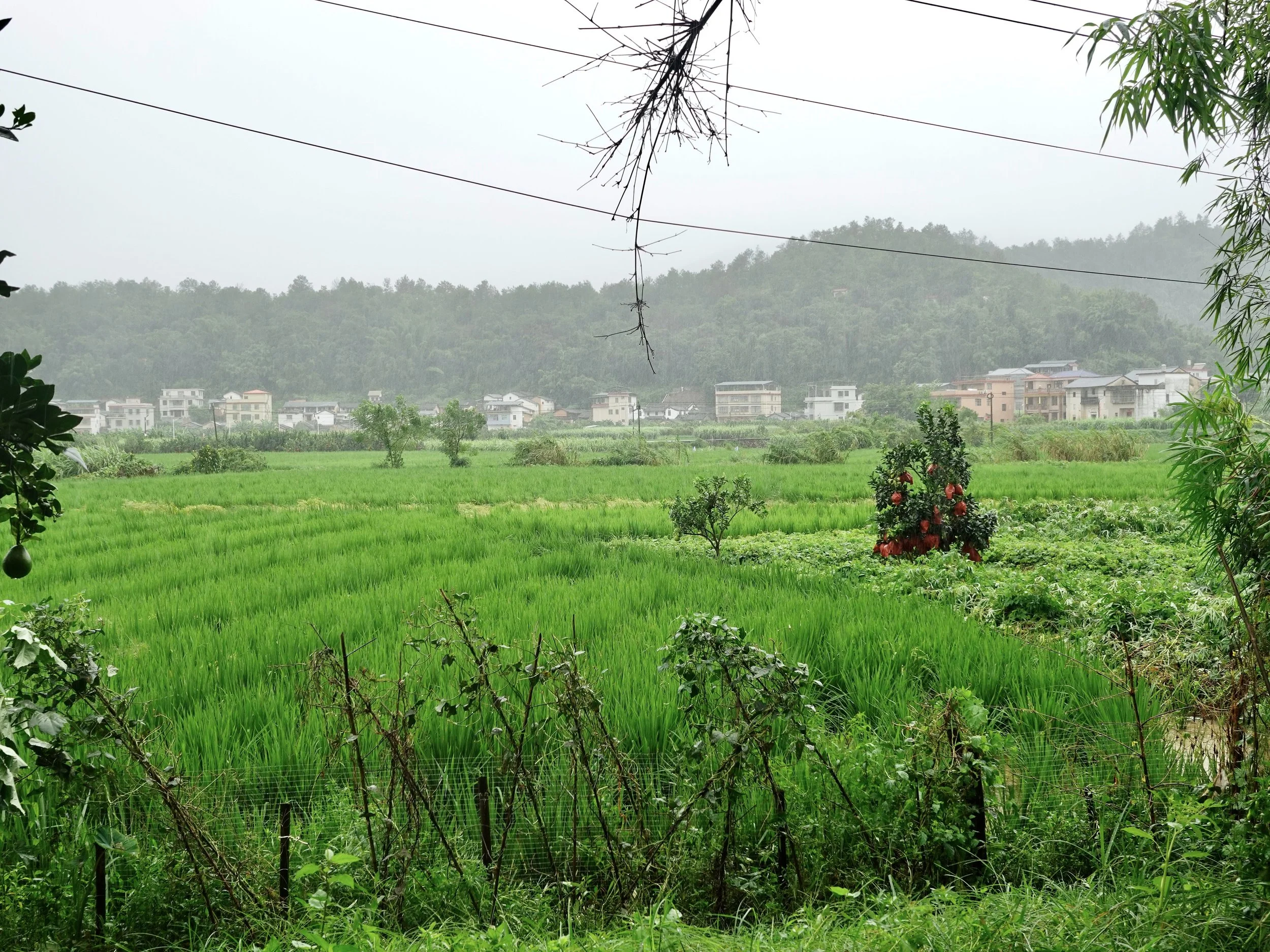
The field in front of my grandfather’s former home, where I tried to imagine the life he had known.
A line of white ducks moved through the green. I watched them longer than the moment required. There was a sense of recognition, though I do not think it came from ancestry in any mystical sense. My father had described this place over the years, and I had assembled my own version of it. Living in Umbria had also altered the scale at which I now noticed rural life: weather, crops, animals, distance and the practical relationship between a home and the land around it.
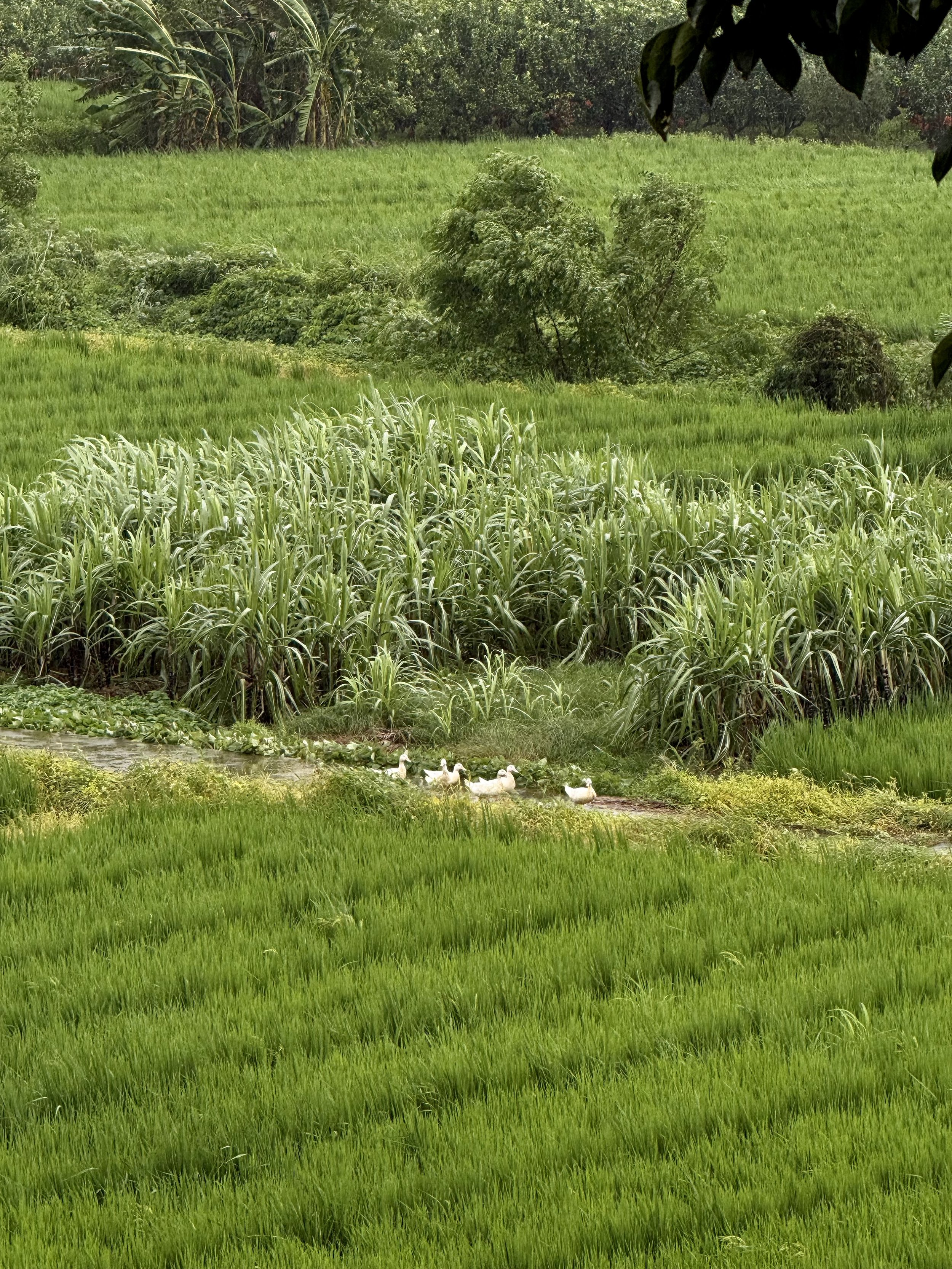
Watching the ducks cross the fields of Anle Village, in a landscape that felt unexpectedly familiar.
Pomelos hung from trees around the village, sometimes beside homes and sometimes almost filling the view. Meizhou is closely associated with its golden pomelo, but in Anle it did not feel like a regional emblem. It was simply part of the domestic landscape: heavy fruit above paths, roofs and walls.
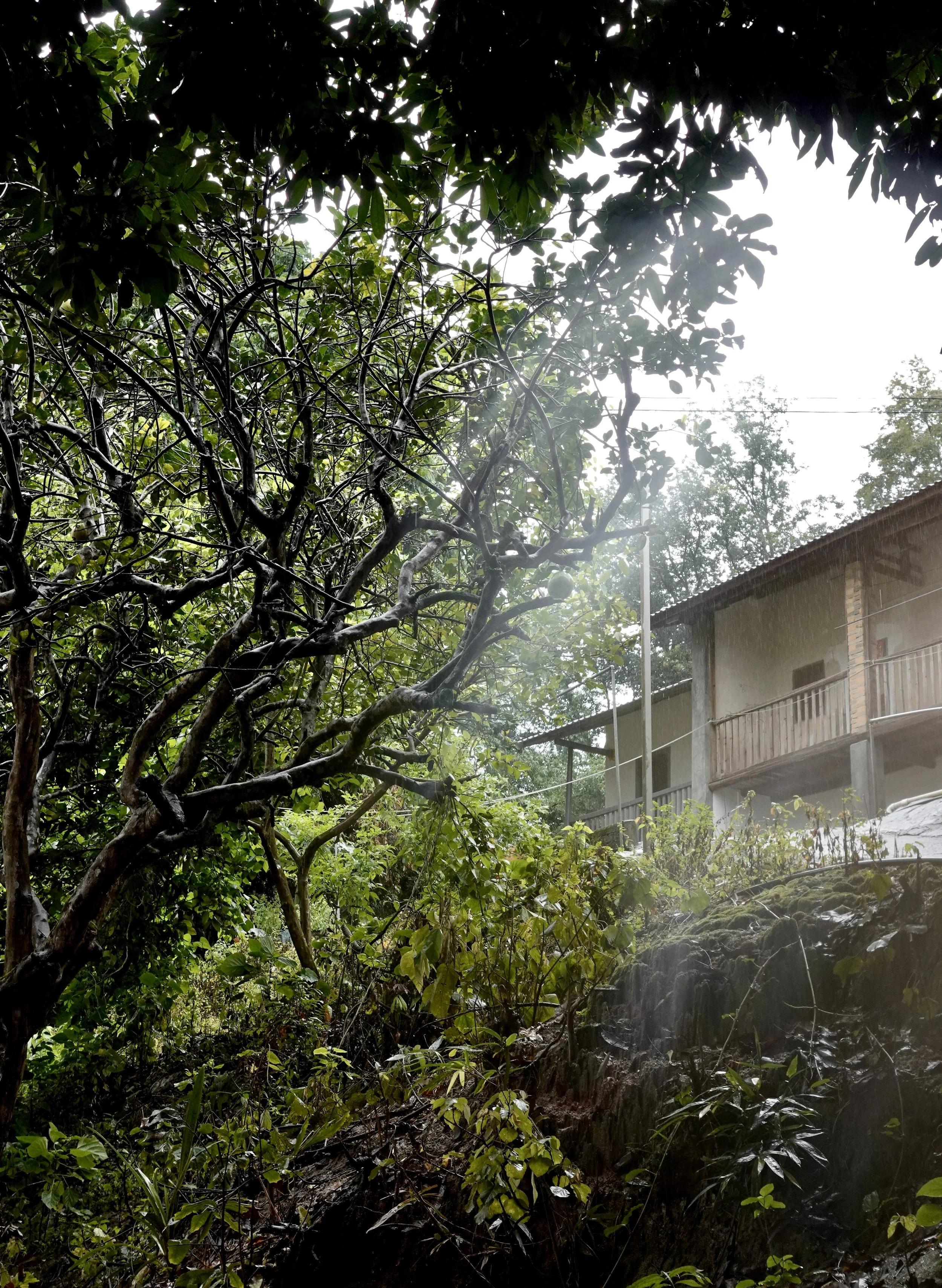
Pomelos appeared throughout Anle Village, growing beside homes and along the paths.
To be called one of their own
I was told that ten Wong households had once lived around my grandfather’s village. Many of the residents came from branches of the same extended family and shared the same surname. This kind of settlement, organised so visibly through kinship, is difficult to encounter in the cities where I had spent most of my life.
Some relatives were entirely new to me. Others I recognised from visits they had made to Malaysia years before. We spoke in a mixture of Hakka and Mandarin, moving between whichever words came most readily. Any linguistic gaps mattered less than the way I was received. Relatives held my hand tightly and treated me as 自己人—literally, one of our own.
The nearest English translation conveys the category but not the feeling. 自己人 removes the distance normally present between people who have just met. It says that the relationship existed before the introduction, and that no long explanation is required before a place is made for you at the table.
The closeness between generations, and the instinct to express care by feeding people, felt familiar from my life in Italy. In both places, the table is often where a family makes its welcome visible. Yet 自己人 carried a certainty of its own: I had not simply been invited in; I was understood to belong.
We returned to Anle to pay respects to our ancestors. Cooked chickens and other offerings were arranged alongside paper money and representations of material goods. Practices differ among Chinese families and communities, but the principle is familiar: food is presented, incense is offered, and paper objects are burned for the deceased. The fire is understood to transform what is offered so that its value can reach the ancestors. It is also a continuation of kinship—a way for the living to keep caring for those who are gone.
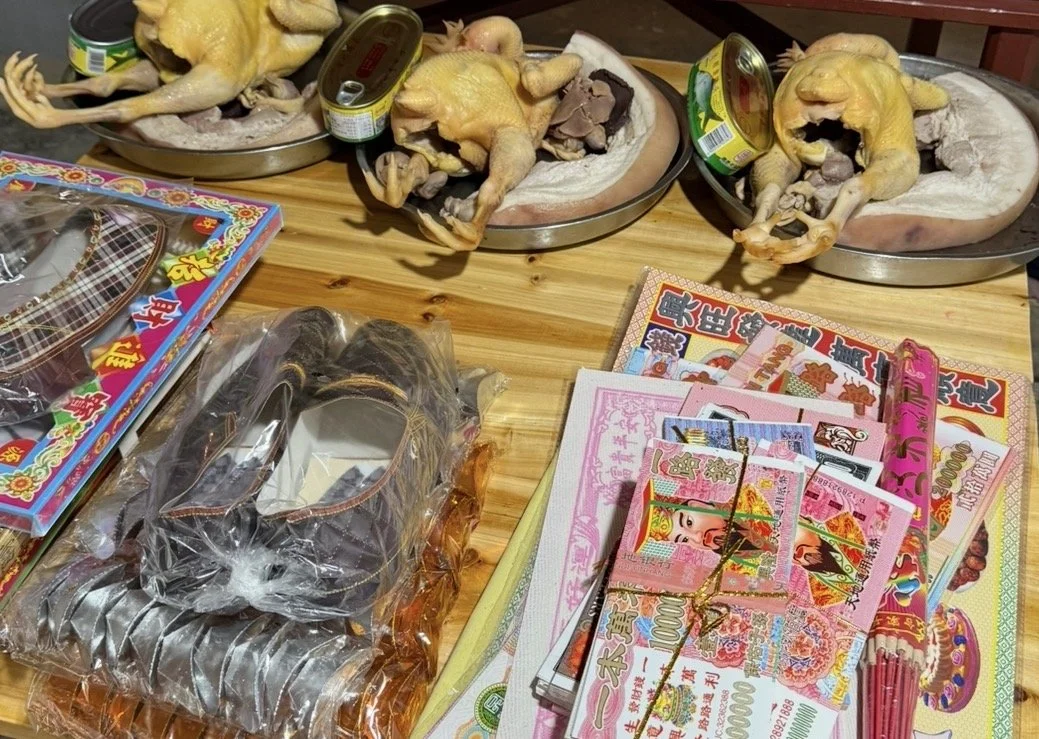
Food and paper offerings prepared for our ancestors. Burning them is understood as continuing to provide for those who have died.
I thought about the provisions my grandparents had once sent in the opposite direction. When they had little in Malaya, they sent lard, clothes and money back to the living relatives who remained in China. Decades later, in the village they had left, we placed food and burned paper offerings for them. Across time and between worlds, care in this family often took material form.
At my father’s age
My grandmother’s beginnings were in Chayang town rather than in the fields of Anle. Its old streets compressed houses, shopfronts and covered passages into a denser fabric. The rain sharpened the darkness of the timber and plaster, and people moved beneath umbrellas between buildings that had outlasted several versions of the town.
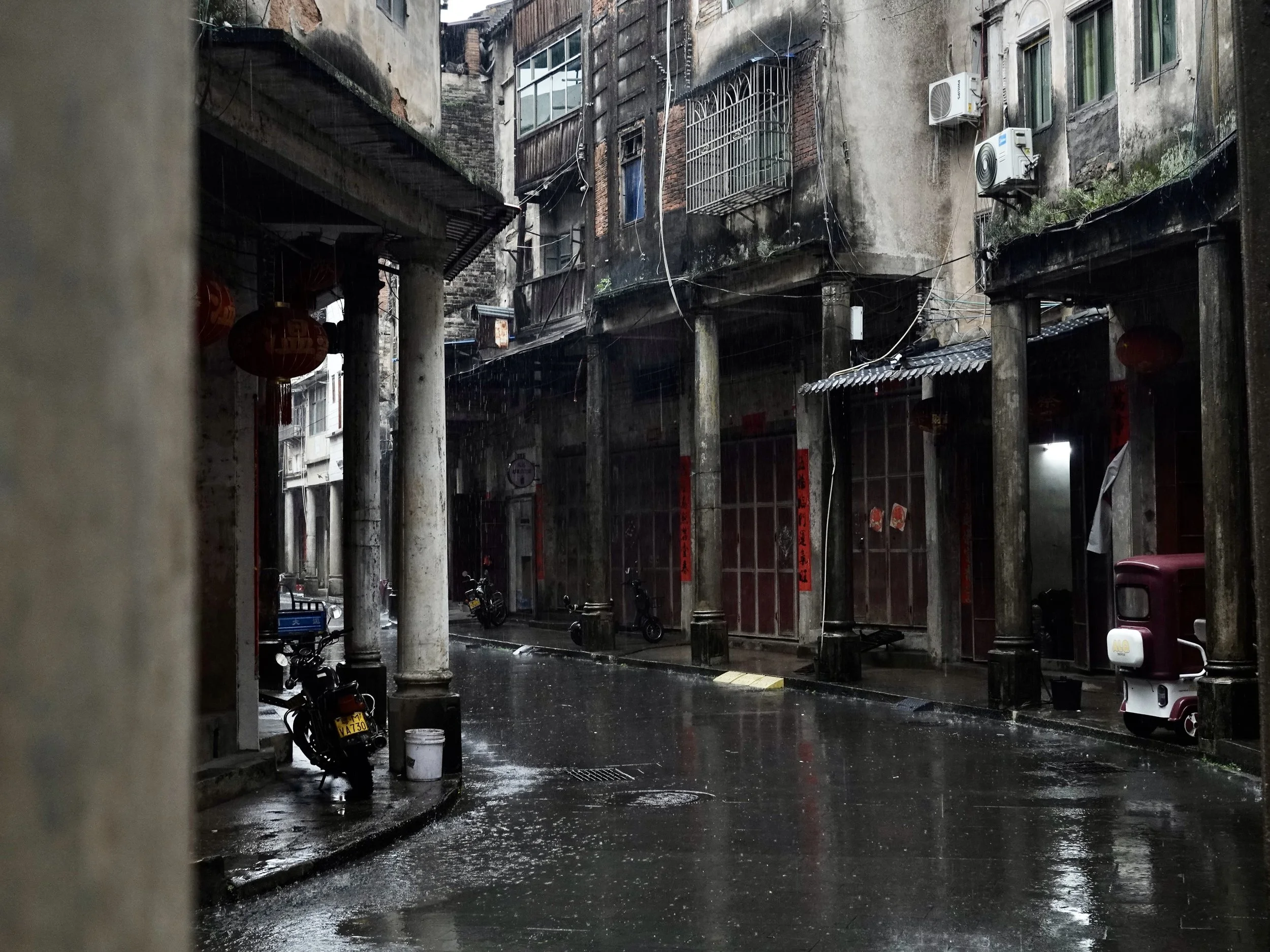
Chayang, the town where my paternal grandmother grew up before leaving for Malaya.
We found the house where she had lived before marrying my grandfather. This building remained standing, unlike his home in Anle. I looked up at its balconies and windows knowing that she had once entered and left this building as part of an ordinary day, long before the house became evidence for a grandson returning from abroad.
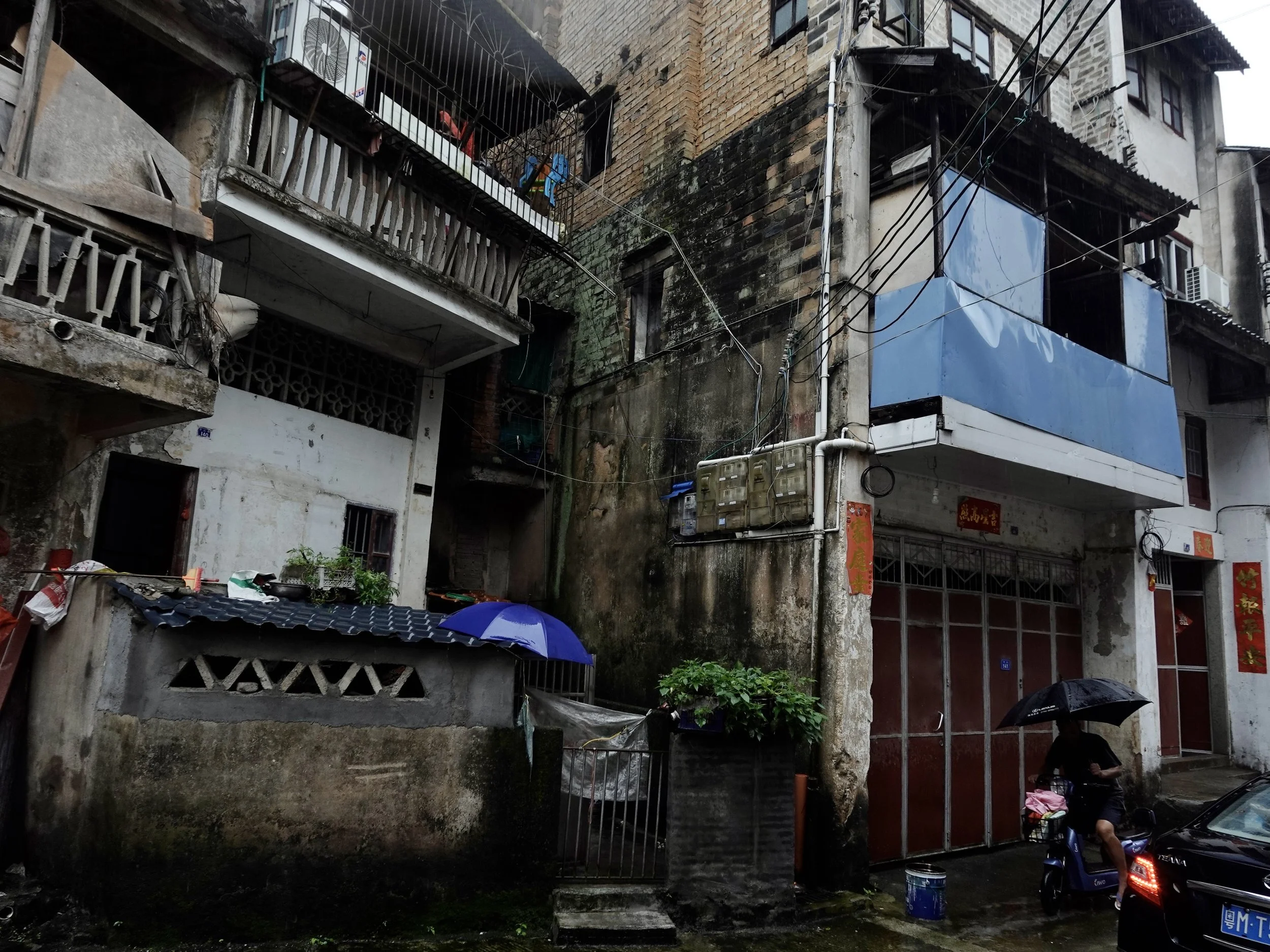
My grandmother’s home in Chayang before she married my grandfather and followed him to Malaya.
My father first came to meet these relatives in the 1990s, when he was in his thirties. I am now in my thirties, making the journey for the first time with him. The symmetry felt important. He had once travelled here carrying stories from his parents; I arrived carrying stories from him.
We encountered different versions of China. His first visit came before the high-speed train that had delivered me to Meizhou in comfort, and before a phone could collapse the distance between relatives. Yet the purpose of our journeys was remarkably similar: to turn family knowledge into personal acquaintance, and to keep a relationship from becoming only a collection of names.
A family record still being written
I was told that I belong to the eighteenth generation of the Wong family recorded through our lineage. A 族谱 is often translated as a genealogy or clan register, but the term carries more than a family tree drawn for private interest. It positions one life within a sequence of generations and family branches.
Ours is not a complete volume waiting safely on a shelf. The ancestral hall no longer stands, and the original genealogy has not been located. One family member is now rebuilding it by speaking with relatives and assembling the information they still hold. The record is being reconstructed through memory before it can return to paper.
Once written, a genealogy can make a family line appear certain and uninterrupted. Watching one being rebuilt reveals the fragile labour underneath that certainty: someone must remember a name, know which branch it belongs to, compare one account with another and decide what can still be established. The cousin who remembered my name from my grandmother’s letters was participating in the same work, even without a book in front of her.
Another relative described a past that no formal register could contain. I will call him Cousin Ming; his name has been changed to protect his privacy. His family lived communally in a tulou until the 1980s. He remembered a settlement of around one hundred people near the old house, large families sharing very little space, and infrastructure that was rudimentary or absent. To attend school, he walked for three hours. As a child, he went into the forest looking for food.
The beauty of the mountains made those memories harder, not easier, to absorb. A green landscape can invite admiration from a visitor while concealing how difficult it once was to live within it. Cousin Ming’s account stopped me from turning old houses into romantic objects. Their walls had contained crowding, hunger, work and the urgent desire to leave.
He showed us a small hut he had built by hand. Its scale and directness required no grand interpretation. It belonged to a life in which making and repairing remained ordinary knowledge.
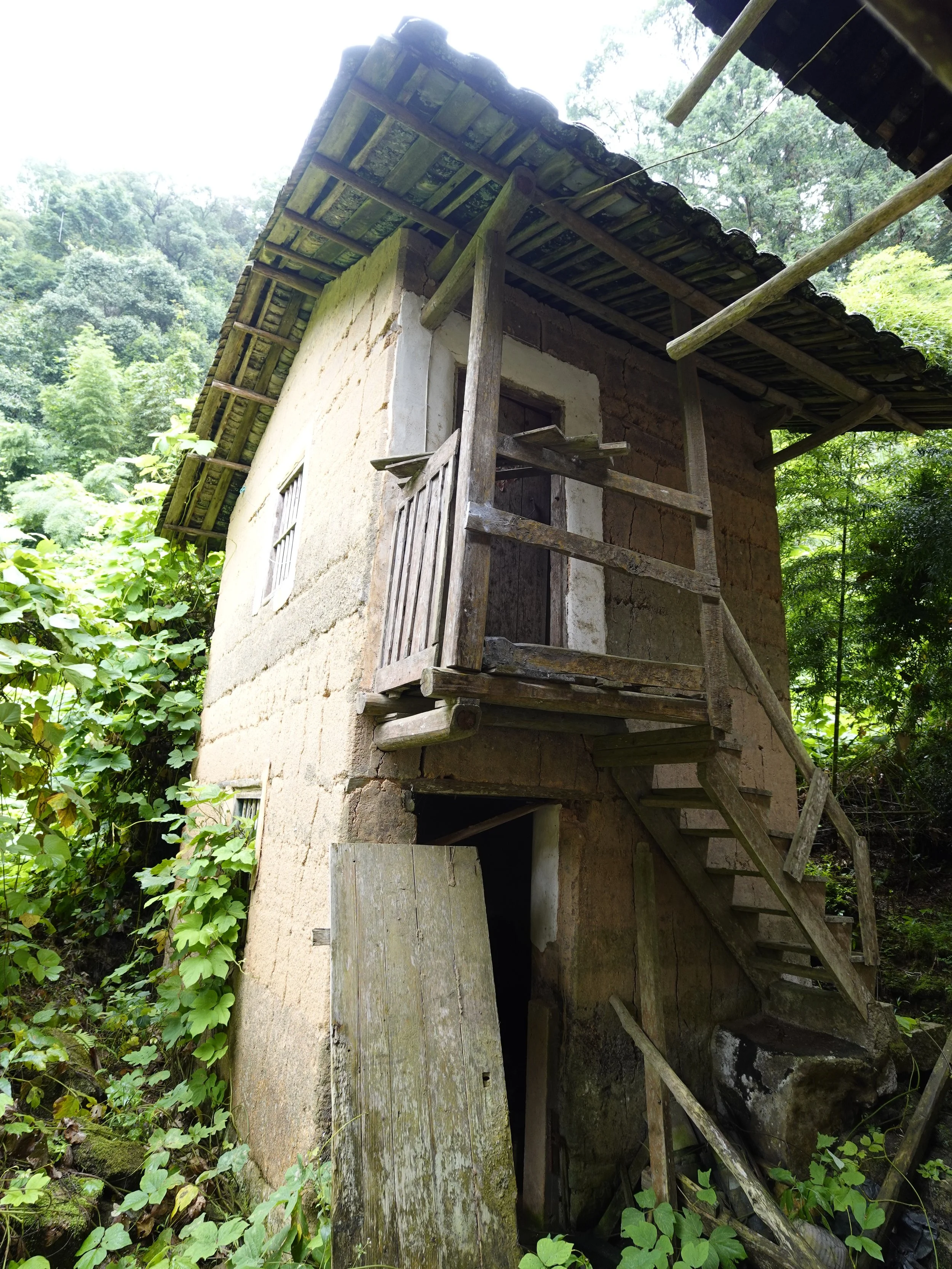
A small hut built by hand by ‘Cousin Ming’, whose name has been changed for privacy.
The previous day’s severe rain had also loosened the mountain road. At one point, a landslide made it impossible for the car to continue. I found myself helping Cousin Ming work out how to navigate away from it. Again, the confidence came from a life I had acquired elsewhere: years in the Umbrian countryside, learning that rural routes answer to weather rather than schedules.
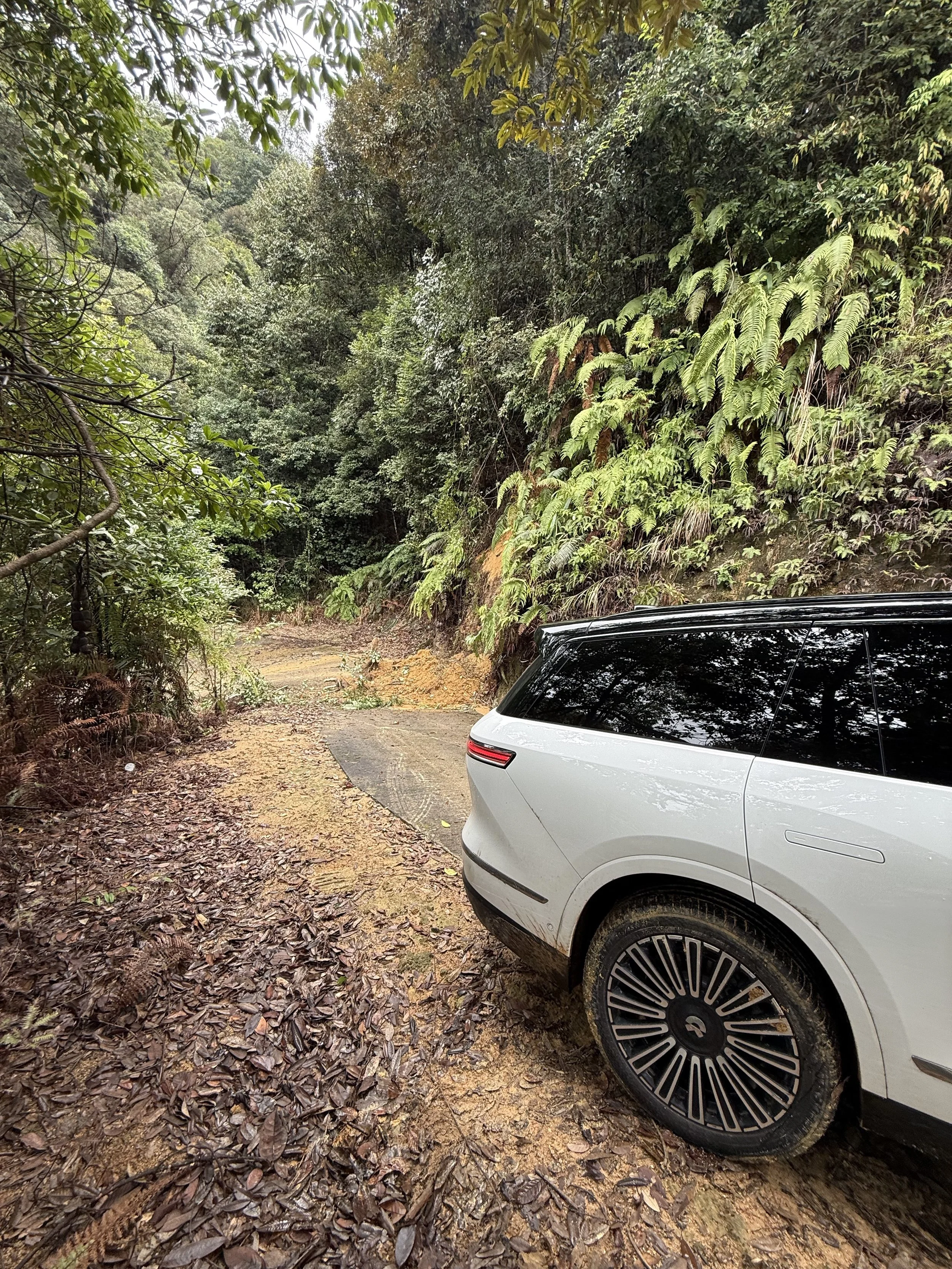
Severe rain had brought earth across the mountain road, preventing us from driving farther.
The road back to my Hakka beginnings had, unexpectedly, passed through Umbria. It was there that I had learnt to feel at ease with remoteness, silence, weather and the need to improvise. That did not make the two landscapes equivalent. It gave me a physical vocabulary through which one countryside could recognise another.
What a genealogy cannot record
Meals with relatives arrived in generous succession, often with ten or fifteen dishes placed across the table. The full range of Hakka food deserves a story of its own. In this account, one dish matters for a different reason: 酿豆腐, tofu filled with minced pork.
The dish took me not to my paternal Hakka grandparents, but to my maternal grandmother in Malacca, Malaysia. She was not Hakka. She had grown up in a village among Hakka neighbours, learnt to prepare their dishes and cooked 酿豆腐 whenever I visited her.
Her name would not belong to the paternal Wong genealogy through which I am counted as the eighteenth generation. Yet she was one of the people through whom Hakka culture reached me most intimately. A family register can trace descent. It cannot record every route by which a taste is taught between neighbours, carried into another household and eventually understood by a child as love.
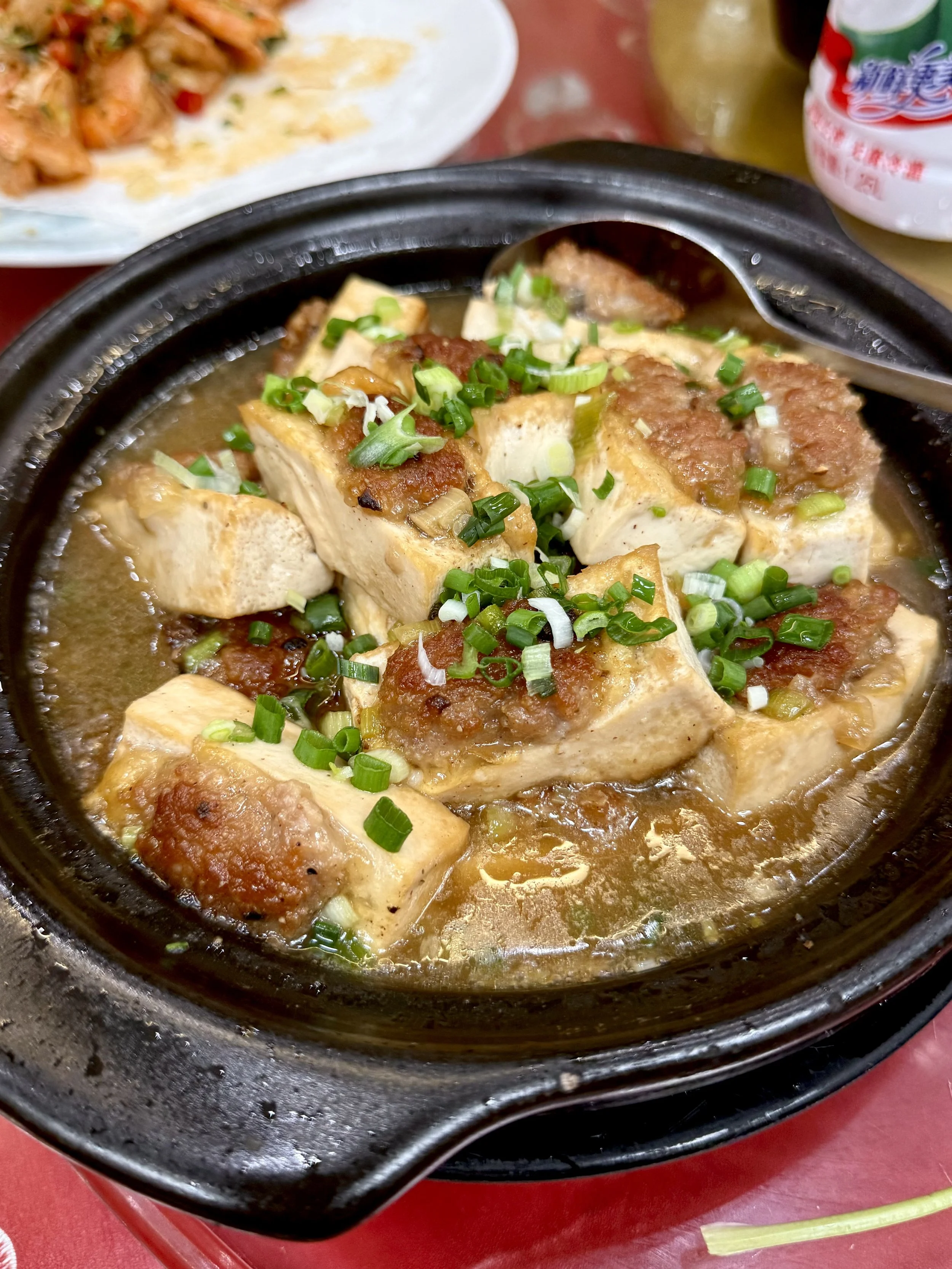
酿豆腐 reminded me of my maternal grandmother in Malacca, who learnt Hakka cooking from neighbours and made this dish whenever I visited.
The place they left from
In Songkou (松口), I learnt that my grandparents’ journey to Malaya had begun at Huochuan Pier (火船码头). Until then, I had been visiting the places where they had lived. Here was the place from which they had left.
The river was brown after the heavy rain, its water covering the lower part of the landing. Beyond it stood wooded hills. Travellers leaving this inland pier would make their way downstream towards Shantou (汕头) before continuing overseas. The water in front of me was only the beginning.
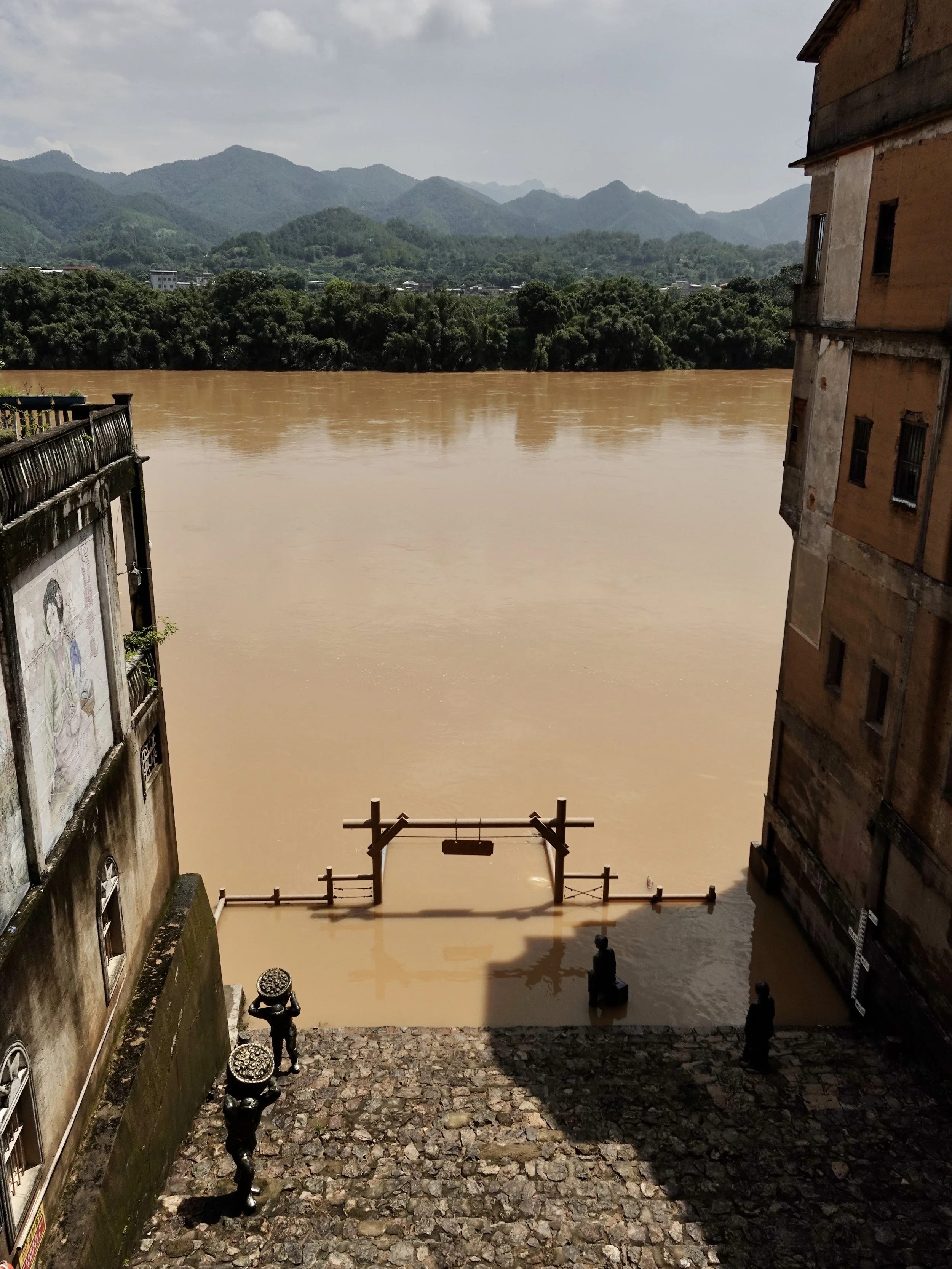
Huochuan Pier in Songkou, where my grandparents began their journey towards Malaya. The lower landing was submerged when I visited.
My grandmother had told my father something about her passage to Malaya: she sat on the floor of the ship. That detail stayed with me. I tried to picture her making the journey with so little comfort, leaving the life she knew for one she could not yet imagine.
There was another part of her account that was much harder to absorb. My grandmother told my father that she had witnessed people falling ill and dying on board. Their bodies were then thrown into the sea. I kept thinking about her sitting on the floor of that ship, witnessing this while still so far from the life she was travelling towards.
At Songkou, I looked at the pier for a long time. I had tears in my eyes. I felt heavy, and for a moment I felt I could not breathe.
I knew my grandmother had reached Malaya. I knew the family life that followed. Yet standing there, I struggled to comprehend what she had endured to get there. I wished I could ask her more. Now I had the place in front of me, and the questions, but she was no longer here to answer them.
Beside the landing, a sculpture shows a man with his luggage, preparing to leave. Behind him, a woman and child stand together to see him off. My attention kept returning to the two who would stay.
Who had stood here with my grandparents at their own departures? Had they spoken about when they would return? How many families had said goodbye at this pier without knowing whether they would see one another again?
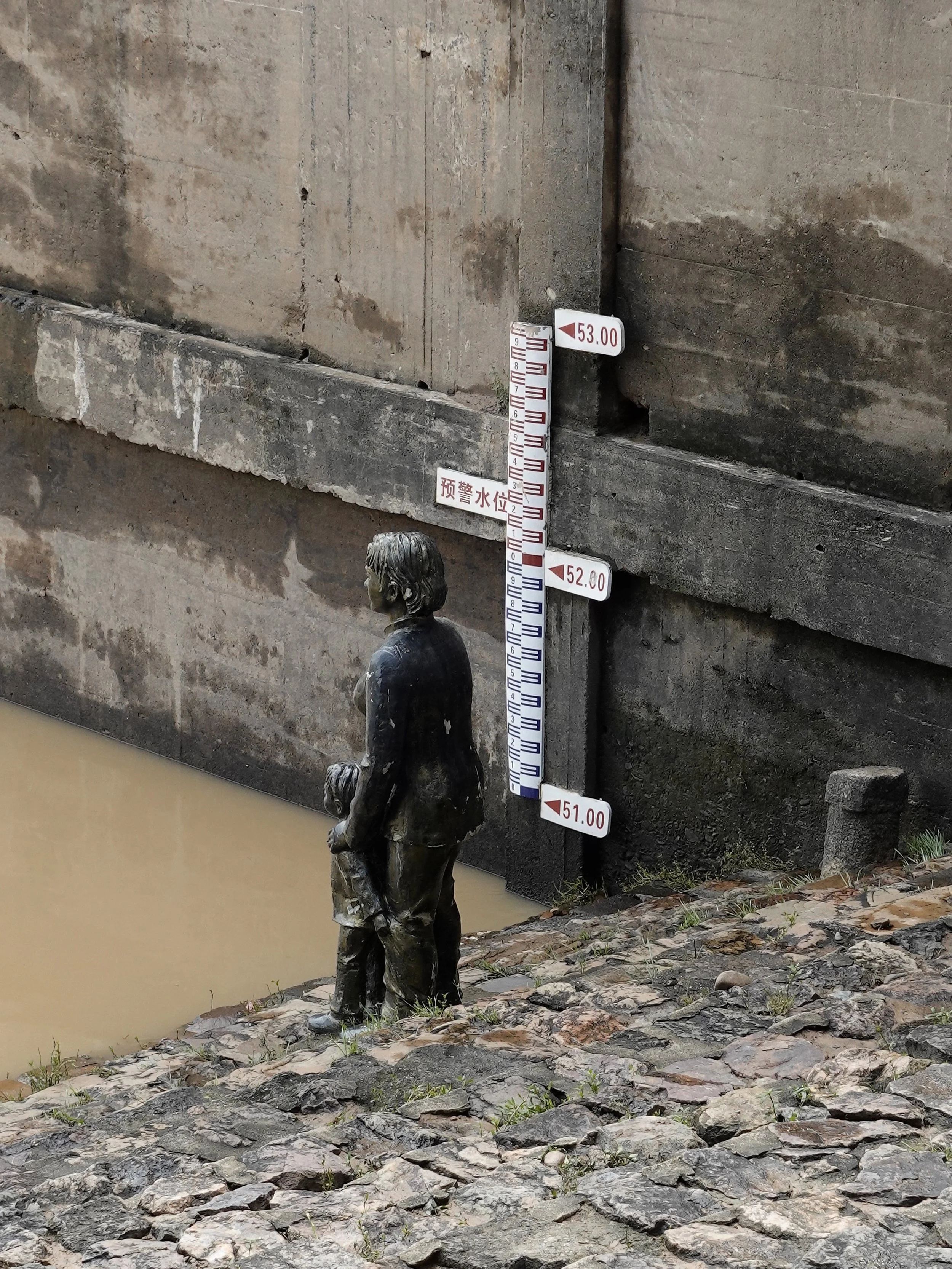
The woman and child in the departure sculpture at Huochuan Pier. I kept thinking about the people who stayed behind.
Above the pier stands Songjiang Hotel (松江大酒店), built in 1932. Its arched balconies still bear the English name HOTEL TSUNGKIANG. Travellers heading overseas once lodged here before continuing their journeys; returning migrants also passed through its doors.
I went inside. I wondered whether my grandparents had entered this building, whether they had been able to afford a room, or where they had waited before departure. I do not know.
Walking through the hotel, I kept thinking about my grandmother sitting on the ship’s floor. A room here would have offered a little comfort before the journey. But I could not place her in one simply because I wanted to imagine her resting.
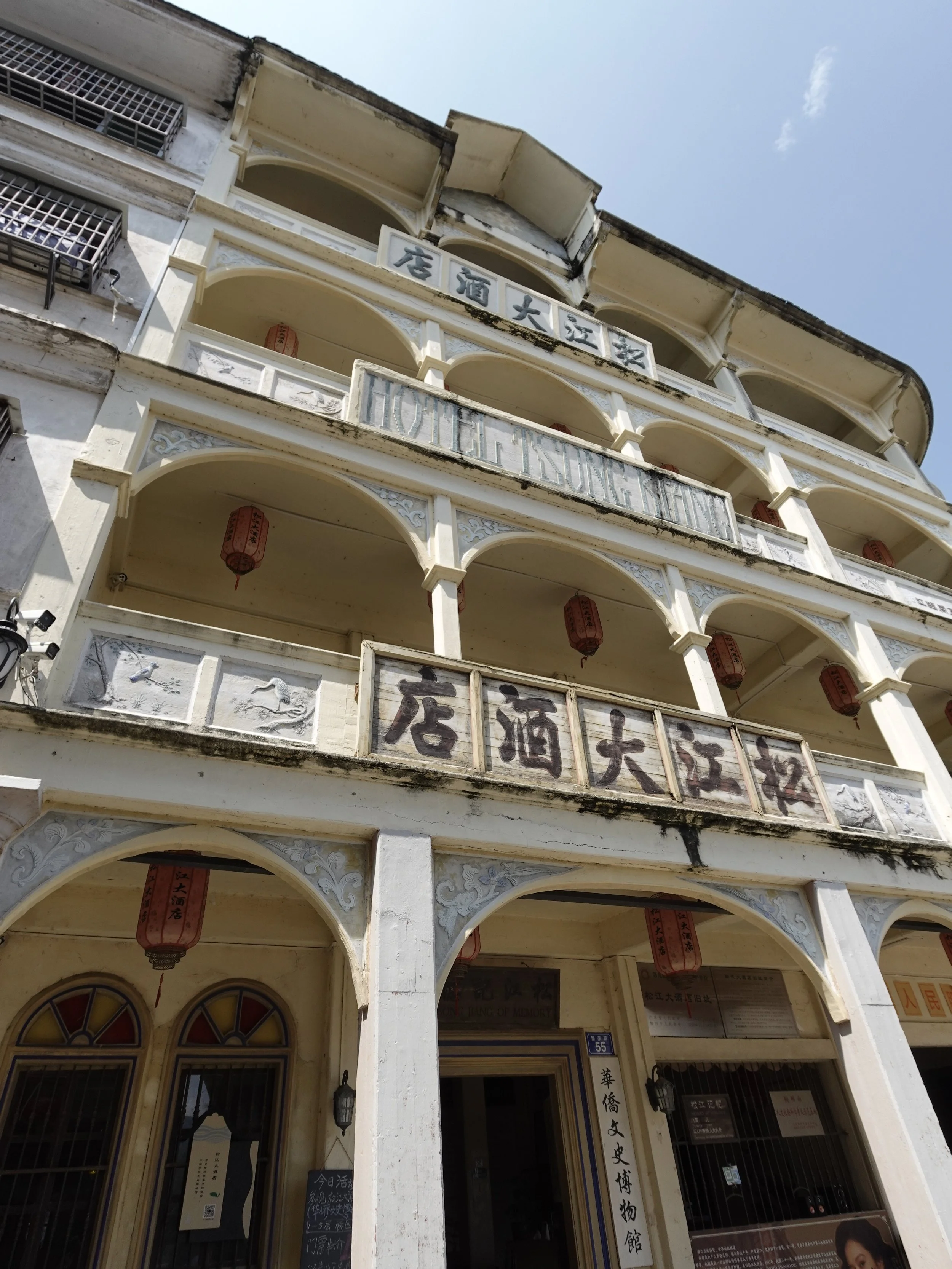
Songjiang Hotel, built in 1932, accommodated departing and returning overseas Chinese. Whether my grandparents stayed here is something I do not know.
Inside were displays of 侨批, qiaopi: correspondence and remittance documents through which overseas Chinese sent family news and financial support home. These records preserved the practical details of lives being lived apart, alongside the effort to remain close.
One envelope bore the words 家母, a respectful and affectionate address to a mother. Among the handwritten addresses and postal marks, those two characters held my attention. Before this became an exhibit, it had been something a person sent to their mother.
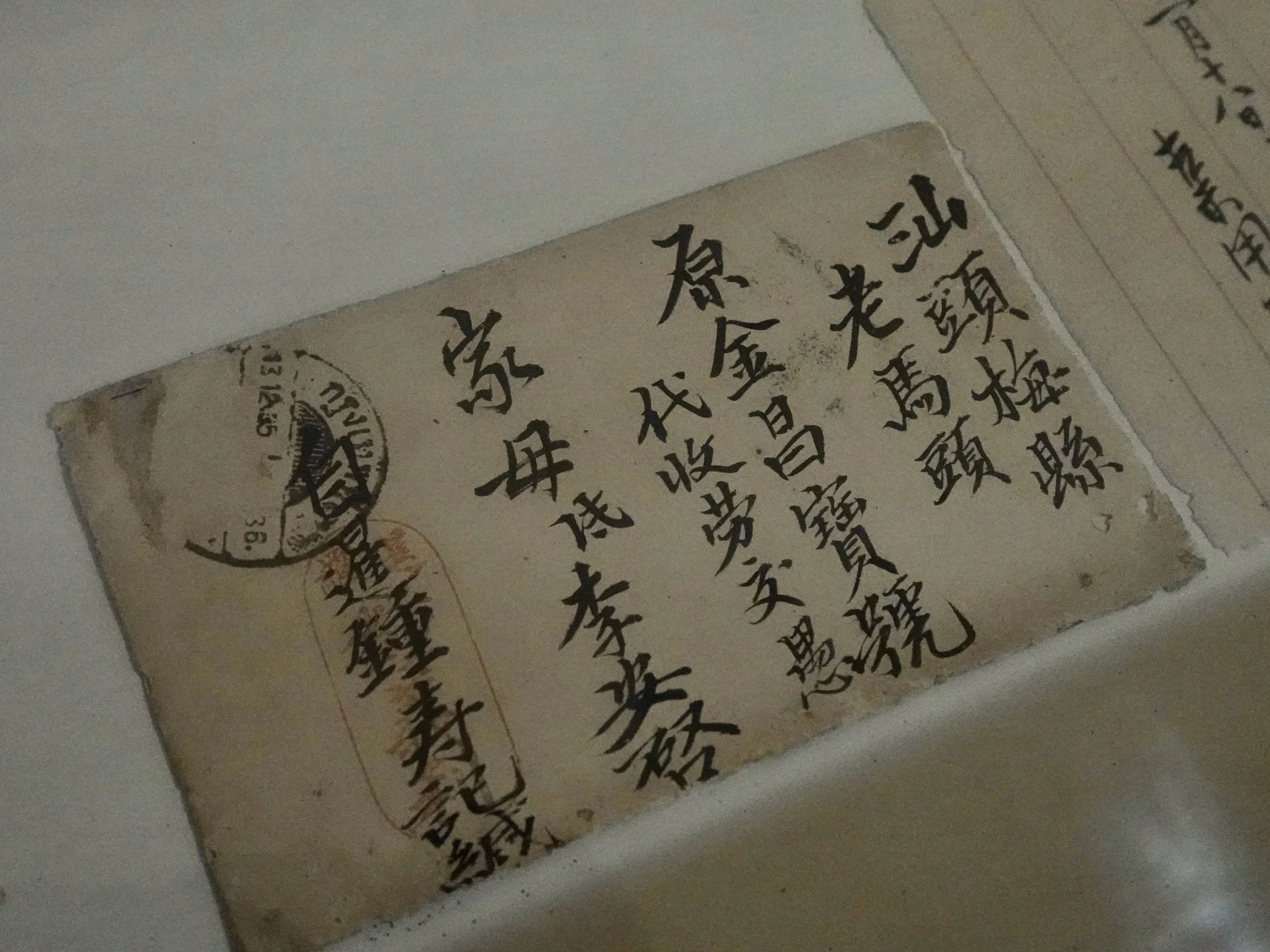
An envelope in the hotel’s qiaopi display, addressed to a mother. Letters and remittances helped families sustain their relationships across the distance.
I thought of the money and provisions my grandparents had sent to relatives in China, even when their own lives in Malaya were difficult. I thought, too, of the cousin who remembered my name from my grandmother’s letters. Her welcome in Anle Village belonged to a relationship that others had spent decades maintaining.
My grandfather’s 1953 hawker’s licence records his working life in Kuala Lumpur. My grandmother’s account preserves something of the passage that brought her to Malaya. Between these fragments lies so much I will never be able to recover.
I grew up knowing them as my grandparents. At Songkou, I found myself thinking about the young people they had been, and how much of their lives had already happened before mine began.
The source
Earlier in the trip, I had visited the China Hakka Museum in Meizhou. After Songkou, I kept returning in my mind to the well at its entrance. Its introductory text placed the region at the meeting point of Guangdong, Fujian and Jiangxi and described a history shaped by movement in two directions. Across centuries of warfare, people from northern China moved south and settled among existing communities that included She (畲族) and Yao people (瑶族), contributing to the formation of a core region of Hakka culture. From the Song (宋朝) and Ming periods (明朝) onward, people from Meizhou also left for Nanyang (南洋) and farther abroad, driven by the need to make a living or escape hardship.
The museum’s account was measured in dynasties, populations and migrations across the world. My family occupied only a minute part of that history: a man leaving Anle in the 1940s; his wife following from Chayang in the 1950s; parcels and letters moving between China and Malaya; my father returning in his thirties; and, decades later, his son doing the same.
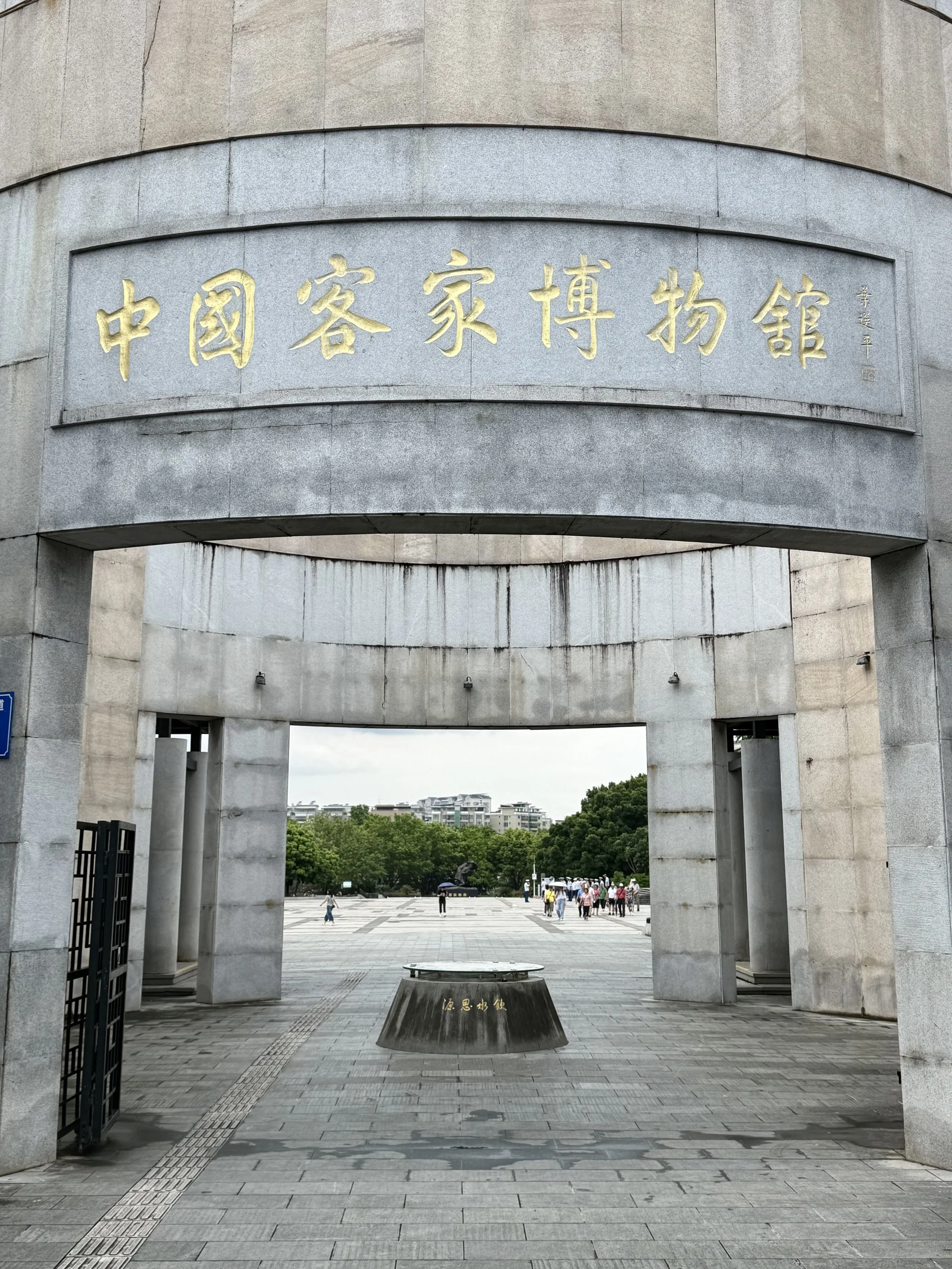
At the entrance to the China Hakka Museum, a well carries a phrase my parents had taught me since childhood.
At the museum entrance stood a stone well. Carved into it in gold were the four characters 饮水思源 (飲水思源 in traditional Chinese). Literally, they mean: when drinking water, remember its source.
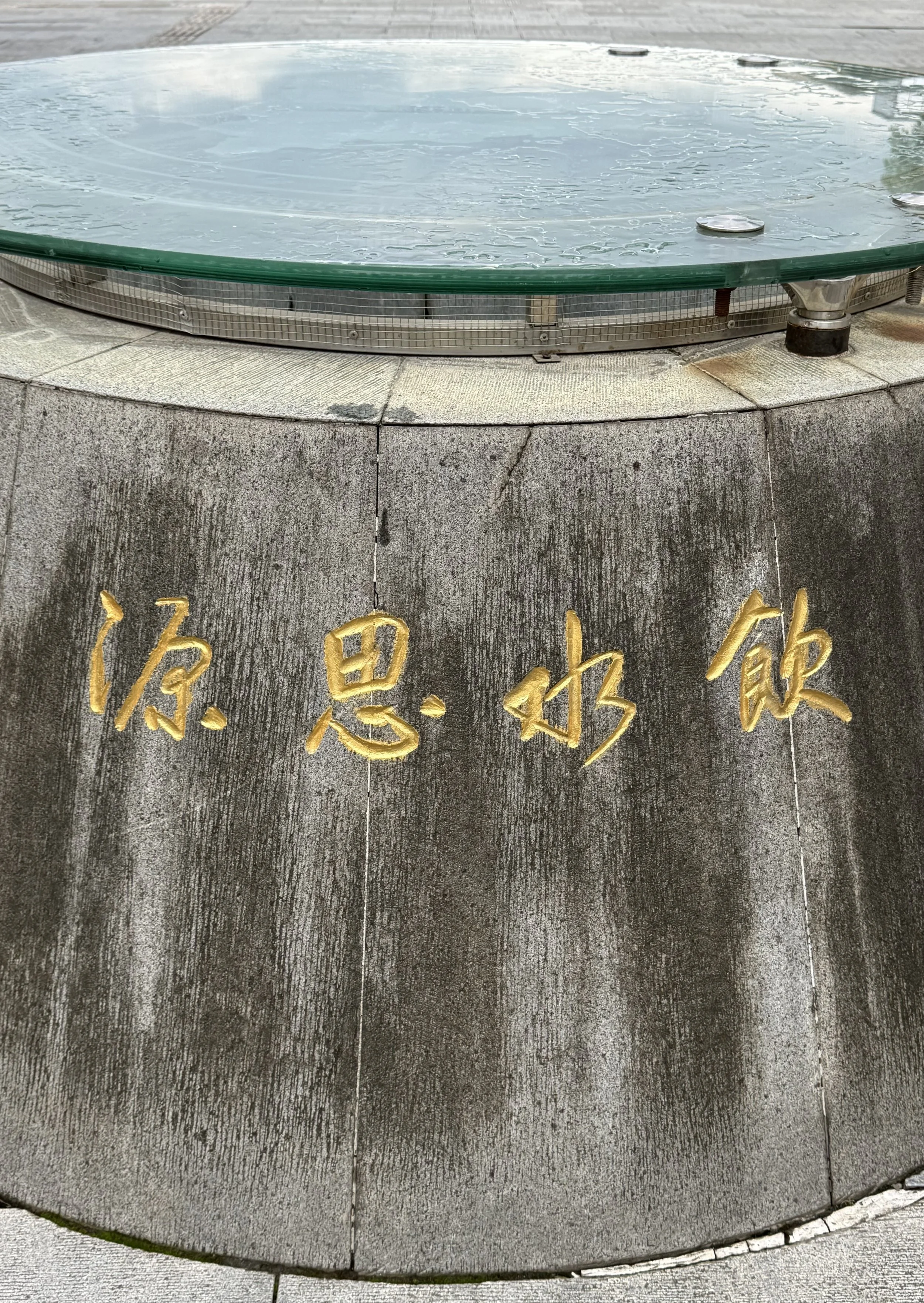
饮水思源: when drinking water, remember its source.
My parents had repeated this idea throughout my childhood: remember where we came from; do not forget our roots. For years I understood it as a moral instruction common to many Chinese families. Standing before the well after visiting Anle and Chayang, I began to understand that they had not taught it to me in the abstract. They had been describing a practice.
My grandparents kept sending what they could after leaving China. My father crossed the distance to meet the family in his thirties. My parents continued speaking about the relatives and the villages, making sure their existence did not recede into an inaccessible past. Then they brought me back at the same stage of my own life.
The source was not only a point on a map. It was a cousin remembering my name from an old letter. It was the roof that remained above a house that did not. It was a family member reconstructing the 族谱 one conversation at a time. It was the hands of relatives calling me 自己人, and a dish that had reached my childhood through a grandmother from the other side of my family. It was also the pier from which my grandparents had left, my grandmother’s memory of sitting on a ship’s floor, and the letters that kept the family connected afterwards.
I did not recover a complete account of my grandparents’ lives. Some questions arrived decades too late, and some records are gone. What I found was the structure that had allowed the connection to survive without completeness: people continuing to remember one another.
饮水思源. I had known the words since childhood. In Meizhou, they became a landscape, a set of hands and a responsibility I could finally feel.
Before you leave, you are invited to sign The Guestbook.
Further Reading: Home, Memory and Belonging
If this story has made you think about where home begins—and how certain places continue to shape us—you may also enjoy:
The Places We Carry — on food, family and finding home between Asia and Italy
My Third Summer in Umbria — on the smaller rituals through which an unfamiliar place gradually becomes home
The Places We Are Taught to Want — on how travel teaches us to see places before we have encountered them ourselves
Unless otherwise credited, all photography and written content are original works by Foodie Goes Travel.
