The Water Between Lunch and Thunder
On Ferragosto, a familiar trattoria, a first walk around Lago di Piediluco and the full force of Cascata delle Marmore revealed a part of Umbria where water is food, relief, spectacle and infrastructure.
Words and photograph by JJ Wong
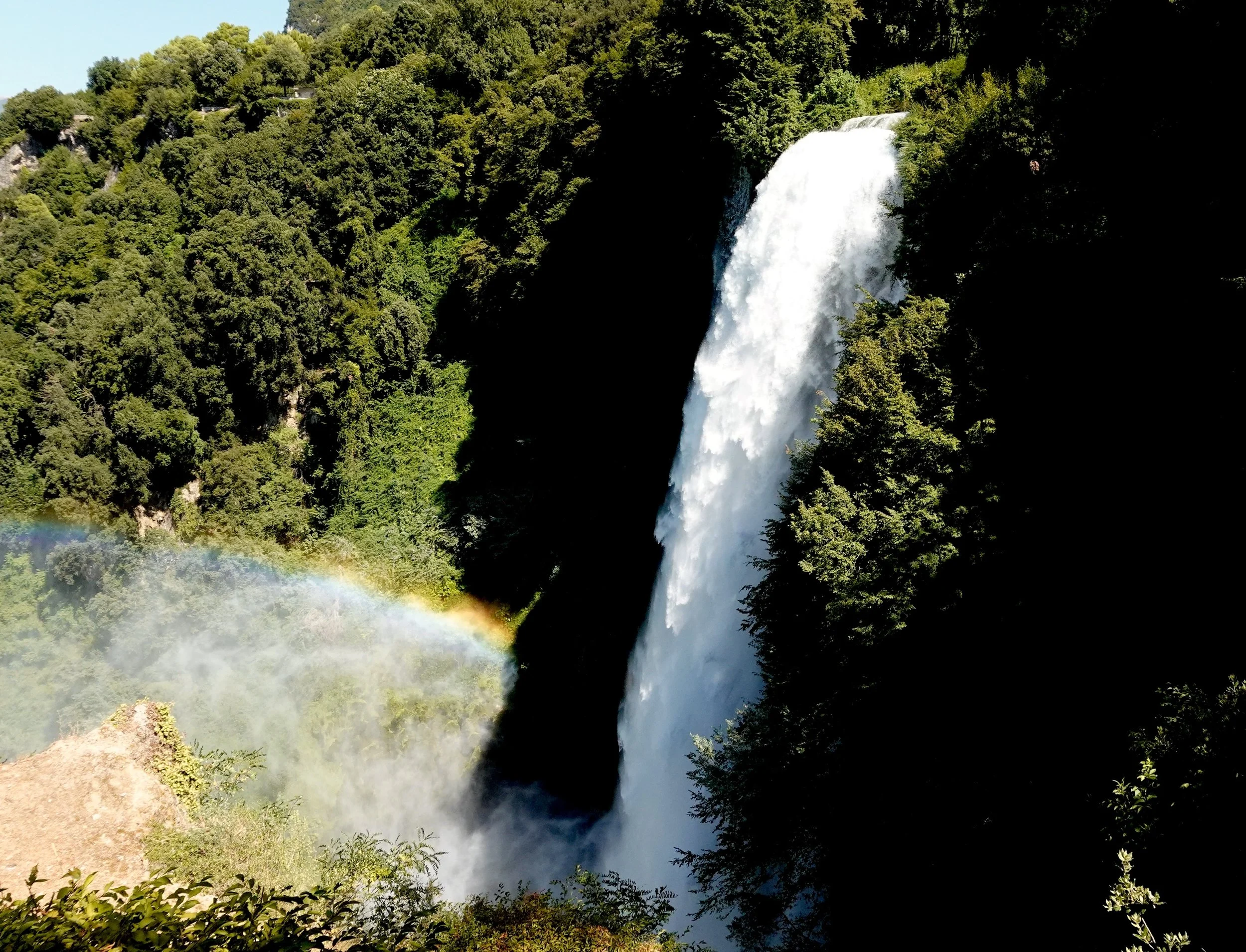
The upper drop of Cascata delle Marmore in full flow on Ferragosto afternoon.
Outside Trattoria Teresa, a blue road sign pointed left towards Terni and Cascata delle Marmore. The signs below it pointed right towards Rieti, Piediluco and the lake. The distances were modest—seven kilometres in one direction, three in the other—but the junction held the outline of our entire day.
At noon, it looked like ordinary roadside information. By evening, it seemed closer to a diagram: the lake on one side, the waterfall on the other, and a table between them.
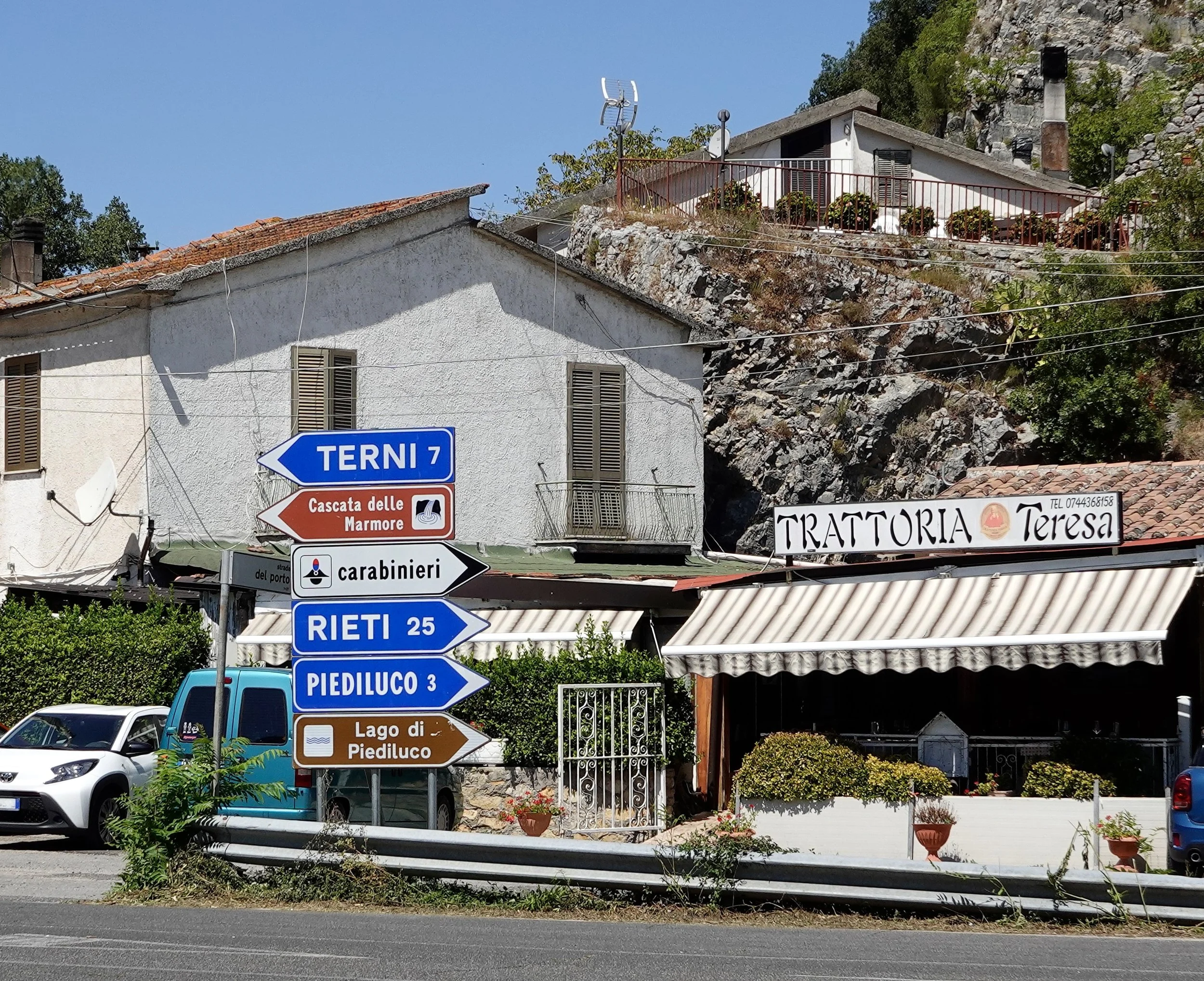
At the junction outside Trattoria Teresa, one road leads to Piediluco and the other to Marmore.
A table between two directions
The dining room was full. This was 15 August—Ferragosto—and an empty restaurant would have been the more surprising sight.
The word comes from the Roman feriae Augusti, the August rest period associated with Emperor Augustus. The popular holiday was once observed at the beginning of the month and later settled on 15 August, coinciding with the Catholic Feast of the Assumption. In present-day Italy, Ferragosto remains the symbolic centre of the summer pause: a public holiday of family meals, outings and departures for the coast, mountains, countryside and lakes. It is both a date and a collective change of pace. Offices close, roads fill, and lunch acquires the weight of an occasion.
In that packed room, the woman who now runs the trattoria carried dishes to our table herself and stopped to talk. We had eaten there before, and she received us with the same warmth we remembered. She was not Teresa. Teresa was her mother-in-law, whose name remains above the entrance and on the menu. The trattoria has passed to another generation without losing the personal hospitality attached to it.
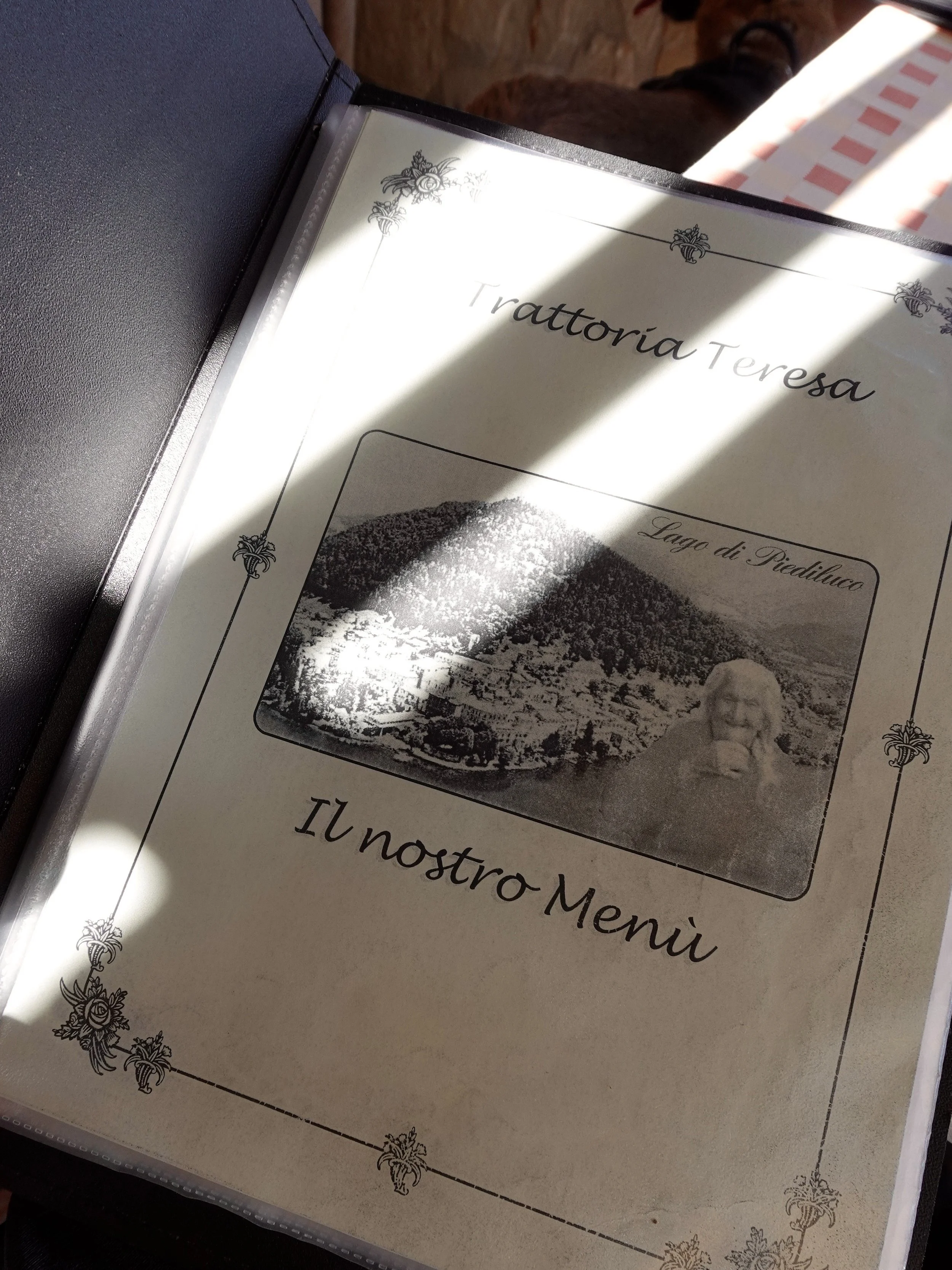
A name carried from one generation of the trattoria to the next.
At Teresa, the lake reached the table before I had properly walked beside it.
We began with anchovy bruschetta and a mixed platter of fish from the lake: several preparations arranged around a paper parcel, with a bright red freshwater crayfish dressed in green sauce at the edge. It was the kind of starter that makes the idea of ordering sensibly feel irrelevant.
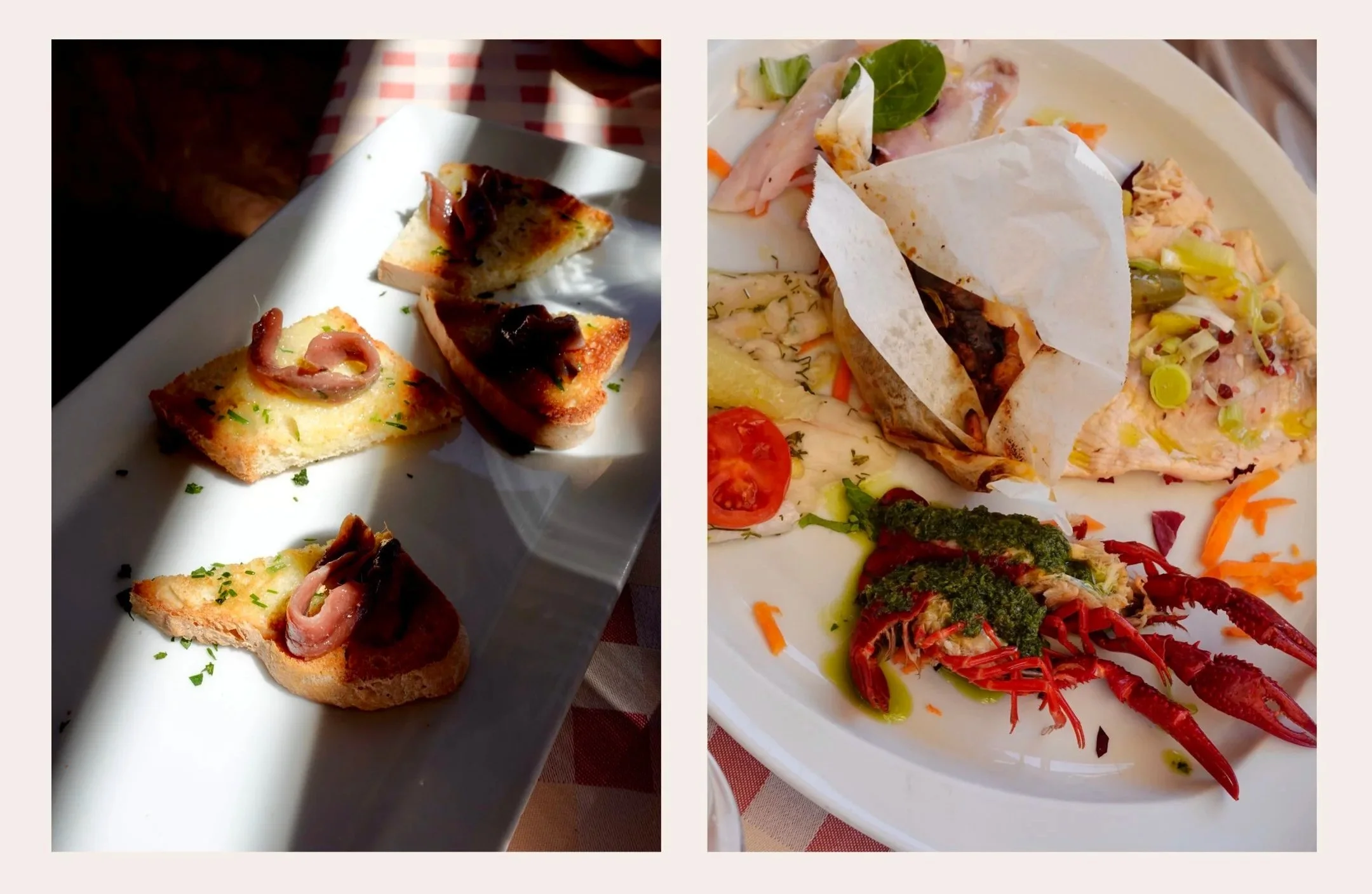
Anchovy bruschetta, followed by the mixed fish platter that changed the course of lunch.
The crayfish was so good that, after tasting the one on the platter, we ordered a full portion. This may be the most dependable form of restaurant praise: not an adjective, but an immediate repetition. The platter returned covered with red shells, the crayfish opened and spooned with a vivid herbal salsa verde. Their sweetness held its own against the bright, savoury sauce.
In English, gamberi di fiume is better rendered here as freshwater crayfish rather than prawns—the claws in the photographs settle the matter. Along with lake fish, they belong to the local table around Piediluco, where water is not only scenery but an ingredient.
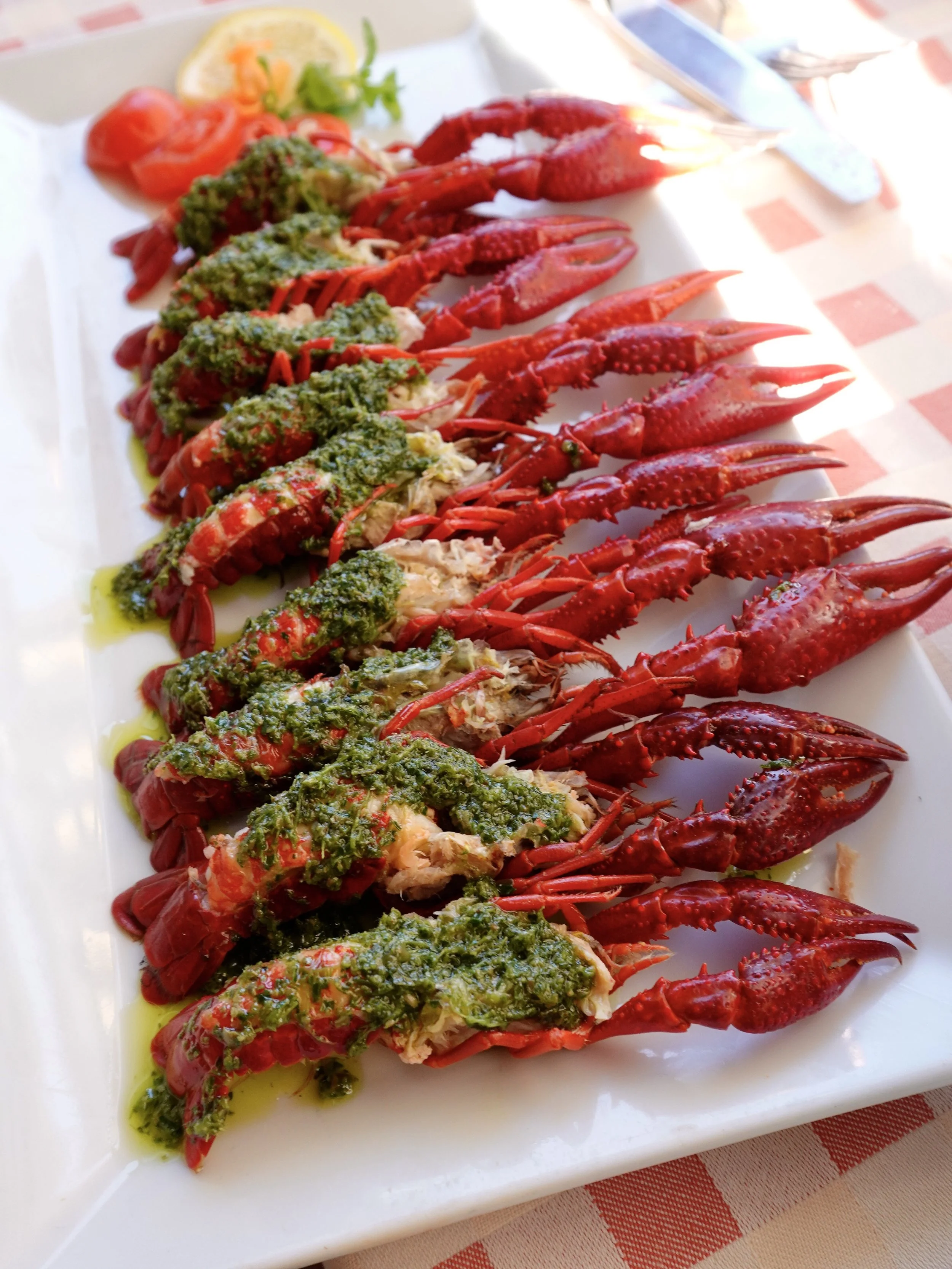
The full portion of freshwater crayfish we ordered after tasting the first one.
The pasta continued the same vocabulary. Paccheri al sugo di pesce persico e gamberi brought broad tubes of pasta together with perch and crayfish in an orange-red sauce. Tagliolini al profumo di lago was more delicate in colour, with a crayfish placed over the coils of fresh pasta. One dish named its ingredients plainly; the other translated the lake into aroma.
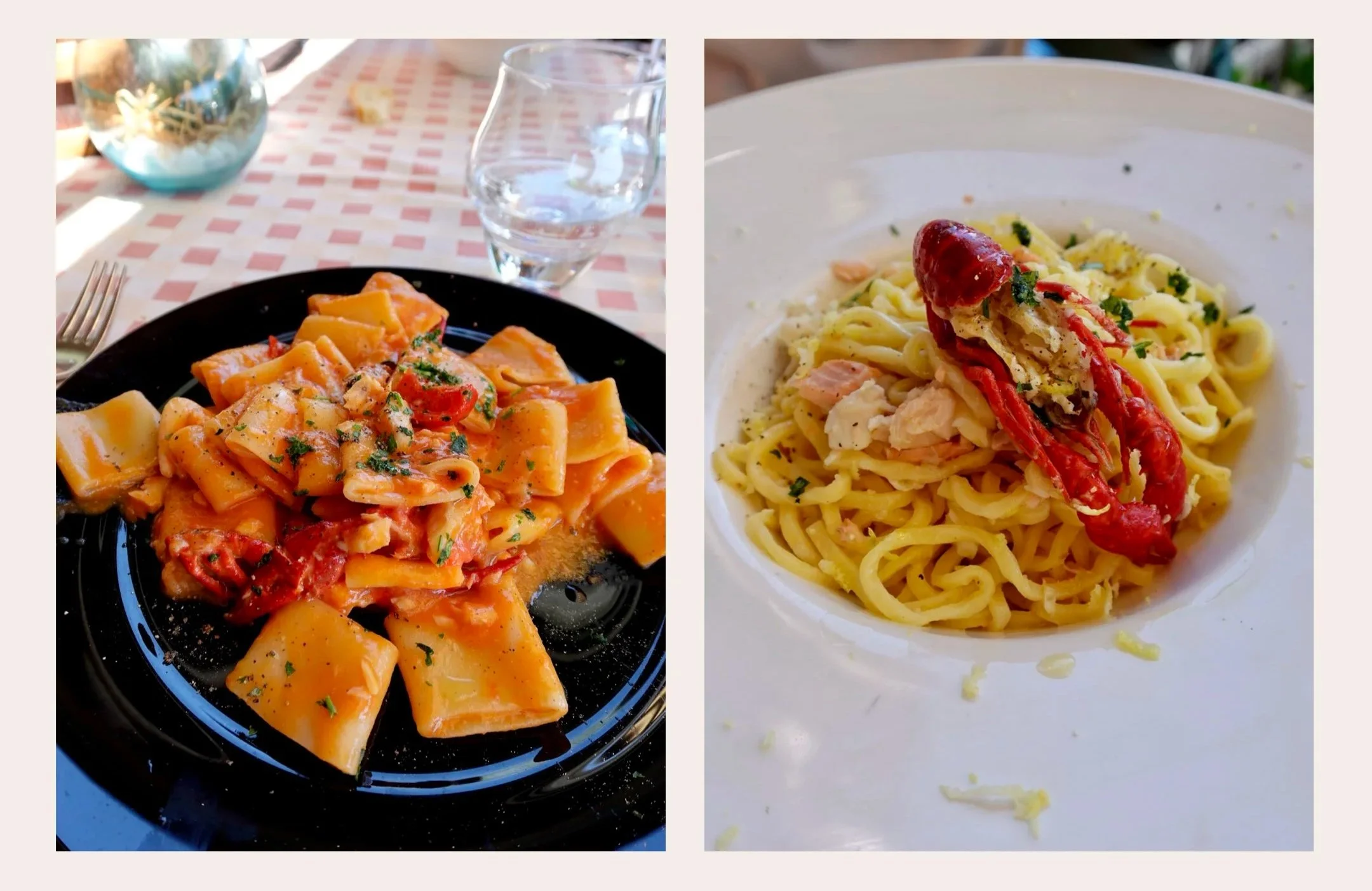
Paccheri with perch and crayfish; tagliolini “with the scent of the lake”.
Then came a homemade pistachio semifreddo under chocolate, chopped nuts and powdered sugar. It was one of the best I have eaten: cool but not numbingly frozen, rich without erasing the pistachio, and just firm enough to soften slowly in the August light.
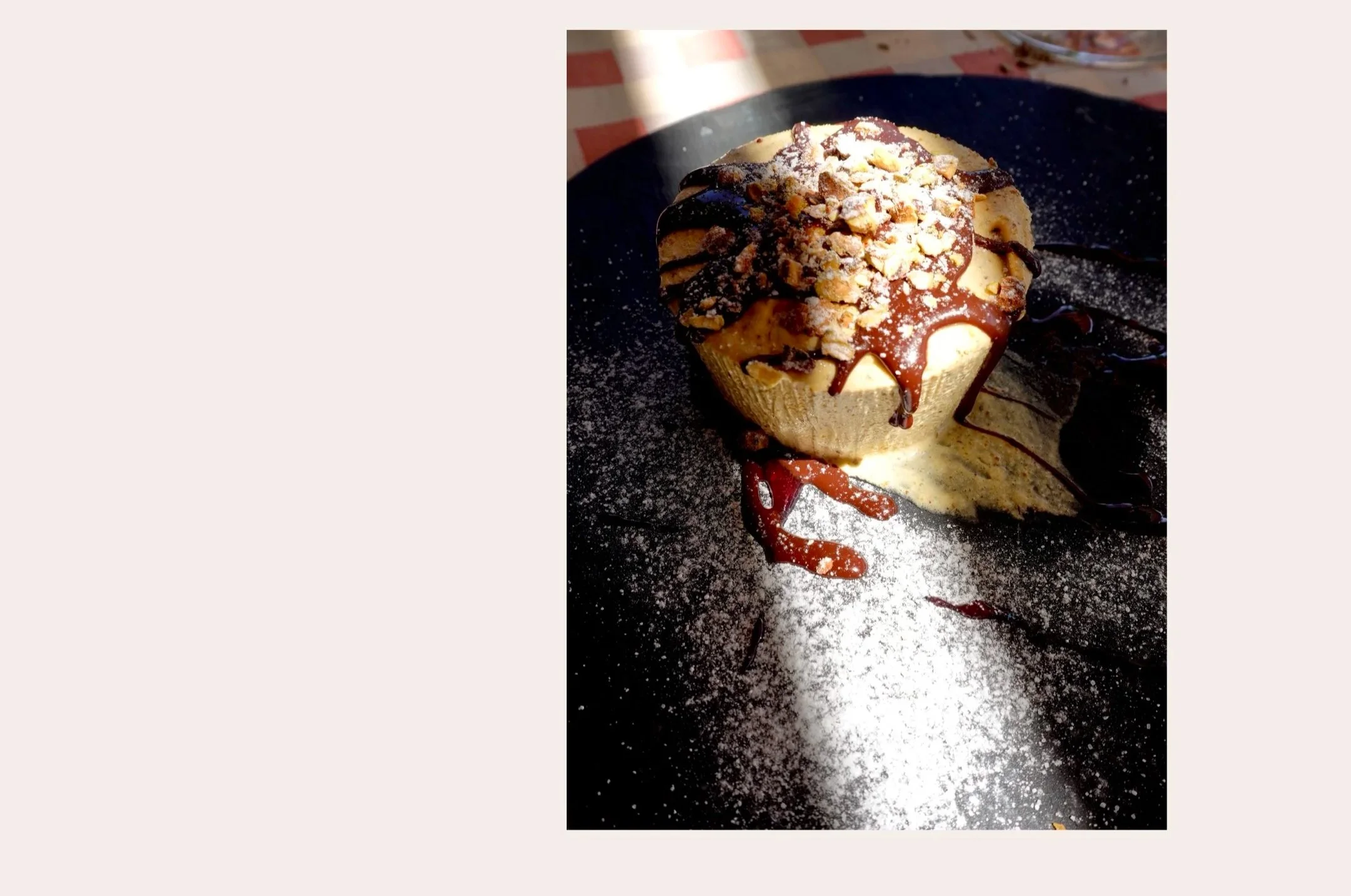
Homemade pistachio semifreddo—the last and most memorable course.
The lake after lunch
After lunch, the water lost its sauces and plates and regained its scale.
This was my first visit to Lago di Piediluco. From the walking trail, the village appeared between reeds and overhanging branches, its houses gathered at the foot of wooded mountains. A small sailboat moved across the surface. In other places, lily pads caught sudden patches of sunlight while the water beneath them stayed almost black.
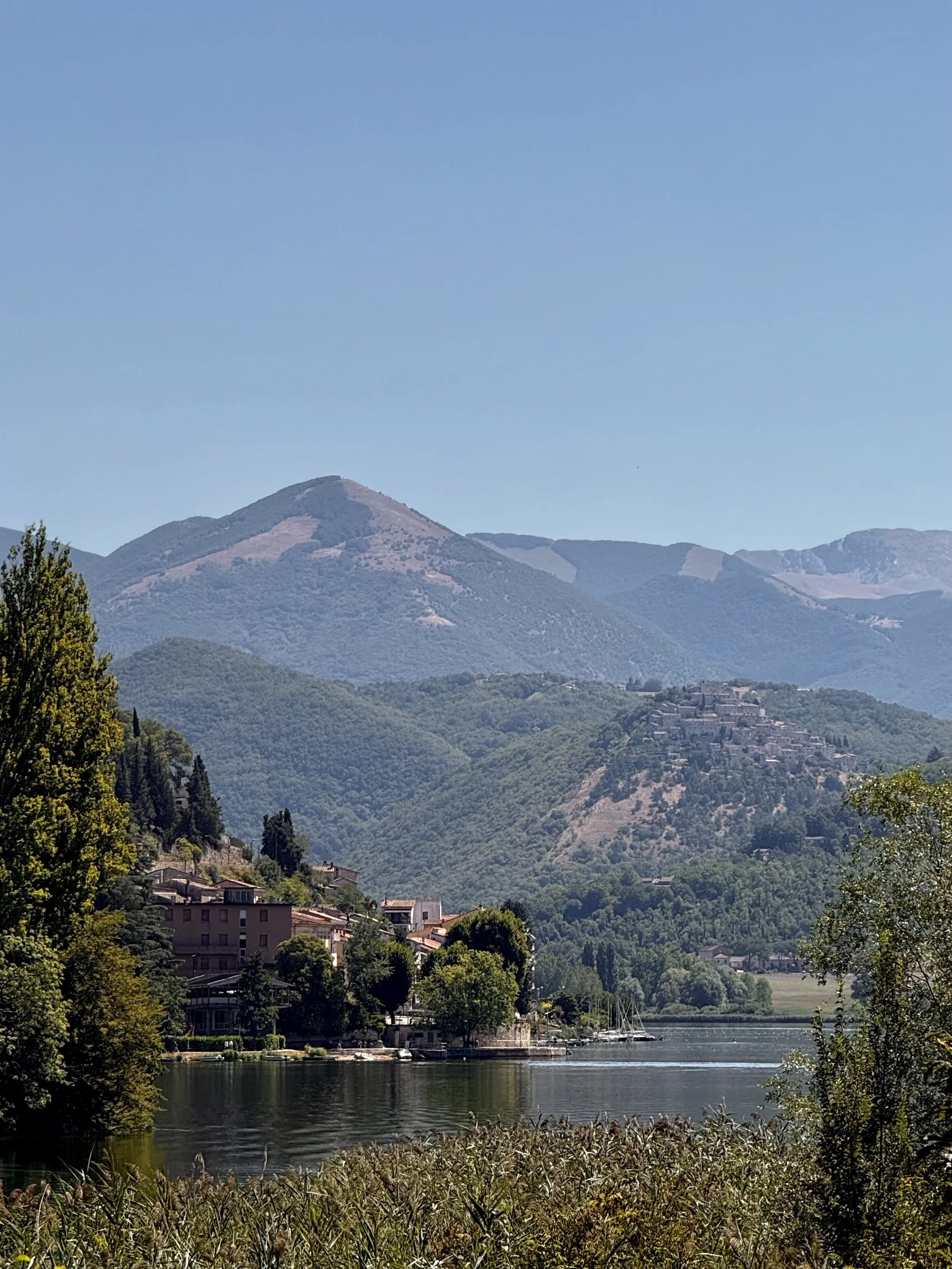
Piediluco gathered between reeds, water and the Apennine slopes.
The shoreline was not deserted, nor should it have been on Ferragosto. Most of the voices around us were Italian; among them I noticed several Asian visitors. Boats, garden tables and people on the path gave the place the atmosphere of a shared summer territory rather than a scene arranged for solitude. The crowd was part of the meaning of the day. Ferragosto is when Italians make collective use of landscapes like this one.
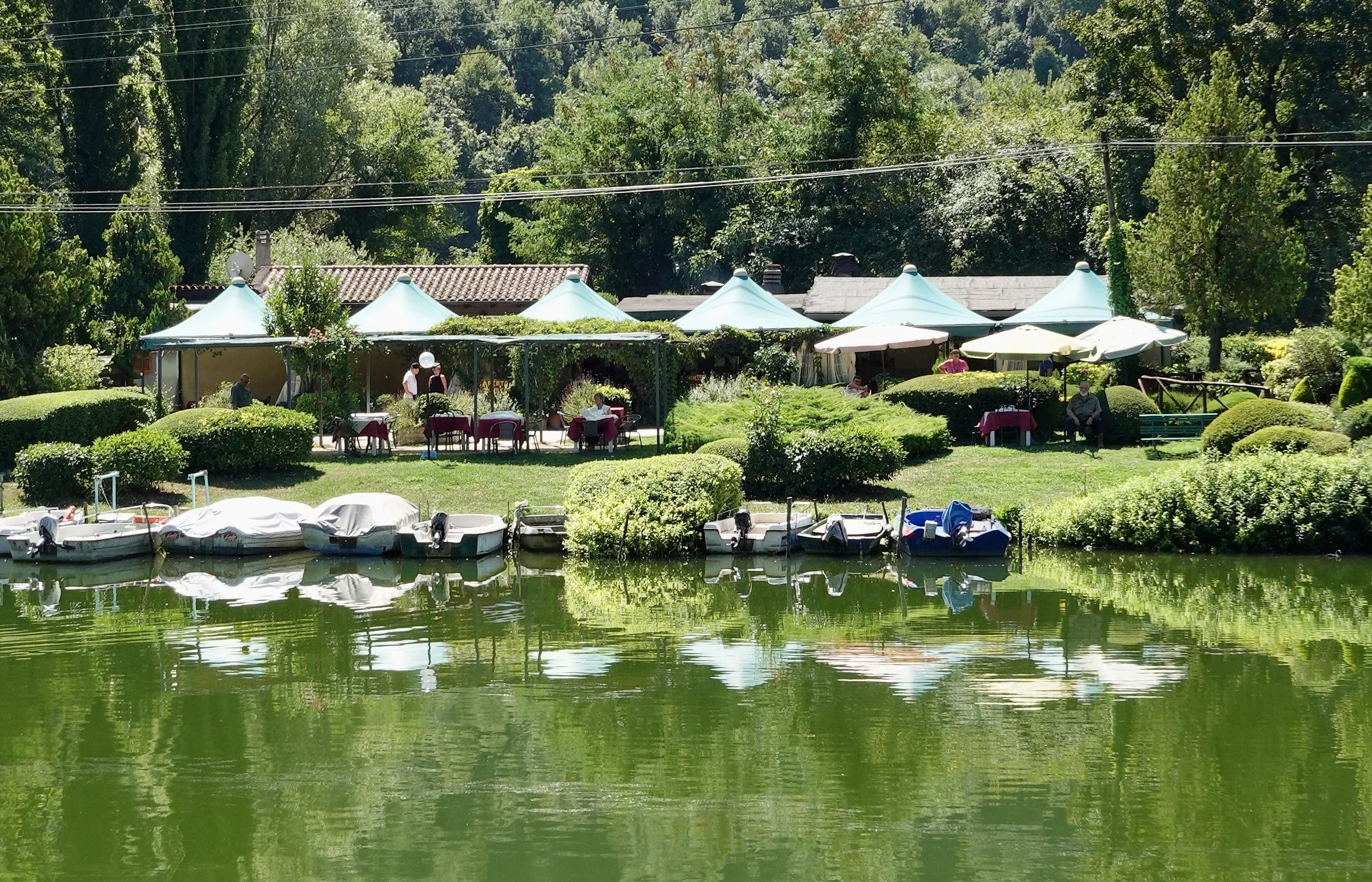
Boats, tables and reflections along Piediluco’s inhabited shore.
The calm surface can make Piediluco appear self-contained. It is not. Umbria’s second-largest natural lake is one surviving part of the ancient Lacus Velinus. Its irregular shoreline runs for about 13 kilometres, and artificial channels connect it with the Velino and Nera river system while helping regulate its level. The sheltered water also supports Italy’s national rowing centre. What looks restful is also trained upon, channelled and managed.
That altered how I understood the photographs. The sailboat still mattered; so did the lily pads and the reeds. But the beauty of the lake was not evidence of a landscape beyond human intervention. It came from a long coexistence—sometimes productive, sometimes contentious—between water, settlement, food, sport and engineering.
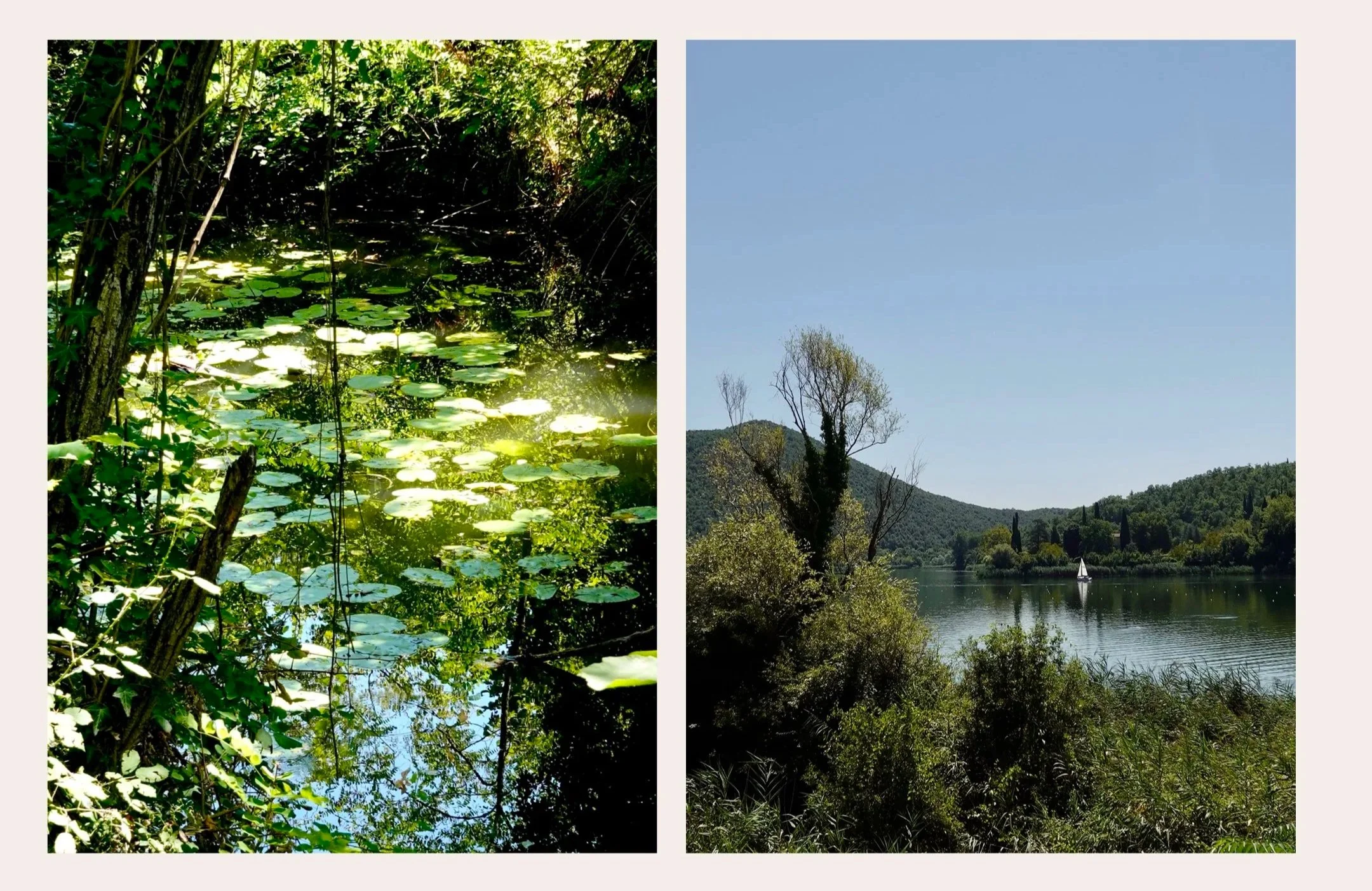
Two scales of Piediluco: light held by lily pads, and a single sail crossing open water.
The lake did not end at the edge of the photograph. Its water system continued towards Marmore.
A solution for one city, a problem for another
We reached Cascata delle Marmore at around three in the afternoon. The water was already in full force. There was no gradual introduction: from the upper viewpoint, the Velino (a tributary of the Nera River and a sub-tributary of the Tiber) dropped out of the green plateau with the volume and authority of weather.
We began on Trail 1 and descended from the upper viewpoint towards the lower one. The route drops through dense woodland by a long succession of paths and roughly 600 steps. Most of it was shaded. Even before we drew close to the falling water, the temperature changed.
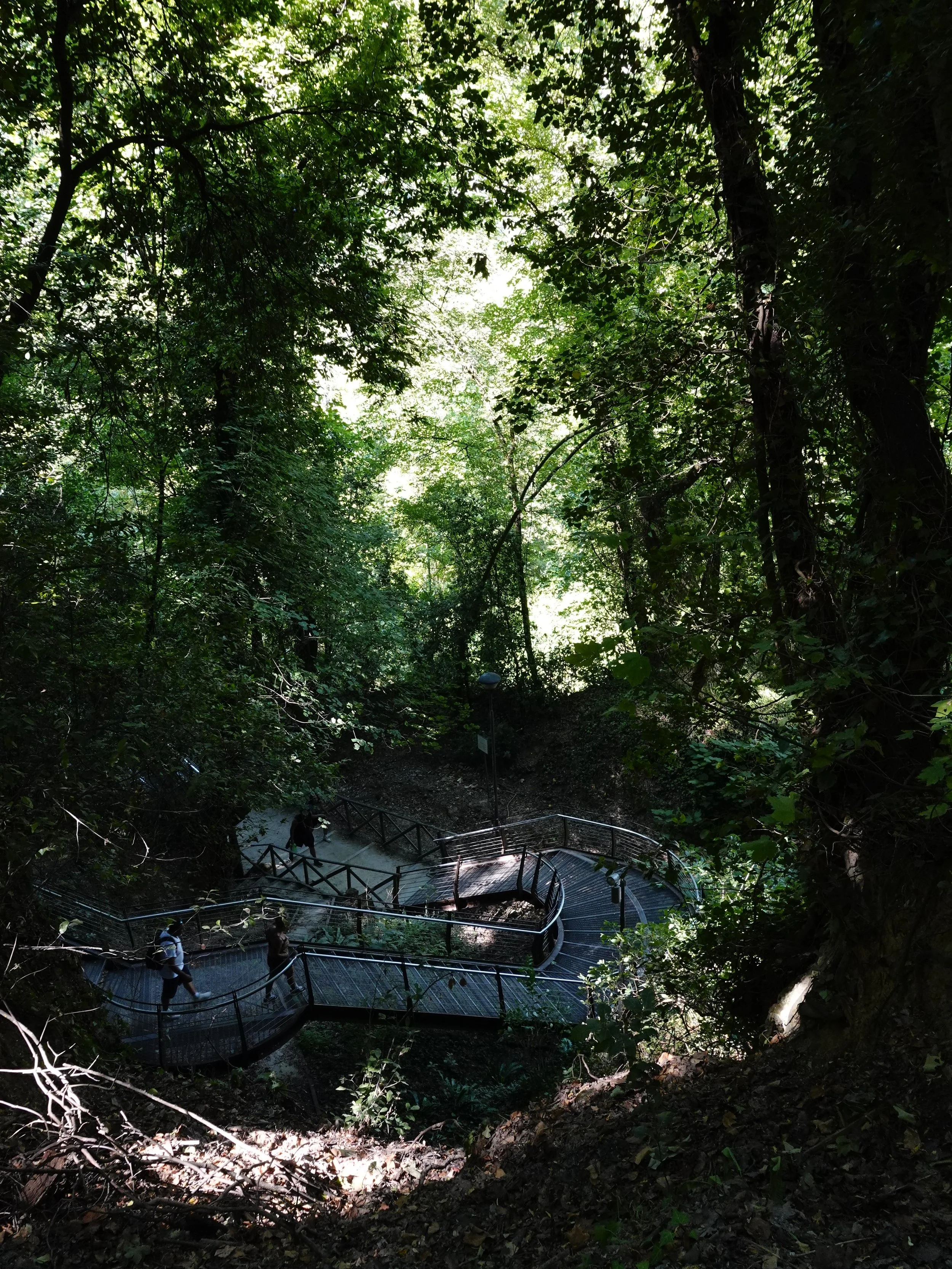
Trail 1 descends through a shaded sequence of steps and platforms.
Mist hung in the air and settled on skin. “Natural air-conditioning” sounds too convenient until a hot Umbrian afternoon disappears inside it. For several hours, we forgot the summer temperature. Under the trees, with spray travelling farther than the visible water, the paths had their own climate.
At the lower viewpoint, people gathered at the railings and raised phones into the spray. It was busy, but the number of visitors helped communicate the scale: seen from above, bodies became small marks beside the white rush of water. Around the lower cascades, Trail 2 brought us closer to the channels before we continued towards the next ascent.
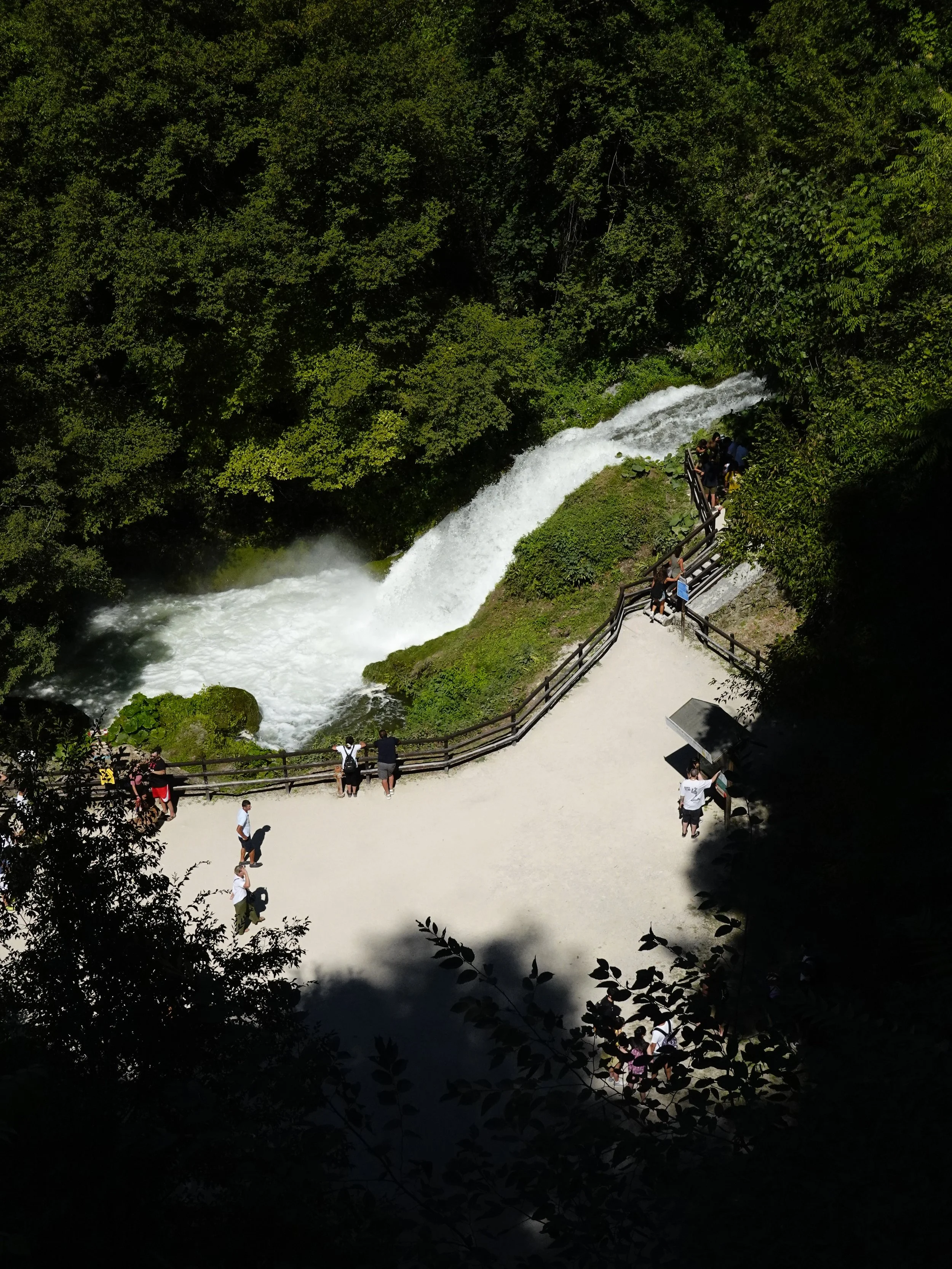
Visitors at the lower level, reduced to scale by the water beside them.
From there, we crossed the road and climbed Trail 4. Then we reversed the entire route: down Trail 4, across the road again, and back up Trail 1 to the upper entrance. We did it all on foot. The return climb was the price of beginning above the fall, but the shade and airborne mist made it far more comfortable than the August date suggested. The official trail descriptions call Trail 4 the route for seeing all three drops together; after the close physical experience of Trail 1, it supplied distance and proportion.
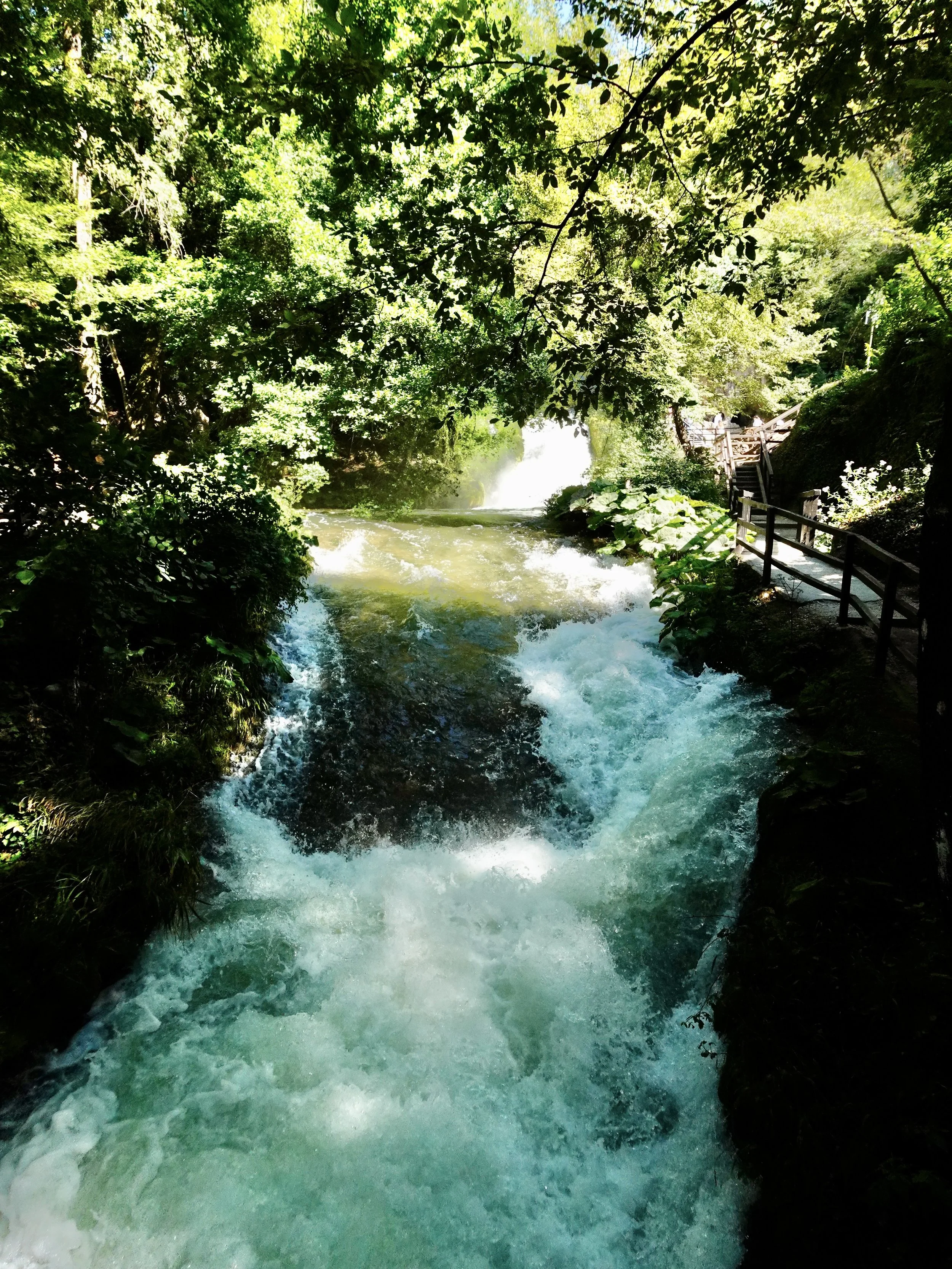
Away from the main drop, released water continues through the shaded park.
The waterfall looks elemental, but its origin is civic and engineered. In 271 BC, the Roman consul Manius Curius Dentatus ordered a channel—the Cavo Curiano—to drain stagnant water from the Reatine plain towards the Nera. The intervention reclaimed land upstream, but it also increased the danger of flooding downstream around Interamna, present-day Terni.
The disagreement outlived the consul. In 54 BC, Cicero acted for the Reatini against the Interamnati before a consul and ten commissioners. In a letter to Atticus, he described the case through the geography itself: Lake Velinus, the cut through the mountain and the water descending into the Nera. The eventual outcome is not known. The central problem is: directing water is never neutral. A solution for one place can become a threat to another.
The road sign outside Trattoria Teresa suddenly looked older than the road. Rieti in one direction, Terni in the other: the two sides of an argument written into the watershed.
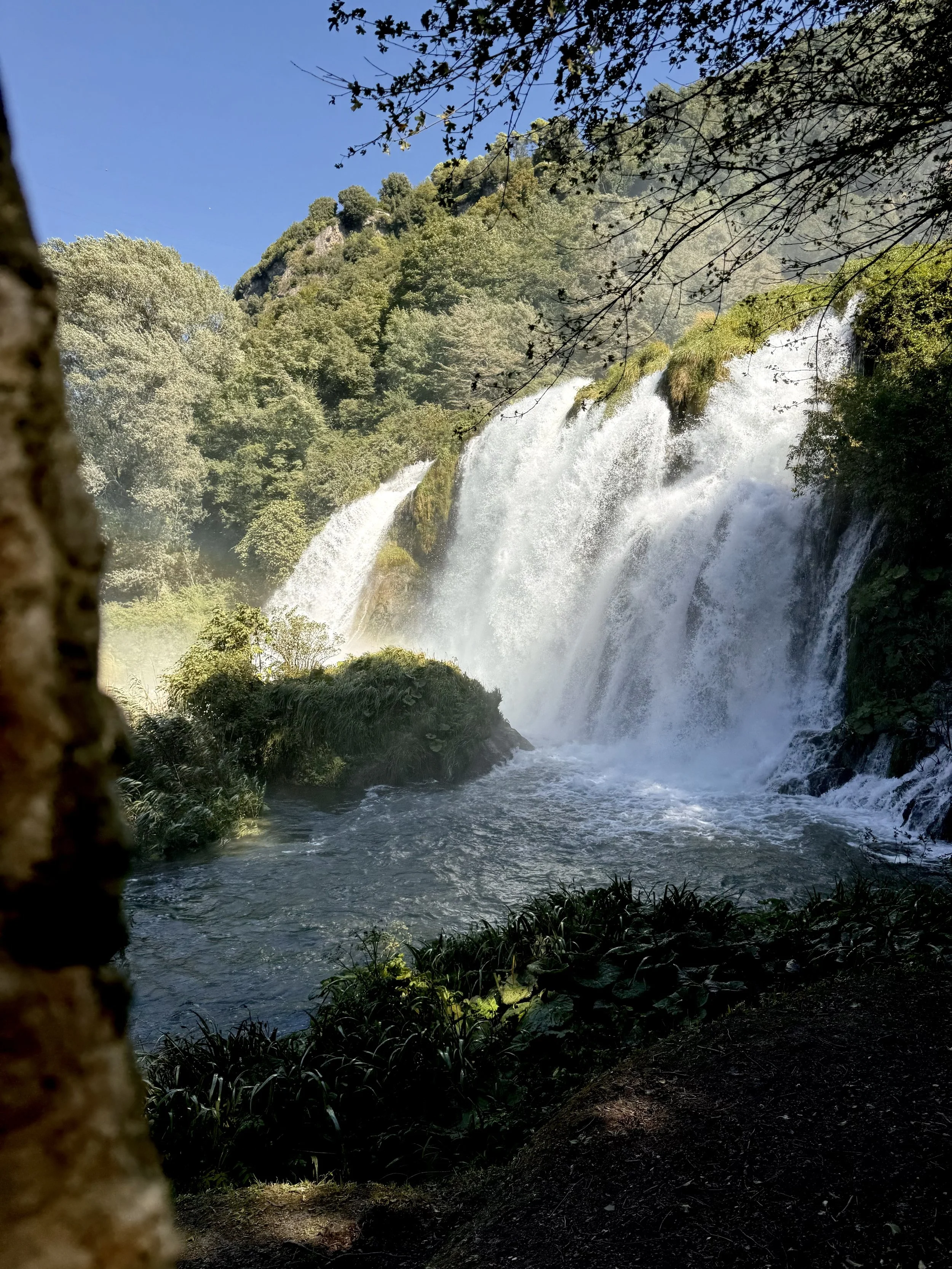
The water at work
Roman drainage was not the final intervention. In the twentieth century, the system was reorganised again for hydroelectric power. The Galleto power station entered service in 1929 and, after expansion, became one of Europe’s most powerful hydroelectric complexes of its time. Between 1929 and 1931, the Medio Nera canal was built to carry additional water into Piediluco, increasing the lake’s function within the energy system.
This is why Marmore does not flow for visitors at the same volume all day. Its public timetable is tied to a working hydraulic landscape. Water is released to produce the great white fall; beyond those periods, much of it serves hydroelectric generation. The spectacle and the infrastructure are not separate stories. They are two uses of the same controlled descent, shaped by the industrial history of the Nera–Velino system.
From Trail 4, the three drops aligned across the valley. The view was majestic, but no longer simple. I could see a waterfall first cut to drain a plain, repeatedly modified after disputes and floods, later connected to an industrial energy system, and now released on a schedule before an audience. None of that diminished it. The history gave the force in front of us more consequence.
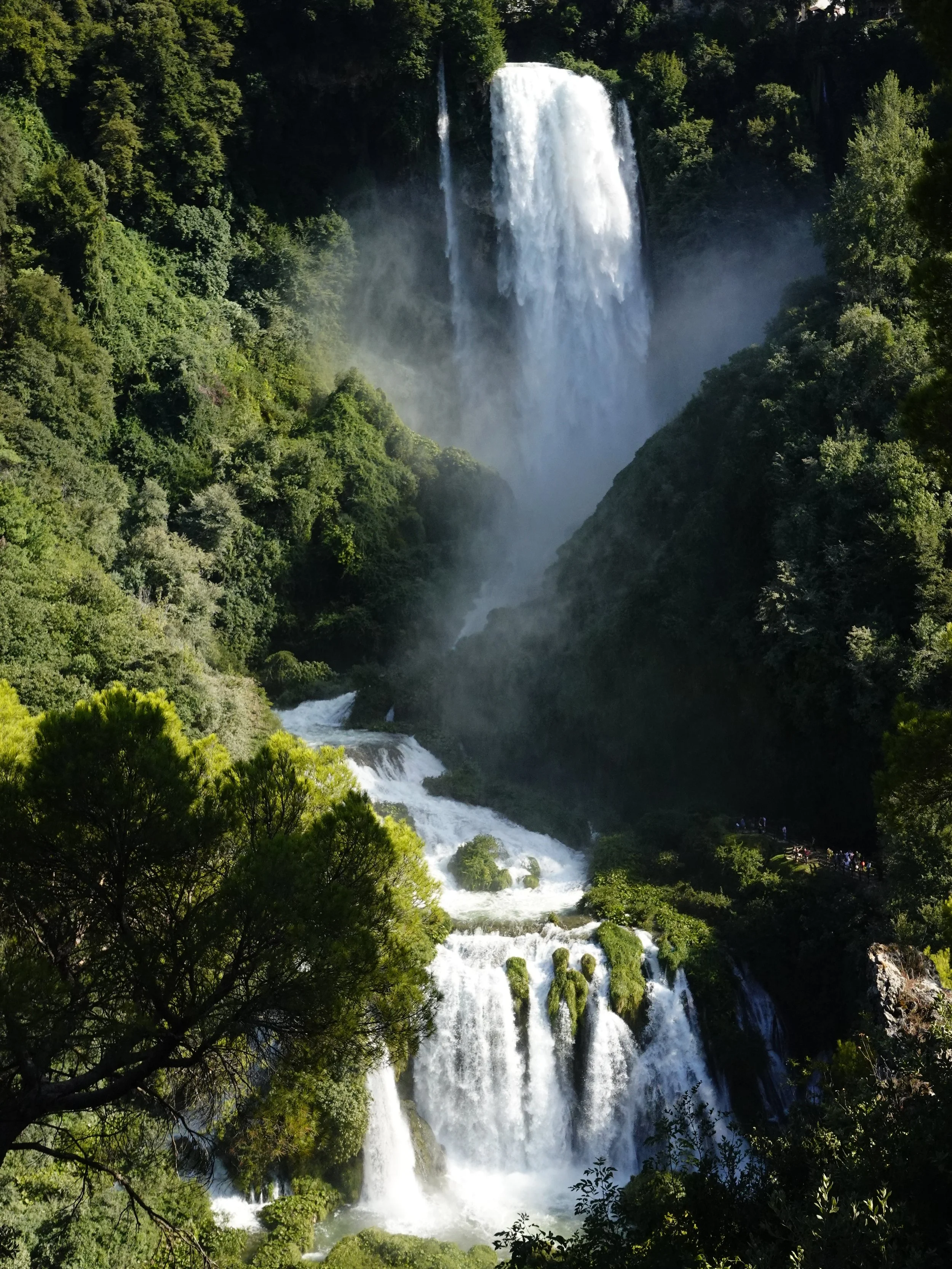
From Trail 4, the engineered landscape resolves into all three drops of Marmore.
For the people around Terni and the Valnerina, this water system is not merely a monument. The regional government describes the Nera River Park as a “park of waters”, joining rivers, lake, waterfall, hydroelectric plants, sports and restaurants within one territory. Tourism supports local businesses; the lake supports rowing and fishing traditions; the falls belong to the industrial memory of Terni as well as to its present economy.
The management also carries costs. In a 2025 hearing of the Umbrian regional assembly, discussion of Piediluco included the effects of daily water-level changes, the stability of lakeside settlement and the economic importance of tourism. The old question—who benefits when water is moved, stored or released—has not disappeared. It has acquired new institutions and new measurements.
By the time we climbed back to the upper viewpoint, lunch felt like part of the same account. At Trattoria Teresa, the water system had fed us. At Piediluco, it held boats, reeds, rowers and a village. At Marmore, it performed for a Ferragosto crowd. Beneath all three experiences, it was being regulated, argued over and put to work.
We arrived too late to watch the flow increase; by three, the falls were already giving everything we had come to see. I would like to return for a night visit and witness the change itself—the warning, the first added rush, and the white water gathering force in the dark.
The first visit showed me the spectacle. A second might show me the moment the spectacle is made.
Stories shaped by the art of noticing.
Before you leave, you are invited to sign The Guestbook.
Further Reading
Unless otherwise credited, all photography and written content are original works by Foodie Goes Travel.
