The Sukhothai Bangkok
Where the Past Remains Present
I drew back the curtains and found a garden waiting below. A path crossed a rectangle of grass. Trees rose from small islands surrounded by water, and leaves gathered across the surface of the pond. Beyond the low roof opposite, a tower reminded me that I was still in Bangkok.
I liked that it remained in view. The city had not disappeared; the distance between it and my morning had simply become more generous. From my Executive Suite at The Sukhothai, there was time to look before doing anything else.
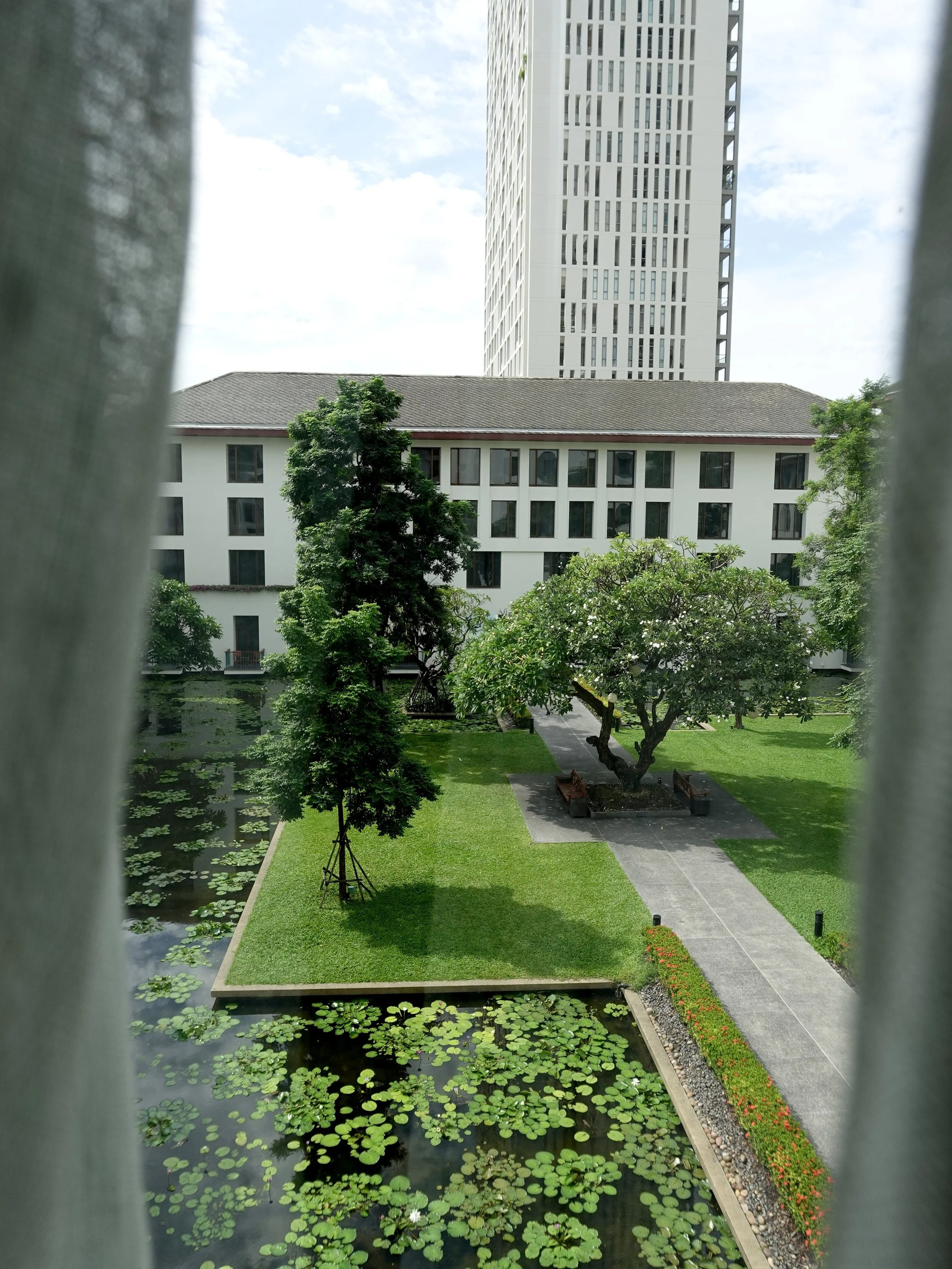
During my two-night stay in September, this was the feeling I kept returning to. I was comfortable here in ways that were easy to experience and harder to explain. I slept well. I swam early. I noticed a flower beside a drink, then another in my room, and another at breakfast. The hotel gave ordinary parts of the day enough attention that I began paying more attention to them myself.
The Sukhothai opened in 1991 and is marking its thirty-fifth anniversary this year. That makes it older than many of the hotels currently drawing attention in Bangkok. Its appeal to me had little to do with age, though. What interested me was how naturally it continued to be itself, and how its references to Thailand’s past remained part of the experience of staying there.
Arriving through the garden
The approach from South Sathorn Road establishes something of the hotel before you reach the lobby. Trees line the driveway, with a raised timber walkway running beside water and planting. Looking back towards the road, I could see the brightness of the city at the far end. The grounds give that short journey a beginning and an end.
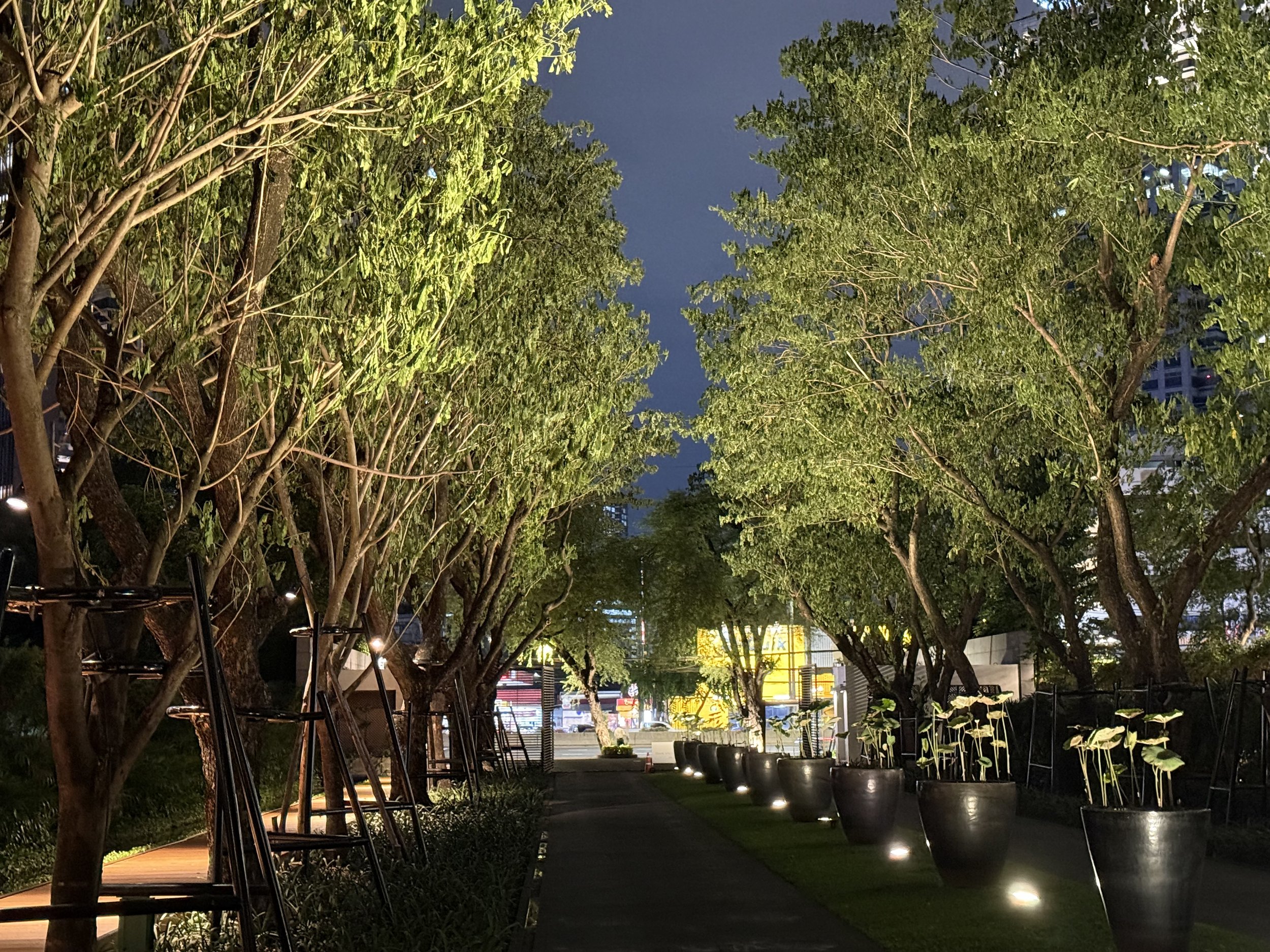
A little distance from Sathorn Road, made tangible by trees and water.
At check-in, my welcome drink arrived on a woven tray with a white towel and a pink lotus. The flower’s outer petals had been folded back, exposing the small, pale details at its centre. Against the deep red of the drink, it was the first thing I wanted to photograph.
Another pink lotus accompanied the fruit in my room. It sat in a shallow dish beside a platter of apples, citrus and pear, with sweets beneath a glass cover nearby. Later, I would see the same careful floral arrangement on a breakfast table. There was pleasure in recognising it again. By then, a flower I had first encountered as a welcome had become part of the hotel’s everyday life.
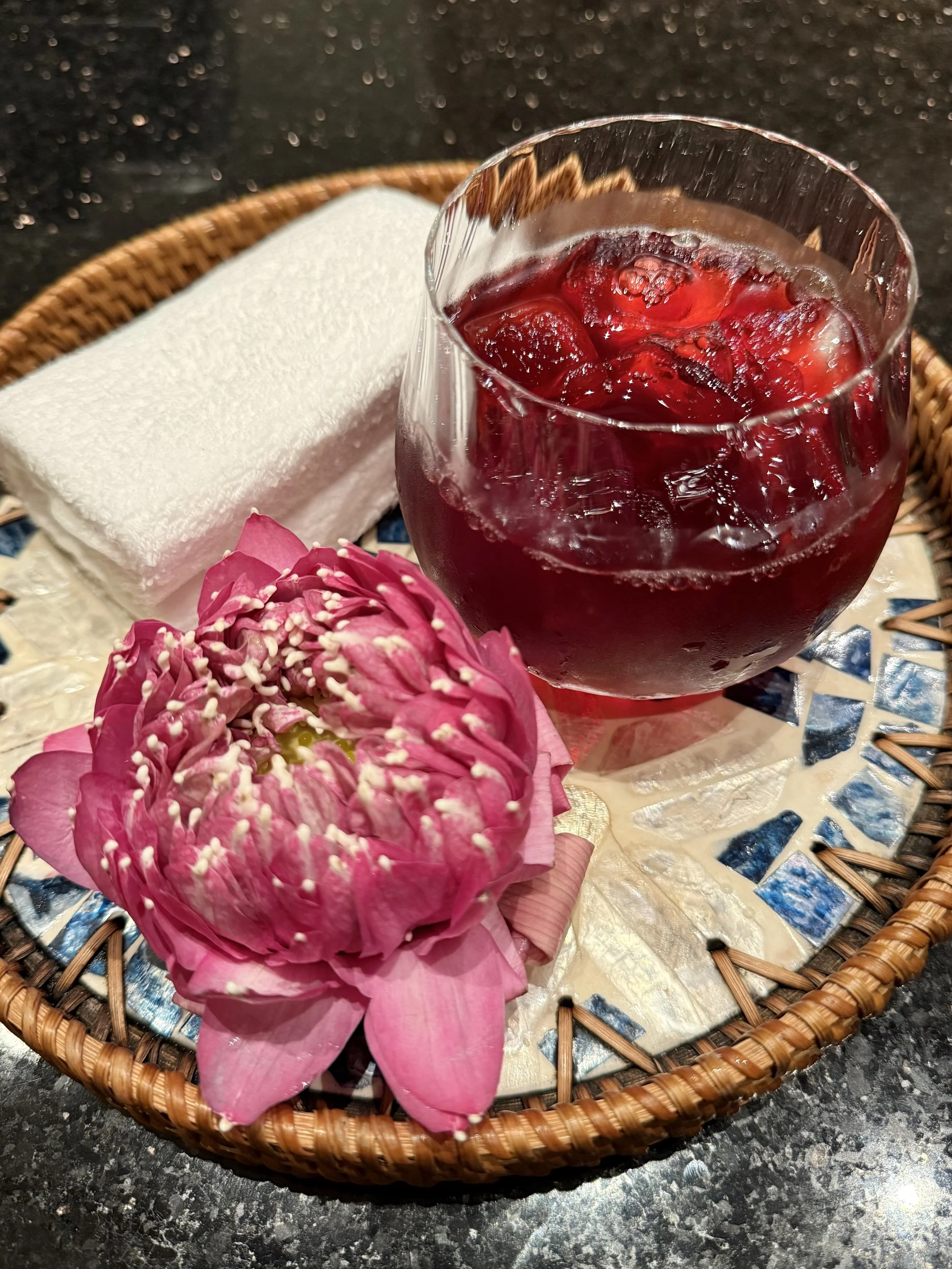
The first lotus of the stay, beside my welcome drink.
How the past remains present
The hotel takes its name and architectural inspiration from the historic city of Sukhothai in northern Thailand. Its monuments belong to a formative period in Thai art and architecture, particularly the thirteenth and fourteenth centuries. The historic town and its associated towns are now a UNESCO World Heritage Site.
Water was integral to that landscape. Reservoirs, ponds, canals and moats served daily life as well as agriculture, protection and ritual. Knowing this gives the hotel’s water courts a context beyond their beauty. They belong to an interpretation of a place where buildings and water were closely connected.
The Bangkok hotel, originally known as the Beaufort Sukhothai, brought together Kerry Hill and Ed Tuttle. Their design draws on the ancient city while giving it the proportions and comforts of a modern hotel. The most explicit references are the brick chedis, or stupas, standing in a reflecting pool. Their tapering forms rise between white walls and repeating openings, with their reflections extending into the water below.
I photographed them through a circular opening. The view gathered the chedis into a single frame, while a modern tower remained visible behind the roofs. In that small composition, different periods of Thailand’s architecture occupied the same view.
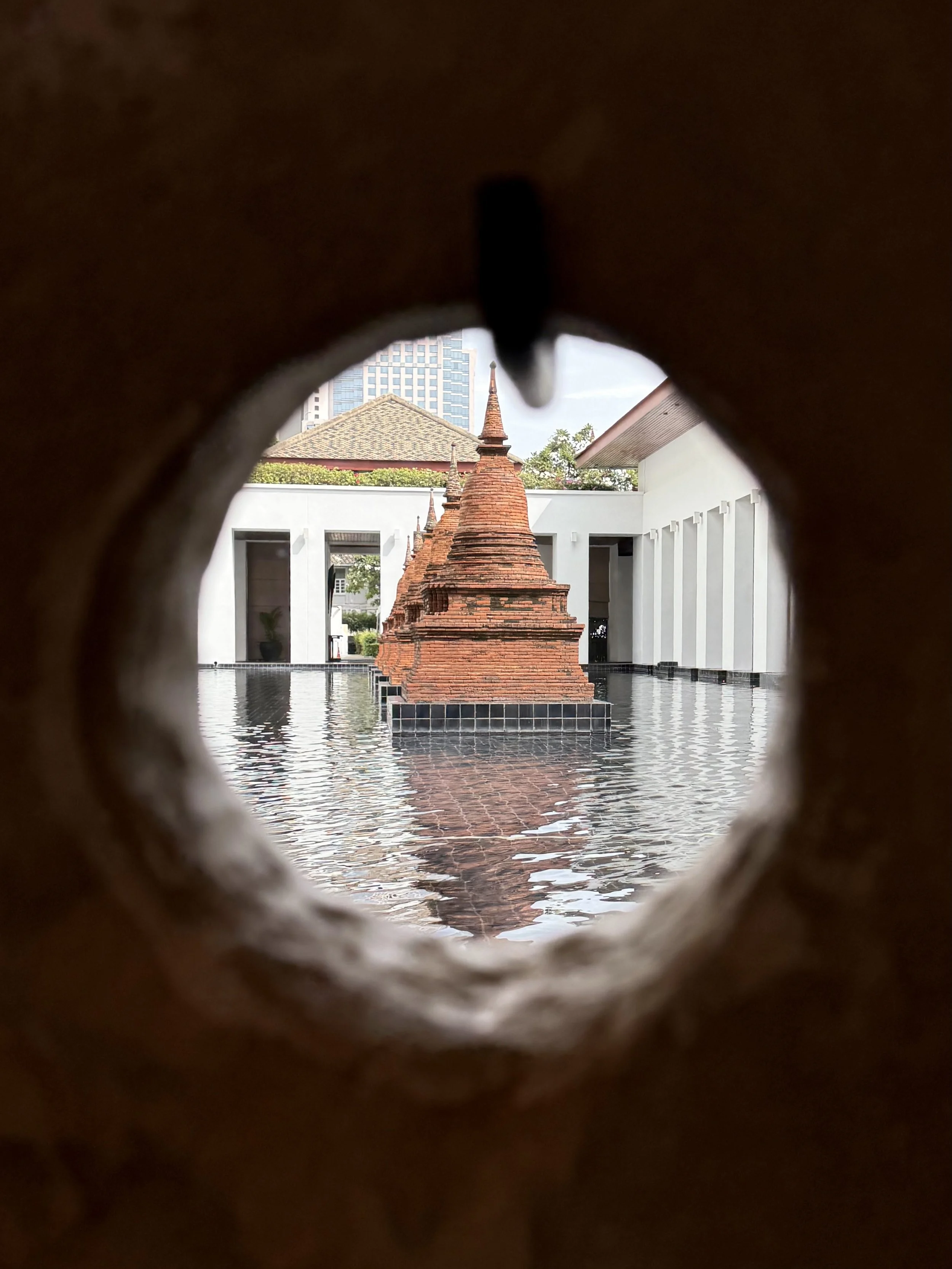
The hotel’s brick chedis, framed against the Bangkok of today.
Elsewhere, the connection is less literal. Low buildings enclose gardens. Repeated windows create a steady rhythm across the walls. A tree interrupts that regularity, its branches spreading over the water. The eye moves between architecture and living things without either dominating the view.
To me, this is where the design becomes most convincing. History has influenced the arrangement of space, including the spaces left open. You encounter it while walking to your room, looking out of a window or sitting down to breakfast. It becomes something you spend time within.
A shape that keeps returning
Once I noticed the rhombus, I began finding it everywhere.
The clearest introduction is the hotel’s illuminated emblem above a water feature. Diamond shapes are arranged into the stepped, tapering outline of a chedi. Seen after the brick structures in the courtyard, the relationship becomes easy to recognise: an architectural form condensed into a graphic one.
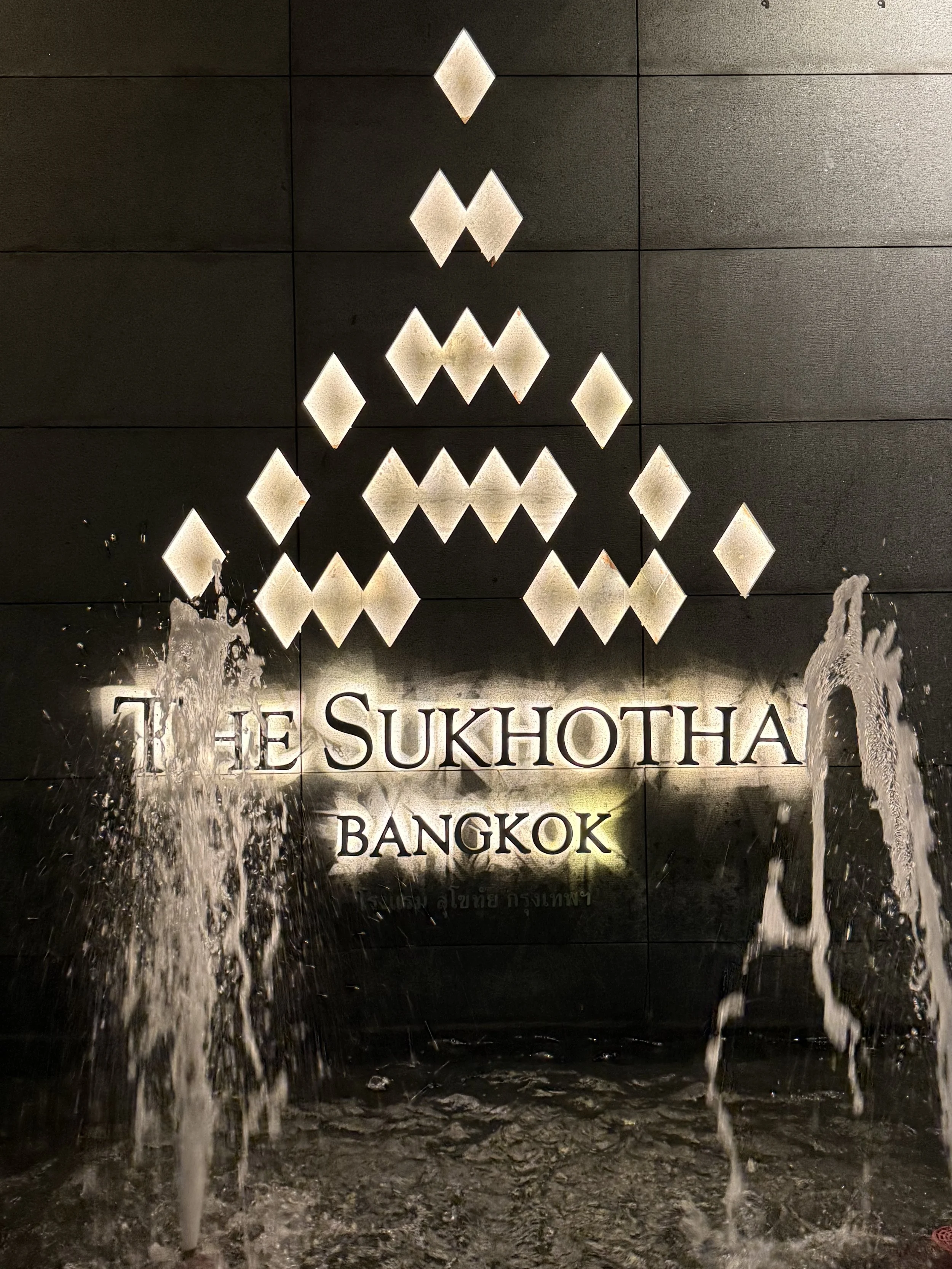
The chedi becomes an emblem through an arrangement of diamond shapes.
In the room, the idea continues at a different scale. Rhombi appear in the wooden wall panelling, where changes in the direction of the grain make the pattern visible. On the porcelain cups, the geometry becomes finer. Even the laundry bag carries the emblem.
These are objects a guest handles or passes every day. Their repetition gives the hotel a recognisable character without requiring a grand statement in every room. A detail noticed at arrival turns up again beside a cup of coffee.
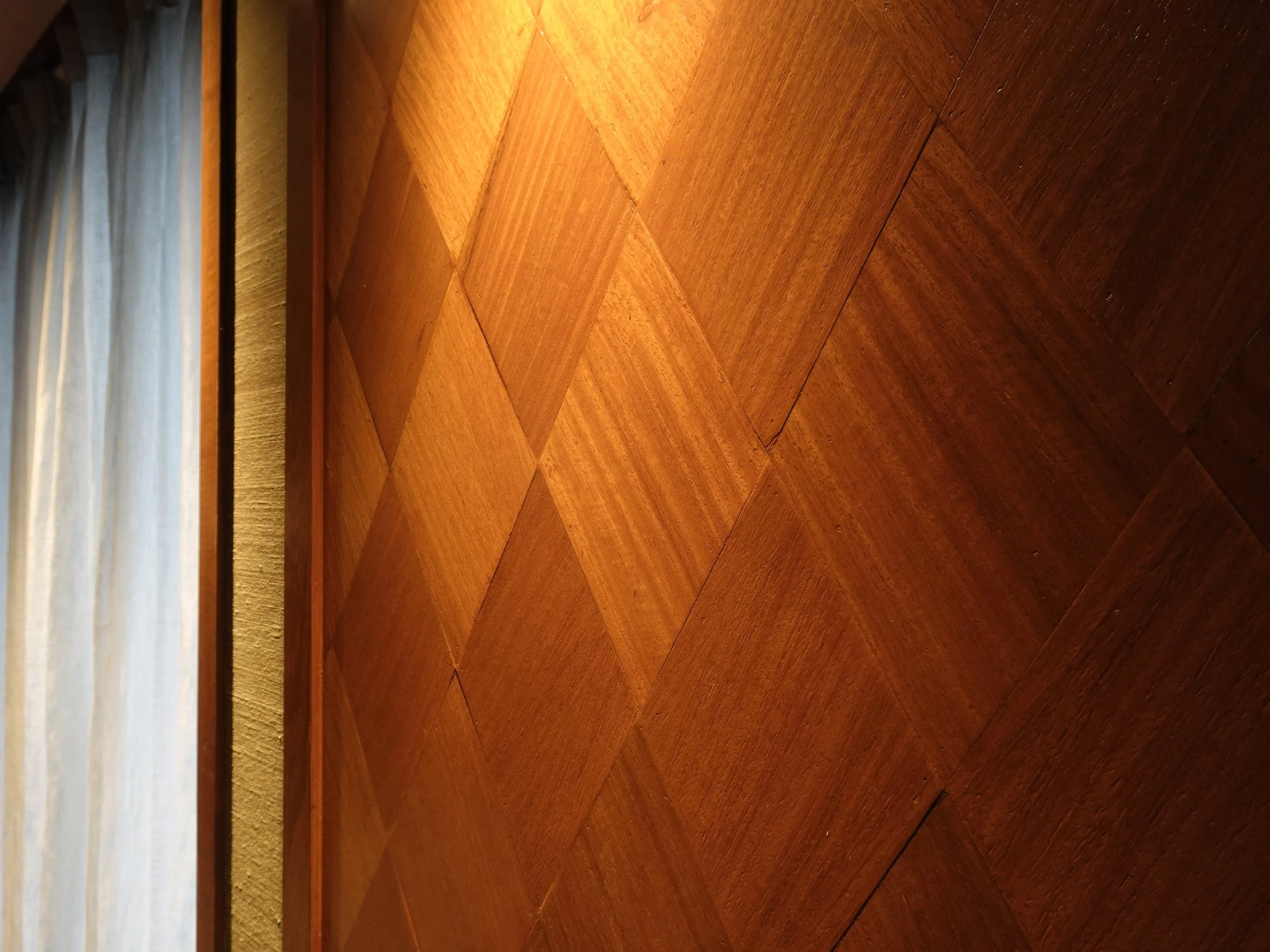
The recurring geometry, expressed through the direction of the wood grain.
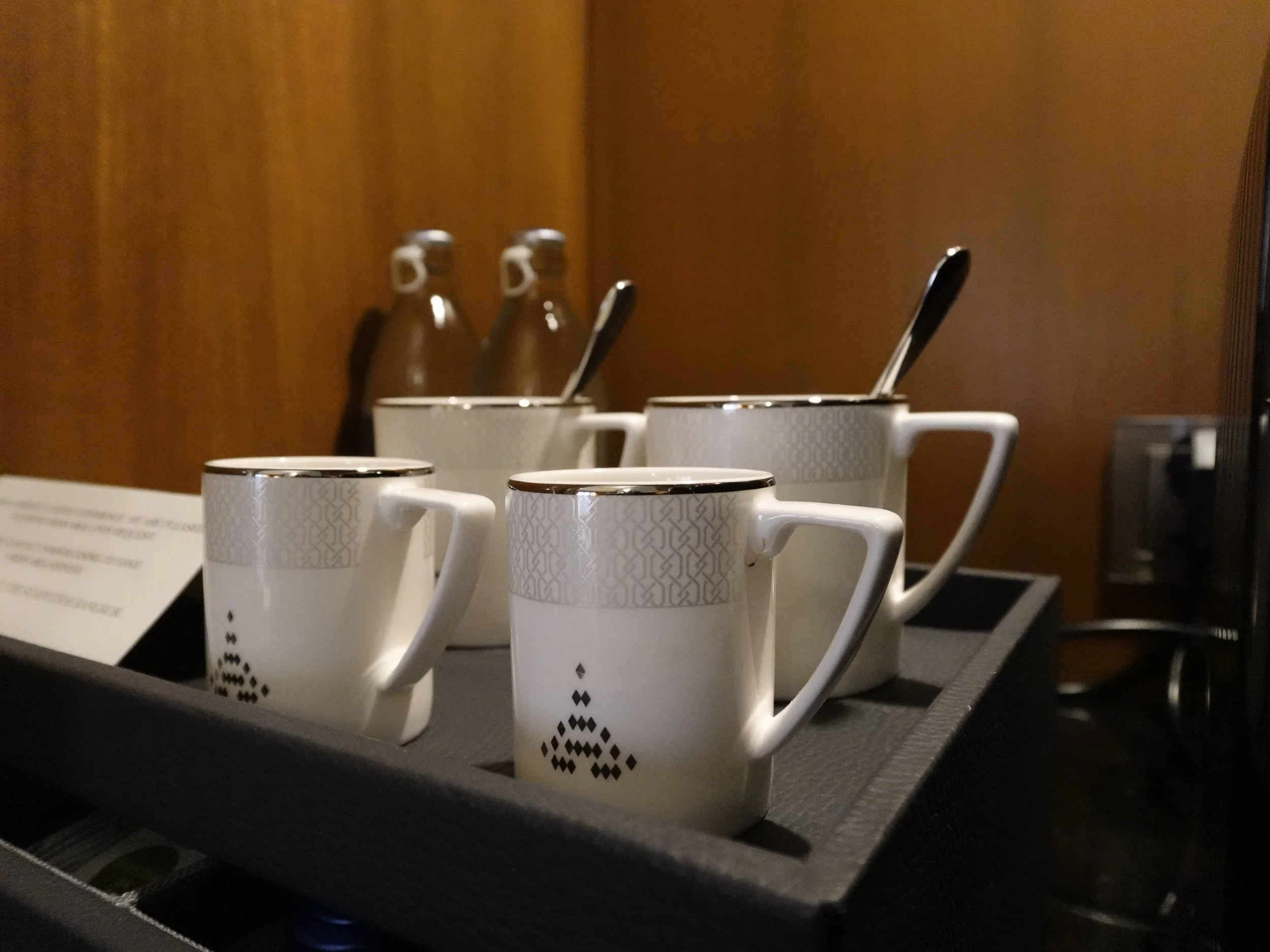
The same attention reaches the porcelain cups.
The water, meanwhile, gives those firm outlines another life. Windows become dark, wavering rectangles. A tree appears to extend below the surface. Among the floating leaves, a reflection can be interrupted by the smallest movement.
I found myself thinking about reflection in both senses of the word. That is my response to the place, rather than a meaning I would assign to the rhombus itself. The repeated shape provides continuity; the water gives me a reason to stop and look.
A room to inhabit
My Executive Suite continued the warmth of the public spaces. Teak flooring and wood detailing gave the room depth, while the silk fabrics softened it. The hotel identifies the drapes as Jim Thompson silk, alongside sofas upholstered in silk. These are materials with a presence of their own, particularly when daylight reaches them.
The open-plan layout felt spacious. The bathroom extended that sense of generosity, with twin vanities and a separate bath and shower. Yet the detail that anchors my memory of the room is its relationship with the garden. The view was part of being there, available whenever I turned towards the windows.
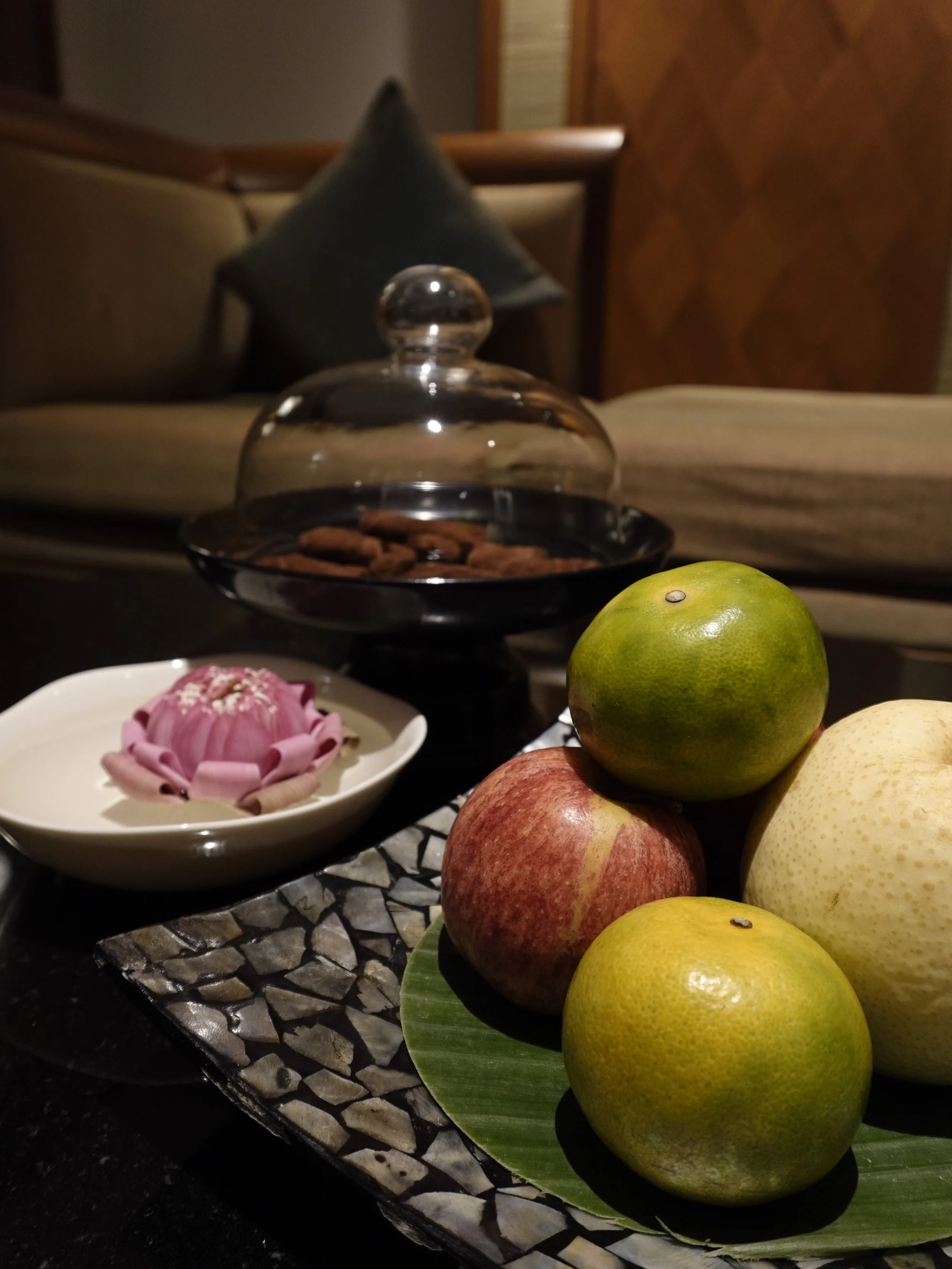
A second lotus in the room, beside the welcome fruit and sweets.
A replica sculptural relief in the bedroom introduced another reference to the past. Its figures brought a different texture to the room, alongside the smoother wood and fabric. The overall effect felt considered, but still easy to live with. I could appreciate the details and then settle into the space.
Sleeping without interruption mattered just as much. A room can be beautiful in photographs and still leave you conscious of its shortcomings once the lights are out. Here, the comfort lasted through the night. In the morning, I opened the curtains onto that garden and felt no immediate need to move on.
Before the day gathered pace
I tend to wake early, and at the pool I found myself entirely alone. The water held the reflections of the building, the roofline and the pale green parasols. There was something especially satisfying about having a space like this to myself at the beginning of the day.
Swimming is already part of my life. On a trip, the opportunity to keep that familiar rhythm can make a hotel feel more welcoming than an elaborate new experience. The Sukhothai’s twenty-five-metre pool gave me room to swim, and the early hour gave me the solitude I enjoy.
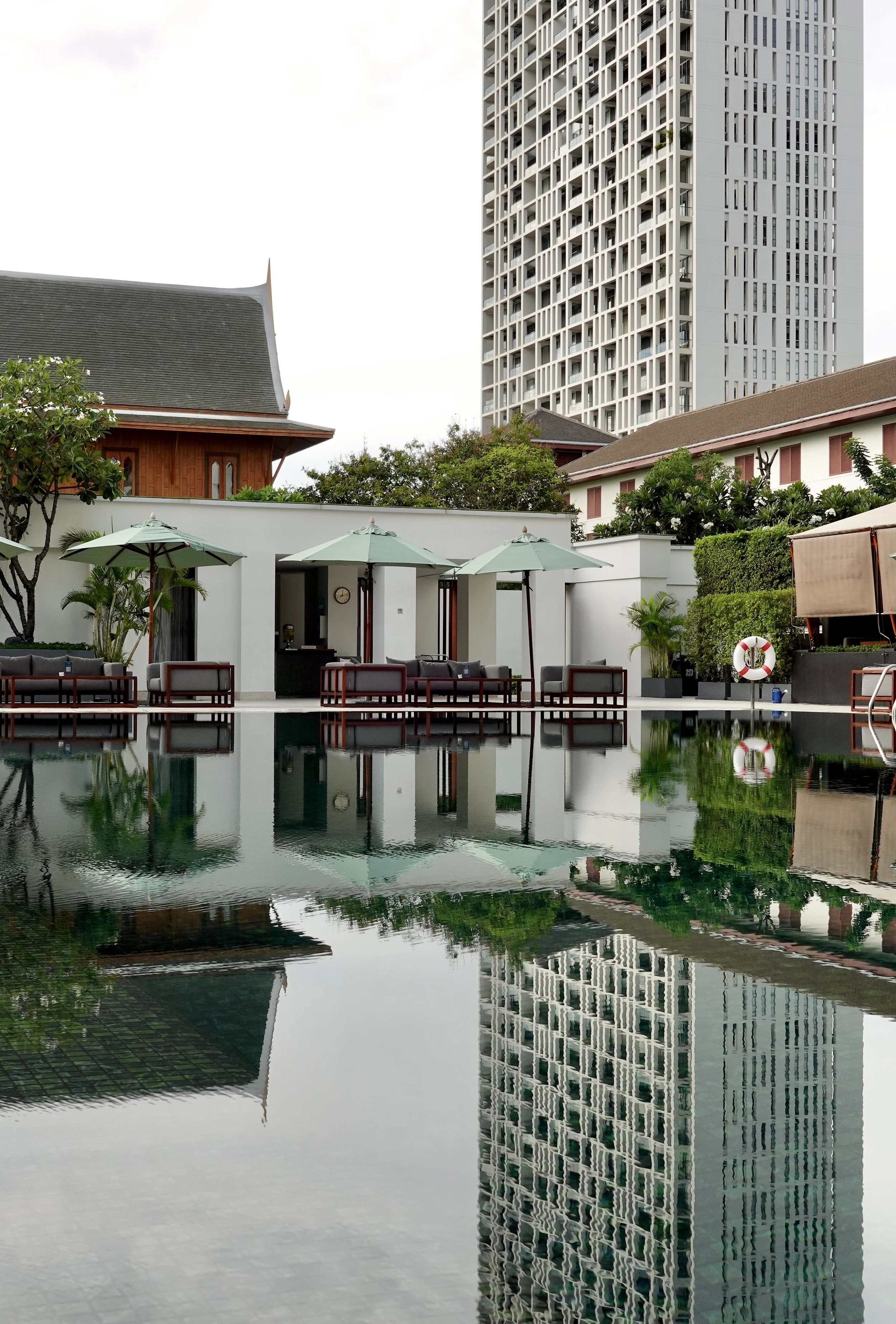
An early start, and the pool entirely to myself.
There is often an expectation that travel should provide a succession of things to see and do. I enjoy those discoveries, but some of the moments I value most are much simpler. This morning needed very little added to it. A swim, a garden outside the room, and breakfast still ahead were already enough.
Walking beside the ponds brought a different kind of attention. Purple water lilies rose above broad floating leaves, while the spaces between them held fragments of the surrounding buildings. The flowers in the ponds were different from the pink lotus arrangements indoors, but both encouraged the same close looking.
Good morning Khun Wong
At breakfast, my coffee arrived with a small note: “Good Morning Khun Wong, Enjoy your breakfast”.
I photographed it because it made me smile. The gesture was modest, but it addressed me directly. In a room serving many people, my morning had briefly become particular to someone else.
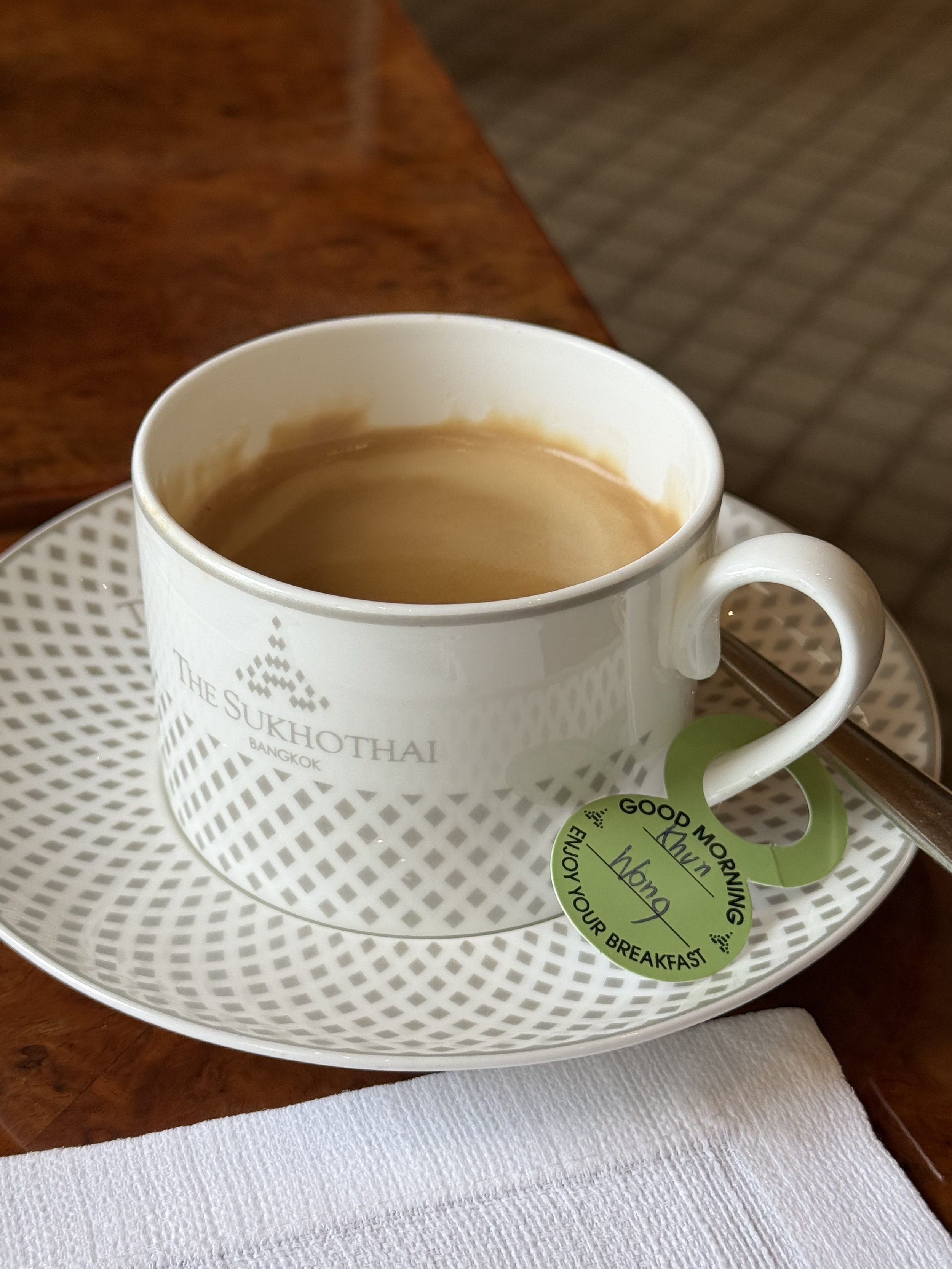
“Good Morning Khun Wong, Enjoy your breakfast.”
The breakfast room had plenty to look at. Blue-and-white ceramics and sculptural pieces stood among the dishes, giving the display a character that belonged to the rest of the hotel. My photographs record both that abundance and the simplicity of an omelette on a white plate. Breakfast could be as involved or as straightforward as I wanted it to be.
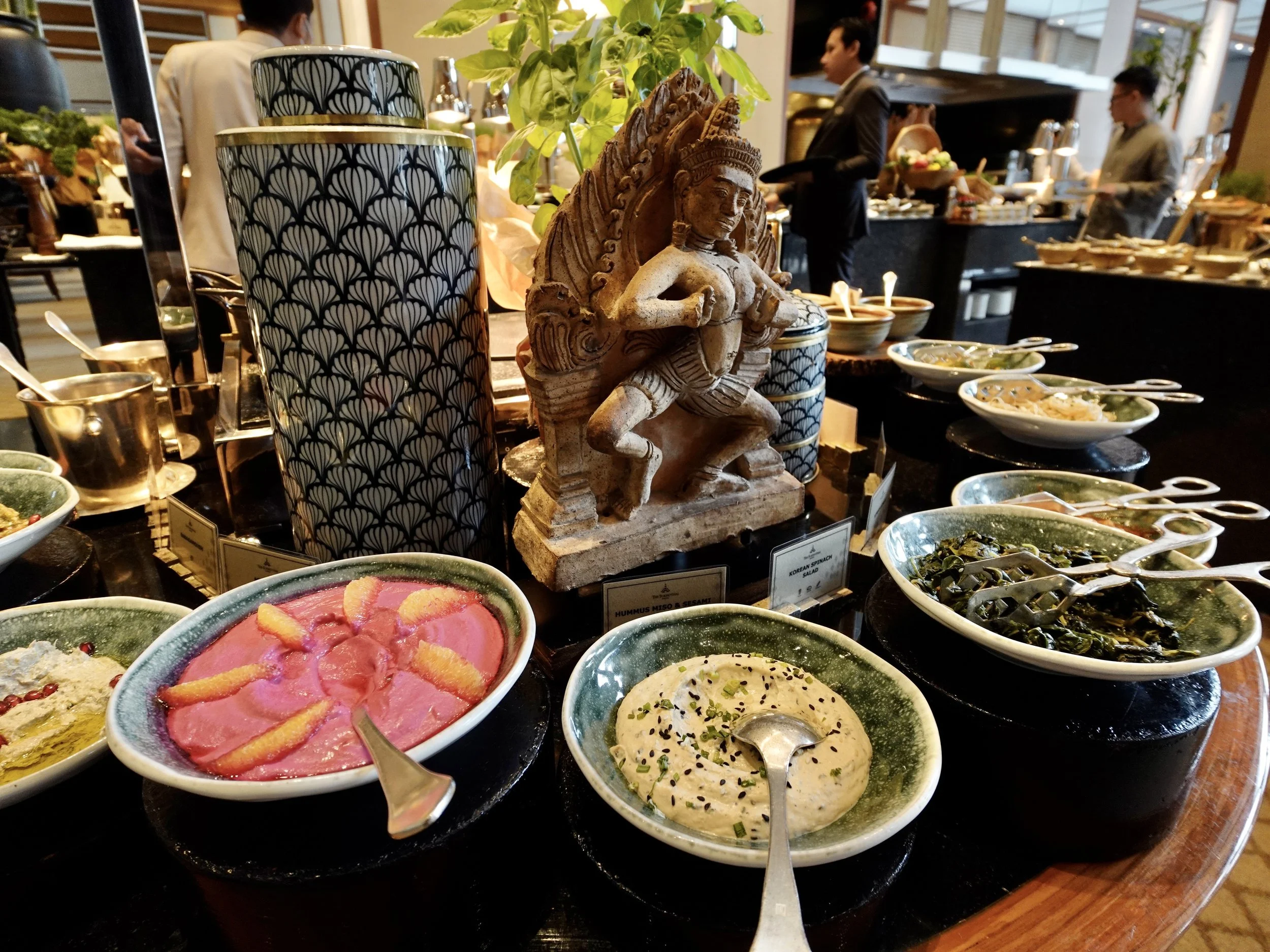
Ceramics and sculptural details carry the hotel’s character into breakfast.
I noticed couples in their thirties, older travellers, Chinese and Korean guests, and small groups of friends or family. During the mornings I was there, I did not encounter the large groups that can change the atmosphere of a breakfast room. This was a small window onto the hotel’s guests, but it contributed to the ease I felt there.
The pink lotus on the table brought me back to arrival. Behind it were pale green chairs and daylight at the windows. It was an inviting place to sit with a coffee and let breakfast take its time.
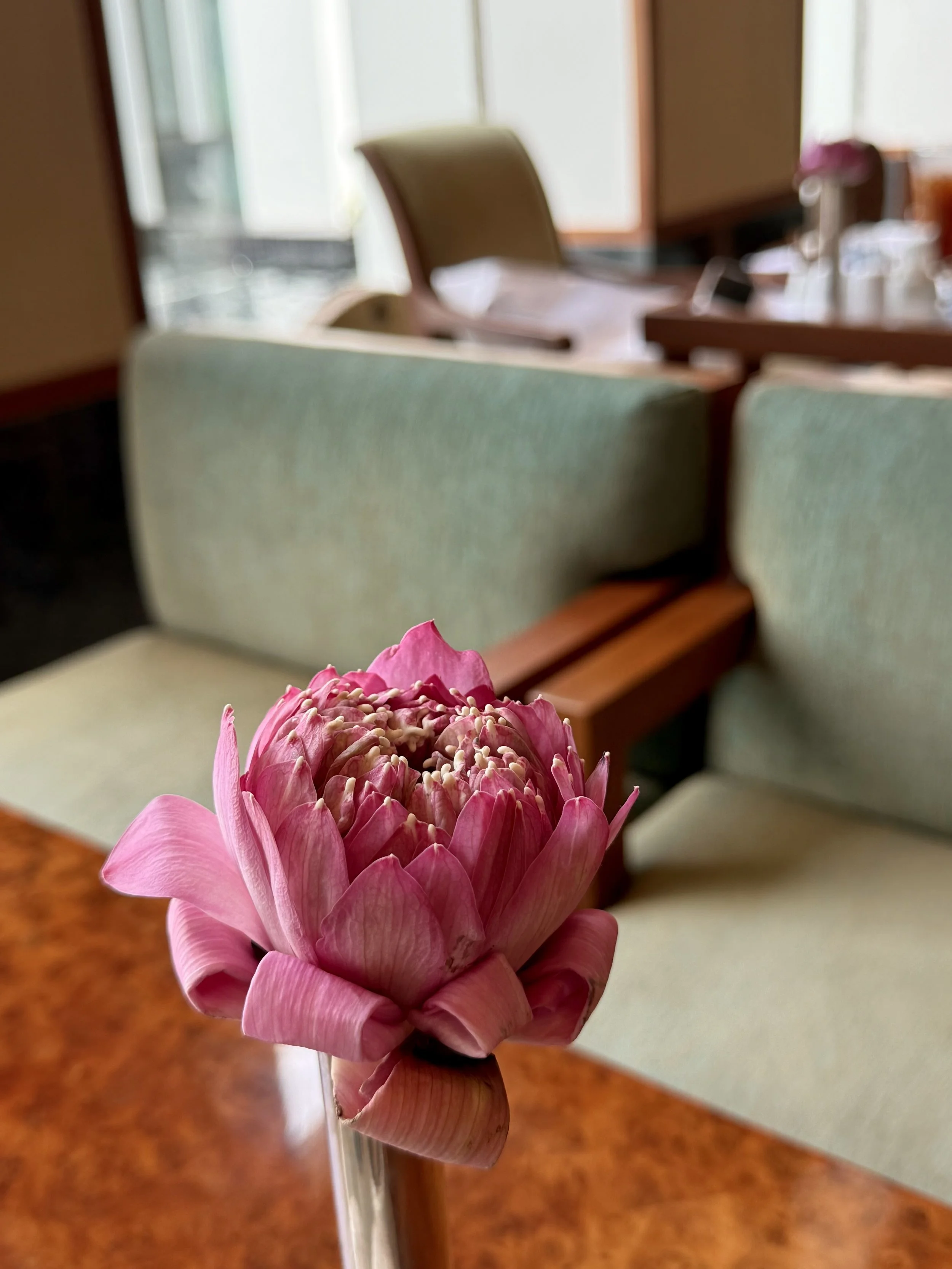
By breakfast, the lotus had become a familiar presence.
The people within the architecture
The warmth of the stay extended beyond the table. There was the pleasure of being remembered as “Khun JJ”, and the consistent sense, from checking in to checking out, that the people working here were comfortable with their guests.
Khun Chutima, Director of Marketing Communications had several meetings, yet made time to come and say hello. Our conversation was brief, but I appreciated the effort. Khun Lily showed me around the hotel, allowing me to look more closely at the spaces I had been encountering during my stay.
Khun Chutima also kindly offered a dining experience at Celadon. I could not fit it into my schedule this time, and it remains something I would like to return for. An invitation like that leaves a welcome unfinished in a pleasant way: there is still a reason to come back.
These interactions mattered because they kept the elegance from becoming intimidating. Beautiful materials and carefully arranged gardens can create an expectation of formality. The people I met made it easy to relax within them. I could enjoy the setting without feeling that I had to behave differently to belong there.
Continuing the story
For a hotel with such a distinctive identity, change must require judgement. There is much that guests come back to recognise, alongside the expectation that comfort will continue to evolve.
The Sukhothai Spa, which opened in 2024, offers one example of that continuing development. Its design draws on the architecture of the ancient kingdom, including the monumental enclosure at Wat Si Chum. Water-filled courtyards, geometric details and garden paths extend ideas already present in the hotel.
During the tour, I also saw the traditional-style structures housing treatment rooms. In the photograph I took, warm timber and the roofline sit above a white lower level. They add another scale of architecture to the grounds, one that suggests the privacy of a small dwelling.
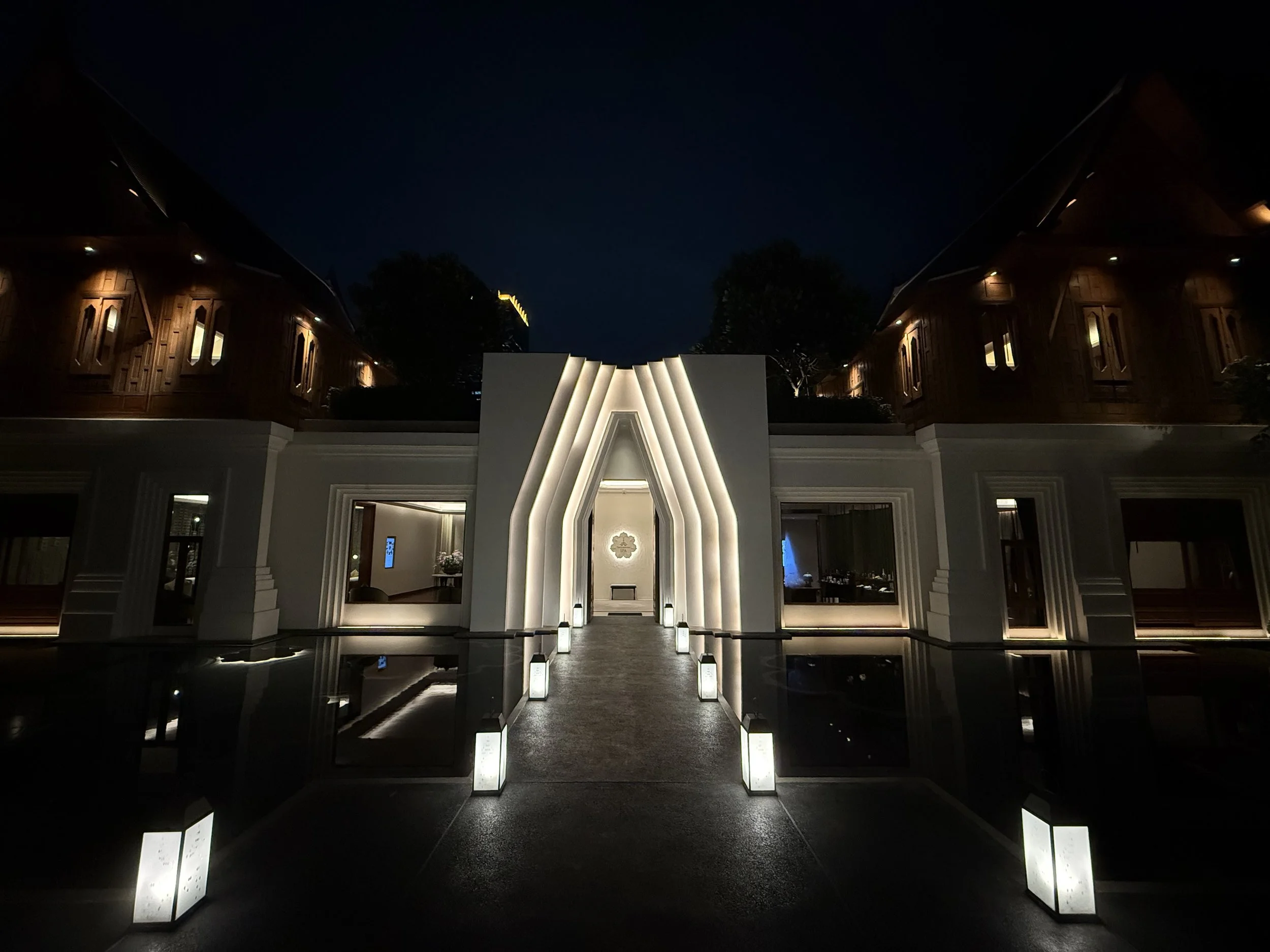
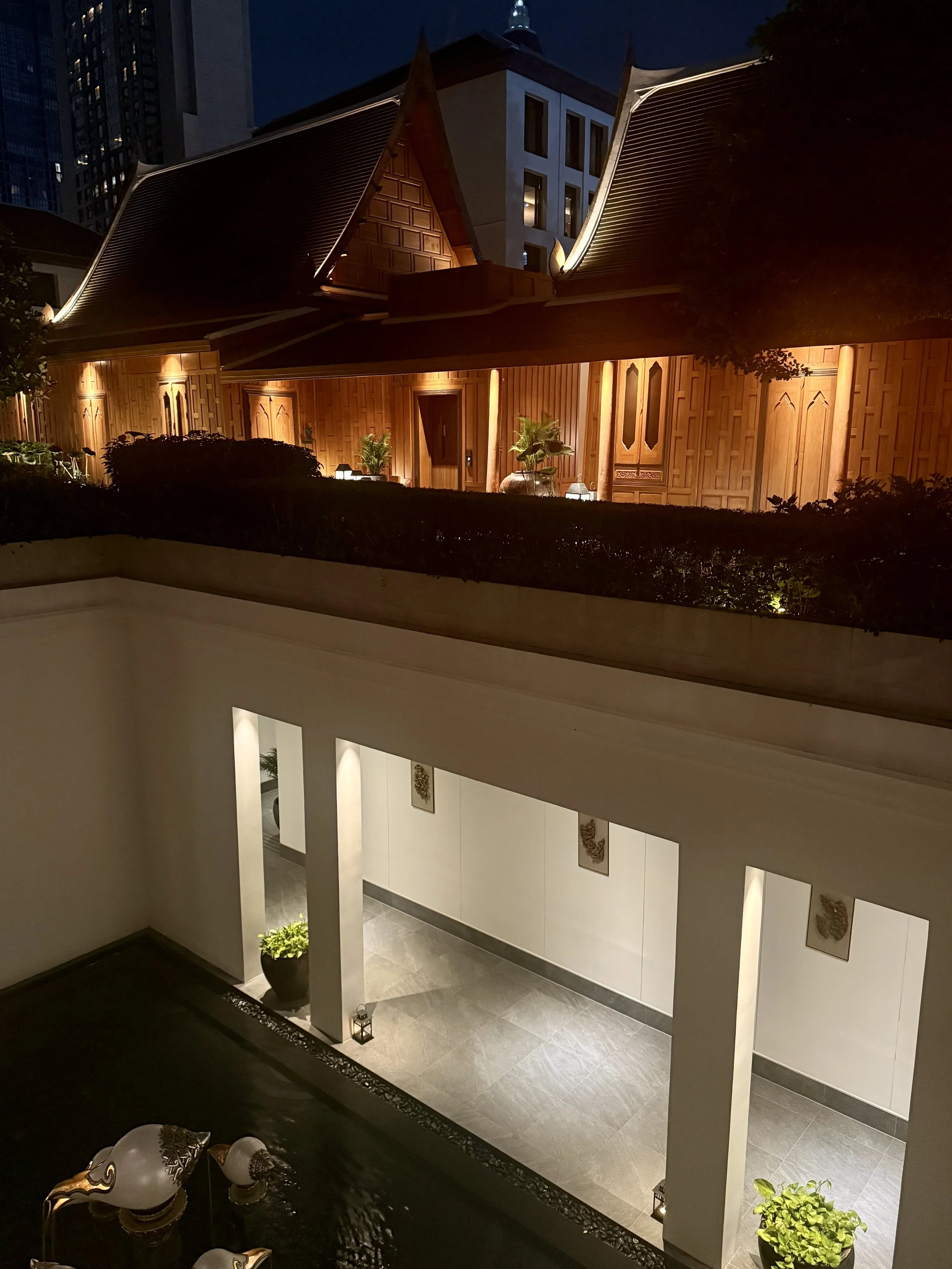
Traditional-style architecture in the treatment room area, seen during my stay.
My interest here was in the setting and its place within the hotel. The newer spa demonstrates how the same historical references can be explored again, with another purpose. A place can grow while preserving the qualities that first made it appealing.
The garden after dark
At night, the grounds acquired a different atmosphere. Round lights hung among the branches, illuminating leaves against the dark sky. Along the timber walkway, pools of warm light drew the eye forward beside the pond. I found it magical.
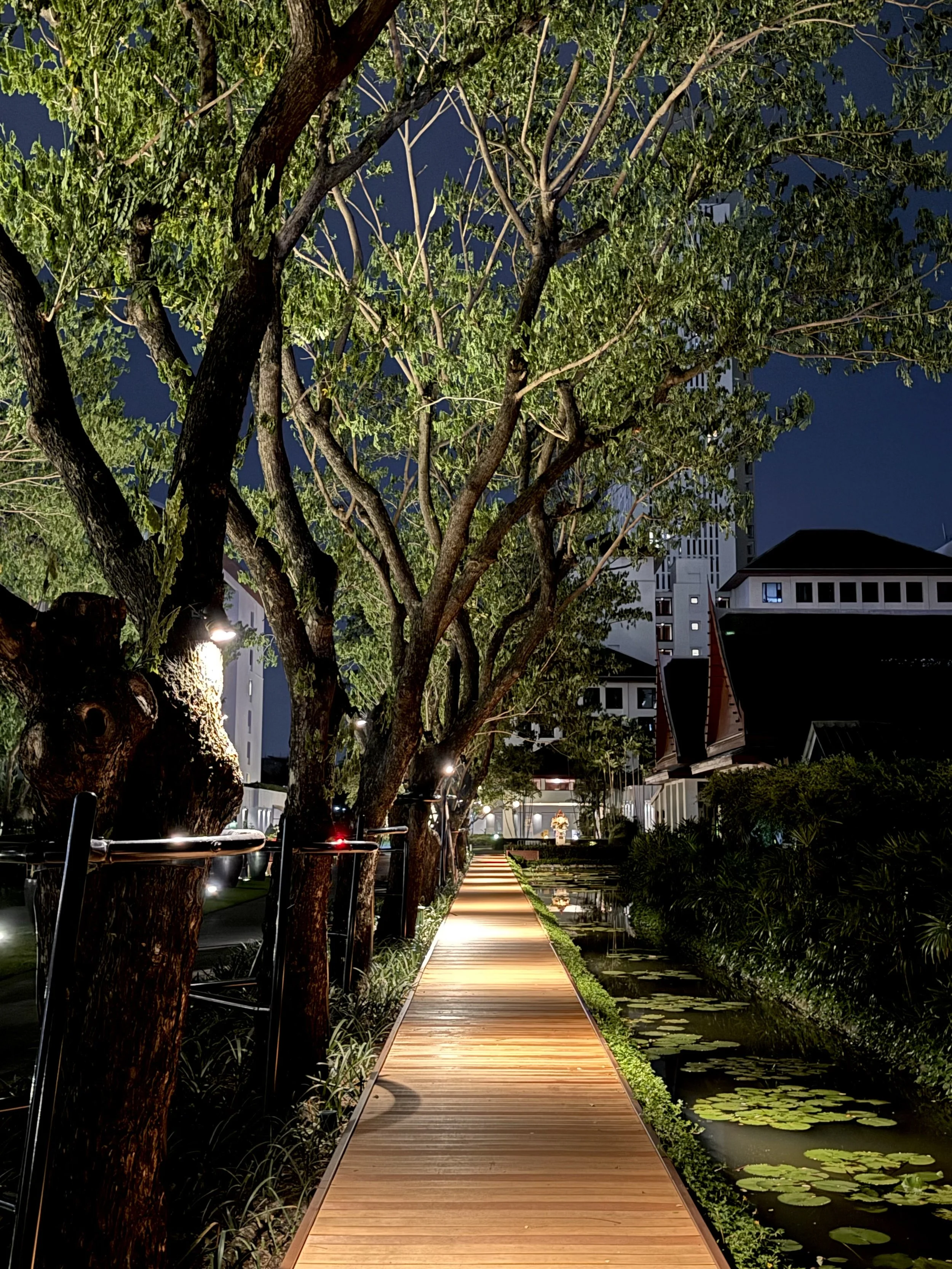
The garden takes on a different atmosphere after dark.
In the courtyard, an illuminated tree stood against the white building. Lit windows and branches were repeated in the water, their reflections broken by floating leaves. I had already seen the garden in daylight; now the lighting revealed another version of it. Looking again was enough to make it feel new.
That is what stayed with me about The Sukhothai. I could admire its design, but I could also be comfortable inside it. Its elegance allowed room for a personal greeting, an early swim and the uncomplicated pleasure of a good night’s sleep. Across the stay, those experiences added up to something more persuasive than any single impressive feature.
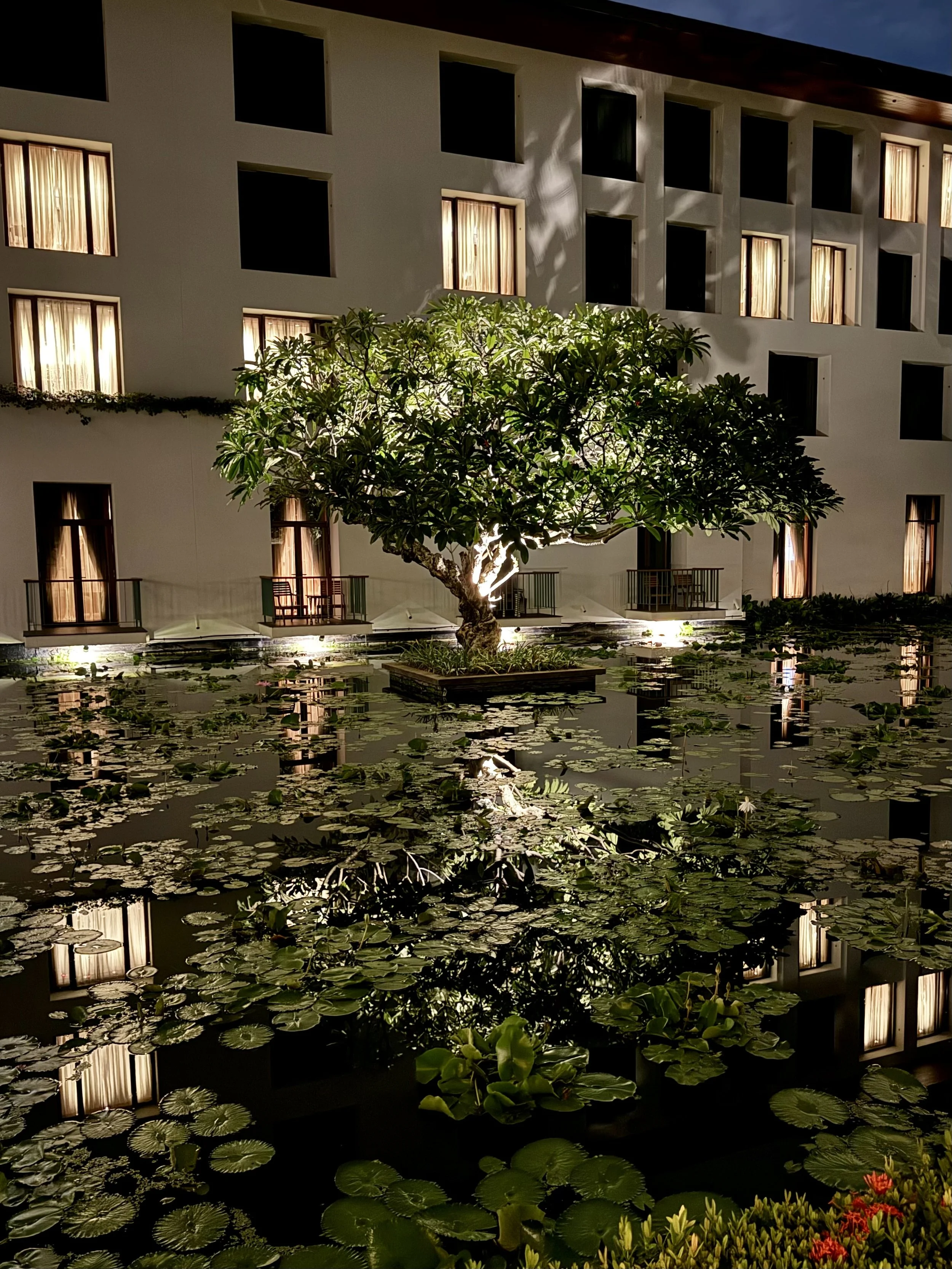
The same courtyard after dark, with windows and branches reflected among the leaves.
It is not the newest or the coolest hotel I have stayed in. That mattered very little once I was there. What mattered was how readily I settled into its days, and how often something small gave me pleasure.
The name Sukhothai is commonly translated as “the dawn of happiness”. By the end of my stay, I thought of it less as a grand promise than as a possible description of a morning. Curtains drawn back. A garden below. A coffee arriving with my name beside it.
Stories shaped by the art of noticing.
Before you leave, you are invited to sign The Guestbook.
Stay at The Sukhothai Bangkok
If you are considering staying in Bangkok, you can check current room rates and availability for The Sukhothai Bangkok through the link below.
CHECK RATES & AVAILABILITY AT THE SUKHOTHAI BANGKOK →
I booked and paid for this stay independently. The Sukhothai Bangkok kindly provided a complimentary upgrade to an Executive Suite. FGT may receive a small commission if you make a booking through the Trip.com link above, at no additional cost to you. All observations and opinions in this article are my own.
More from the Journal
Unless otherwise credited, all photography and written content are original works by Foodie Goes Travel.
